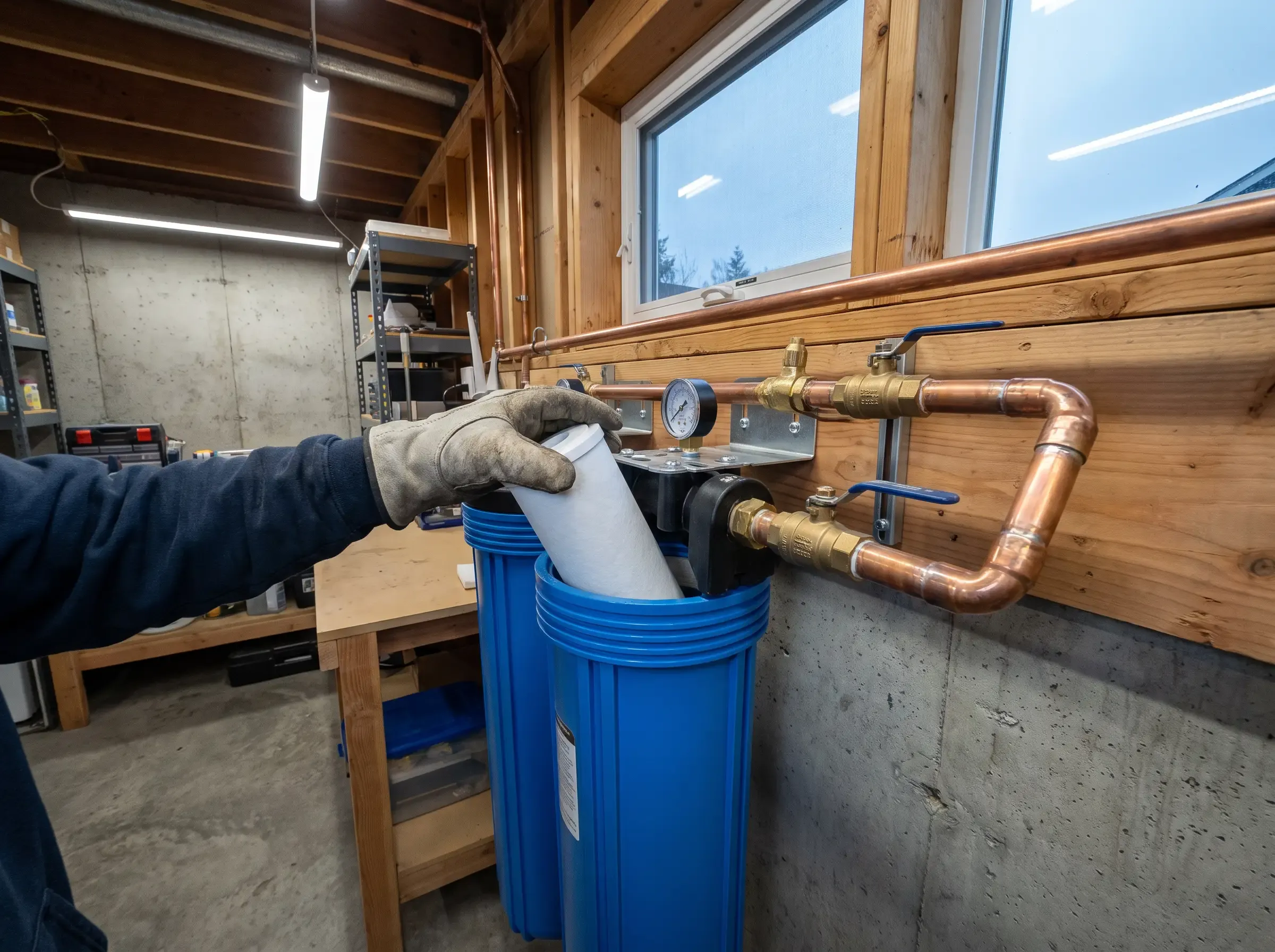
- What does whole-home water filtration cost?
- $850 to $5,400 installed for whole-house filtration, and $4,800 to $8,000 for whole-house reverse osmosis. Where you land depends on what your water test finds, not on the size of your house.
- Do I need a water test first?
- On a well, yes, always. Designing treatment without a test is buying equipment and hoping, and the stages required for sediment, iron, hardness and bacteria are all different. On treated Bellingham city water the design conversation is shorter, because the utility already handles disinfection.
- Whole-house filtration or reverse osmosis at the sink?
- Usually both, each doing its own job. Whole-house filtration protects fixtures, appliances and showers from sediment and chlorine; an under-sink reverse osmosis unit at $300 to $950 handles the water you actually drink. Running the whole house through reverse osmosis costs $4,800 to $8,000 and treats thousands of gallons you will flush.
- Will a filter reduce my water pressure?
- Every filter costs some pressure, and correct sizing is what keeps it unnoticeable. We size housings and media beds to peak simultaneous demand rather than average use, and on a well we check that the pump and pressure tank can accept the added restriction before selecting equipment.
- Are there rebates for water treatment in Whatcom County?
- None that we can verify. PSE, the Community Energy Challenge, Opportunity Council and the state HEAR programme all pay for energy equipment, not water treatment, and the federal §25C and §25D credits are terminated for 2026 anyway. Budget this project from your own pocket.
- Does a water softener count as filtration?
- No, they solve different problems and are sometimes both needed. Filtration removes particulate, taste, odour and specific contaminants; softening exchanges hardness minerals that scale your fixtures and water heater. A test tells you whether hardness is actually your issue or whether you are about to soften water that did not need it.