
Bellingham & Whatcom County
DIY Mini Split Kit Commissioning in Whatcom County
Do the labour you are capable of doing, and pay a professional only for the part that needs gauges, a vacuum pump and a licence.
- WA L&I #BELLIHC808NM Active registration — verify it with the state
- $30,000 bonded Surety bond on file with L&I
- $1,000,000 insured General liability coverage
- Local since 2020 Owner-operated in Whatcom County
- We pull the permit City of Bellingham or Whatcom County, and we meet the inspector
What people call us about
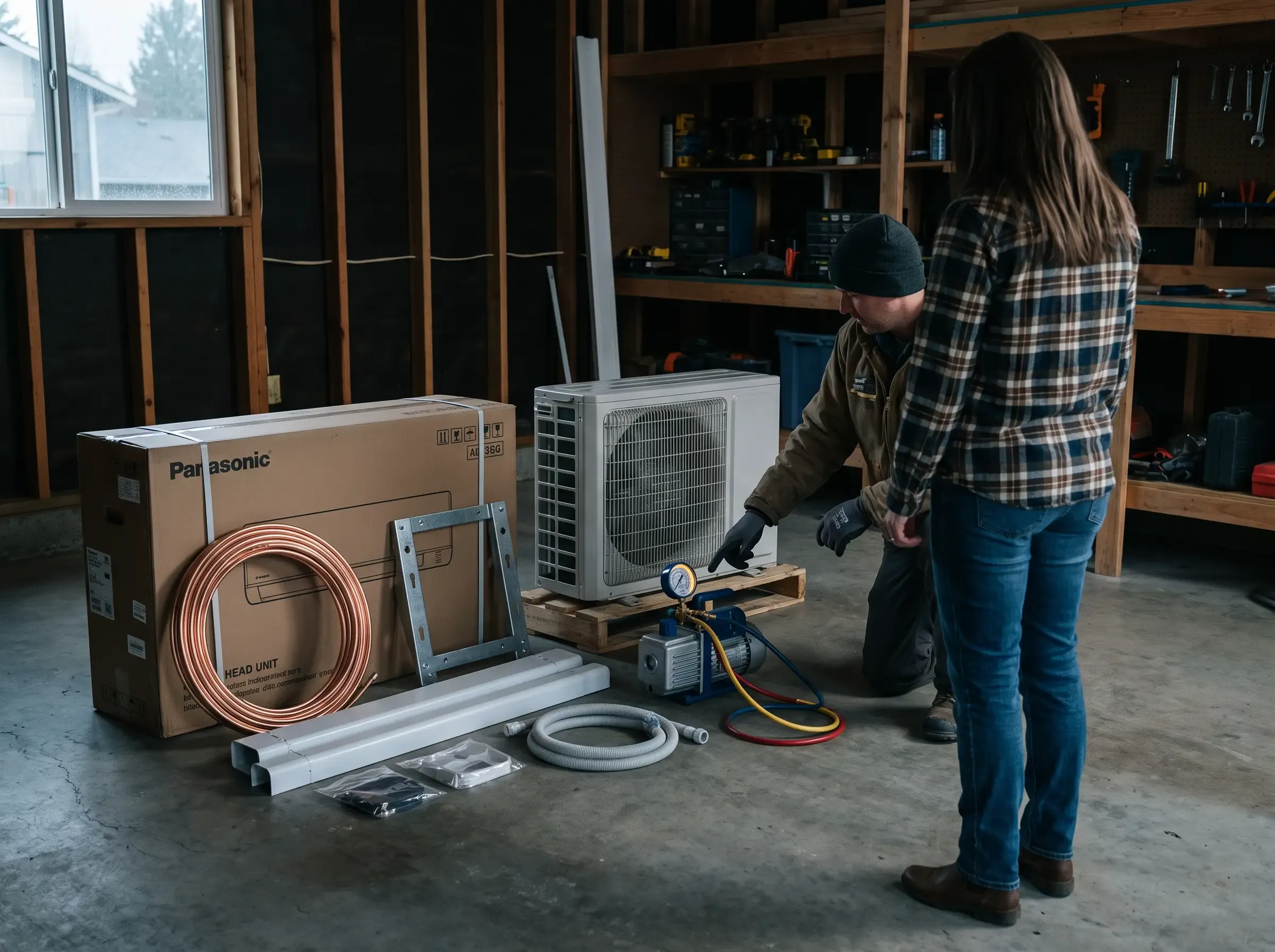
You bought a mini split kit online, or you are about to, and you can absolutely mount a bracket and drill a three-inch hole. What you cannot do at home is prove the joints do not leak, pull a real vacuum, confirm the charge, or legally handle refrigerant. So there is a third option between paying full installed price and gambling on a pre-charged coupling: you do the mounting and the routing, and we do the part that decides whether the system lasts ten years or four.
This is your job if
- You already own a DIY kit, or a kit is on the way, and you want a professional to finish and verify it.
- You are comfortable on a ladder and with a hole saw, and you have someone lined up for the electrical work.
- You are conditioning a shop, garage studio, ADU or single stubborn room, where the budget genuinely decides whether the project happens.
- You started an install yourself, got as far as the refrigerant connections, and stopped because that is where the tools end.
- You want to know before you buy whether the specific kit you are looking at is worth commissioning at all.
Rebates that apply to this work
-
Federal §25C Energy Efficient Home Improvement Credit
Internal Revenue Service
$0 — terminated
EndedHistorically 30% of cost, up to $2,000/year for heat pumps and heat pump water heaters. Gone. The One Big Beautiful Bill (P.L. 119-21, enacted July 4, 2025) accelerated its termination.
- Paperwork:
- You file it
- Deadline:
- Terminated — property placed in service after December 31, 2025 does not qualify
- Verified:
- 2026-09-04 · source
Check what you qualify for
Four questions. No email required, and the answer is sometimes “nothing” — we would rather tell you that now than after a sales visit.
How the job actually goes
-
Talk it through before you buy anything
Bring us the kit you are considering and the room you want to condition. Some kits are worth finishing and some are not: capacity at Bellingham’s 19°F design temperature, whether the lineset is field-flared or uses a pre-charged quick-connect, parts availability, and whether the manufacturer honours a warranty on an owner-installed unit all matter.
Your part: Send us the model number and a photo of the wall and the outdoor location before you order.
-
Agree the split of work in writing
We put in writing what you are doing and what we are doing, so nobody is guessing on the day. Typically you mount the wall bracket and the indoor head, drill and sleeve the wall penetration, set the outdoor unit on a pad or bracket, and route the lineset, condensate and control cable neatly. We take it from the point where the refrigerant circuit has to be proven.
Your part: Do your part to the standard we agree, especially the wall penetration slope and the condensate route. Redoing your work is what turns a cheap project into an expensive one.
-
Get the electrical done by a licensed electrical contractor
The dedicated circuit and the disconnect are not homeowner work here, and they are not our work either: we do not hold an electrical contractor licence, so a licensed electrical contractor performs and permits that portion. This is also the step that reveals whether an older panel has room, and it is the line item the low advertised prices for kit installs leave out.
Your part: Book the electrician yourself or ask us who we coordinate with, and get their scope in writing too.
-
Sort the permit honestly
A mechanical permit is required whether a contractor or the homeowner installs the equipment. If we are doing the commissioning we can pull the mechanical permit for the work we perform; on an owner-installed system the permit may need to be the homeowner’s, which the City of Bellingham allows for your own residence through eTRAKiT, or Whatcom County Planning and Development Services for unincorporated addresses. We will tell you which situation you are in rather than leaving it unpermitted.
Your part: Decide early whether you are pulling an owner permit; retro-permitting after the fact is more work than doing it in order.
-
Nitrogen pressure test and evacuation to a micron gauge
This is the visit that earns its fee. Field-flared joints get inspected and torqued, the circuit is pressurised with dry nitrogen and held to prove it holds, then evacuated and verified on a micron gauge with a standing decay test. Damp air left inside a lineset turns into acid in the oil, which is why cheap installs fail at year four rather than year one. If a joint leaks, we find it now, while it costs an hour.
-
Charge, commission, and record the readings
We release or weigh in the charge as the equipment requires, adjust for the actual lineset length, then verify operation in both heating and cooling: superheat and subcool where the manufacturer specifies them, amp draw, temperature split, condensate flow, and defrost. You get the measured values on paper, which is what any future technician, or a buyer’s inspector, will ask for.
Your part: Be there for the handover and learn the settings, particularly leaving the setpoint alone rather than running it like a furnace.
-
Hear the honest verdict, including when it is a no
If we find a flare that cannot be saved, a lineset kinked past use, or a unit sized so far off the load that it will never satisfy the room, we say so and price the fix. Occasionally the verdict is that the kit is not worth finishing, and we would rather tell you that than take a fee to start a system we know will disappoint. On rebates: PSE requires its heat pump rebates to be installed by a contractor in its network, so a homeowner-installed system does not qualify, and there is no federal credit for a 2026 install either.
Permits
A mechanical permit is required whether a contractor or the owner installs the equipment. We can pull the permit for work we perform. On an owner-installed system the permit may be yours to file, through City of Bellingham eTRAKiT for your own residence inside city limits or Whatcom County Planning and Development Services for unincorporated addresses. A great many Bellingham mailing addresses are actually county, so we confirm jurisdiction before the visit.
Equipment we install
Daikin
Aurora single-zone wall-mount and floor-mount heat pumps · Atmosphera R-32 single-zone wall-mount heat pumps · MXM and MXT multi-zone outdoor units · SkyAir light commercial split systems · Daikin FIT ducted inverter heat pumps and matched air handlers
Daikin is the line we install most often, for unglamorous reasons: the ductless equipment is good, the registered parts term is long, and the seasonal instant rebates are real money on a tightly priced job. It is not the strongest sub-zero machine on the market, and at a 19°F design temperature it does not need to be. Two honest cautions: Daikin runs a large dealer program in Whatcom County, so shop the installer and the scope of work rather than the logo on the brochure. And the industry move to R-32 means an older R-410A Daikin already in your house sits on a different parts path than anything current we would quote you.
Mitsubishi Electric
M-Series single-zone ductless systems · Hyper-Heating INVERTER (H2i) and H2i plus outdoor units · MXZ multi-zone outdoor units · SVZ air handlers and SEZ concealed ducted indoor units · P-Series light commercial equipment
This is the equipment to buy when the building is genuinely hard: a mountain cabin, a leaky 1920s four-square, or a multi-zone layout with long linesets and awkward head placement. The low-temperature engineering is the best documented in the industry, the controls are the best to live with, and the heat pump carries the load instead of handing off to strip heat every January. The counterpoint is money: on a tight, well-insulated house at 19°F you are paying a premium for capacity below zero that Bellingham weather will not request. The headline 12-year warranty is also gated behind a contractor program, so compare the ten-year reality against a Daikin or Fujitsu bid.
Fujitsu
Halcyon residential ductless systems · AIRSTAGE H-Series residential ductless systems · XLTH extra-low-temperature-heating outdoor units · AIRSTAGE Orion XLTH and Altair 500 R-32 single-zone wall mounts · AIRSTAGE Aquila multi-room outdoor units for two to five zones
Fujitsu is the value play in the ductless field and it is badly underexposed here, mainly because no Whatcom County contractor bothers to market it. The XLTH hardware suits a cold, snowy foothills site well, and a Fujitsu bid usually lands under a comparable Mitsubishi bid for similar published performance. The real drawback is logistics rather than engineering: fewer distributors here stock Fujitsu inverter boards and sensors, so a failed control board can mean waiting on a shipment instead of a same-week repair. The Halcyon-to-AIRSTAGE rebrand also makes parts lookups genuinely confusing when you are matching components to a unit installed five years ago.
Sized for 19°F, not for a rule of thumb
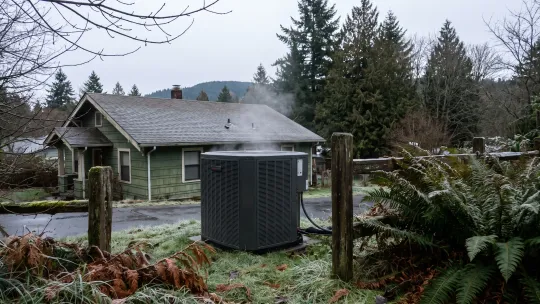
Washington's energy code puts Bellingham's outdoor heating design temperature at 19°F — colder than Sea-Tac's 24°F. We size from a load calculation against that number and spec equipment on its capacity at 5°F, because that is the figure that decides whether your auxiliary heat strips run all winter.
Bellingham sits in climate zone 4C (marine): heating-dominated, damp, rarely below 10°F. It is close to ideal heat pump territory, provided the system is not oversized.
Questions Bellingham homeowners actually ask
- What exactly is DIY mini split kit commissioning?
- You do the mechanical labour you are capable of, and we do the refrigerant and startup work that requires gauges, a vacuum pump and certification. In practice you mount the head and the outdoor unit and route the lineset. We pressure test with nitrogen, evacuate to a verified micron reading, set the charge, and commission the system in both modes with the readings written down. Almost nobody in Whatcom County offers this, and we do it because a working system matters more than billing you for labour you can do.
- Which DIY kits can you actually commission?
- Field-flared kits are the straightforward ones, because the joints can be inspected, torqued, pressure-tested and evacuated properly. Pre-charged quick-connect kits are more limited: the coupling design is what it is, and if we cannot evacuate the circuit we cannot verify it, which changes what we can promise. Send us the model number before you buy and we will tell you plainly which category it falls into.
- Will a DIY kit qualify for the PSE rebate?
- No. PSE’s electric-resistance-to-heat-pump rebate requires installation by a contractor in its network and excludes do-it-yourself installs, so a kit you install yourself is out regardless of how good the equipment is. Do the arithmetic first: a $1,500 or $2,400 rebate on a contractor-installed system can close much of the gap.
- What do you actually do at the commissioning visit?
- Inspect and torque the flares, nitrogen pressure-test the circuit and hold it, evacuate and confirm the vacuum on a micron gauge with a standing decay test, set or verify the charge for the real lineset length, then run the system in heating and cooling while measuring superheat and subcool, amp draw, temperature split, condensate flow and defrost. You get the numbers on paper, and a straight answer about anything we had to correct.
- What am I allowed to do myself, legally?
- You can do the mechanical mounting, the wall penetration, the lineset routing and the condensate work on your own home. You cannot handle refrigerant: federal rules under 40 CFR Part 82 require Section 608 certification to purchase or handle it, which is the boundary that makes commissioning a professional job. Electrical work on a dedicated circuit belongs to a licensed electrical contractor, and we hold no electrical licence, so we will never tell you we can do that part.
- Who pulls the permit if I do the installation?
- A mechanical permit is required either way, and who files it depends on who does the work. We can permit the portion we perform; for an owner-installed system the permit is often the homeowner’s to pull, which the City of Bellingham allows for your own residence via eTRAKiT, or Whatcom County Planning and Development Services if your address is unincorporated. We sort this out before the visit rather than leaving your system uninspected.
- What happens if you find something wrong with my work?
- We tell you, show you, and price the correction before doing it. The usual finds are a flare that was over- or under-torqued, a wall penetration that slopes the wrong way and sends water inside, a condensate line with no fall, or a lineset kinked at a tight corner. Most are an hour of rework, and finding them before charging the system is the entire point of paying for this visit.
- Does the manufacturer warranty survive a DIY installation?
- It depends entirely on the brand, and you should check before you buy rather than after. Some manufacturers void coverage on owner-installed equipment, some require professional startup documentation, and some DIY-marketed lines are designed for it. Having a professional commissioning record with measured values helps in every case, but it cannot rewrite a warranty condition that says a licensed contractor must install the unit.
- When is a DIY kit the wrong choice?
- When the rebate you would forfeit exceeds the labour you would save, when the run is long or crosses storeys, when the panel work is significant, or when you are conditioning your main living area and cannot afford for it to be marginal. A garage studio or a stubborn bedroom is a good DIY candidate; a whole-house multi-zone as your only heat source is not.
- How does the cost compare with a full installation?
- You save our mechanical labour and pay for the commissioning visit, the electrical work and the equipment. Whether that beats a full install depends on the rebate: a contractor-installed system in a home with electric resistance heat can pull $1,500, or $2,400 with PSE Efficiency Boost, and a DIY install pulls none of it. Call us with the kit price in hand and we will run both numbers.
Get a quote for diy mini split kit commissioning
Tell us what you have now. We will tell you what fits and what it costs.
Related work
Ductless Mini Split Installation
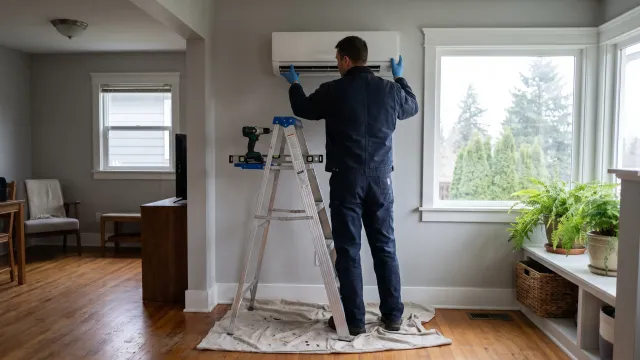
Heat and cool the rooms you actually use, without tearing your house apart to add ductwork.
$3,000–$ 10,000 Details →
Heat Pump Repair
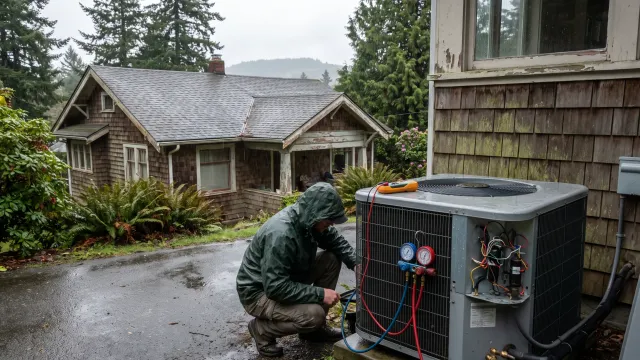
Find out what is actually wrong, in plain language, with the repair price and the replacement price side by side.
Details →
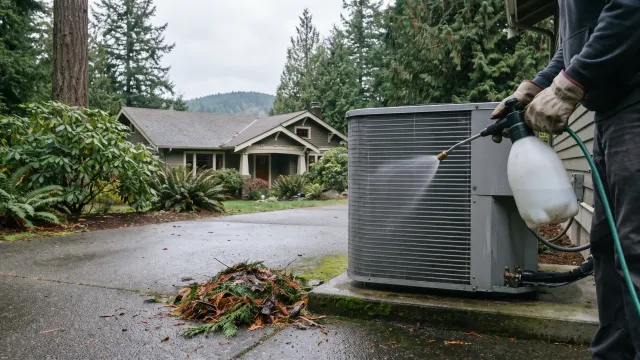
Heat Pump Maintenance
An hour of attention each year keeps the capacity you paid for and finds the cheap failures before they become the expensive ones.
Details →
Ready for a straight answer on your house?
Tell us what you have now and what you want it to do. We will tell you what fits, what it costs, and which rebates you actually qualify for — before anyone comes out.
Monday–Friday, 8:00 AM – 5:30 PM · Emergency calls answered 24/7