
Bellingham & Whatcom County
Heat Pump and Mini Split Maintenance in Bellingham
An hour of attention each year keeps the capacity you paid for and finds the cheap failures before they become the expensive ones.
- WA L&I #BELLIHC808NM Active registration — verify it with the state
- $30,000 bonded Surety bond on file with L&I
- $1,000,000 insured General liability coverage
- Local since 2020 Owner-operated in Whatcom County
- We pull the permit City of Bellingham or Whatcom County, and we meet the inspector
What people call us about
Nobody has touched the system since it went in, the filter is whatever came with it, and last winter the auxiliary heat seemed to run more than it used to. On a ductless system there may be a smell at startup, because the blower wheel and the coil have been collecting damp air for years. None of that announces itself as a breakdown; it shows up as a bill that creeps and a house that takes longer to recover.
This is your job if
- A ductless system three or more years old that has never had the blower wheel or coil properly cleaned, and now smells musty on startup.
- A ducted heat pump where nobody has changed the filter since the house was bought.
- An outdoor unit under fir or cottonwood, where the coil packs with needles and seed fluff every year.
- A home near saltwater, where salt exposure means the coil and cabinet need washing and inspection on a schedule.
- A rental or ADU where you want a documented annual service record for the equipment warranty.
How the job actually goes
-
Ask what the system has been doing
Before touching anything we ask about run times, auxiliary heat, noises, smells, and whether any room has drifted from the others. Those answers decide where we spend the visit. A system that has been fine for a year gets a different hour than one that has been quietly running its strips since November.
Your part: Note anything odd during the year, including the month it started. Seasonal timing is a real diagnostic clue.
-
Airflow first: filters, blower wheel, coil
Airflow problems cause more heat pump complaints than refrigerant does. We check and replace filters, inspect and clean the indoor coil, and on ductless systems clean the blower wheel and drain pan properly rather than spraying the visible louvres. That wheel is where the mildew smell in a damp house lives, and cleaning it is the most valuable thing a mini split gets each year.
Your part: Tell us the filter size you buy, or ask us to write it down so you are not guessing at the hardware store.
-
Wash and inspect the outdoor unit
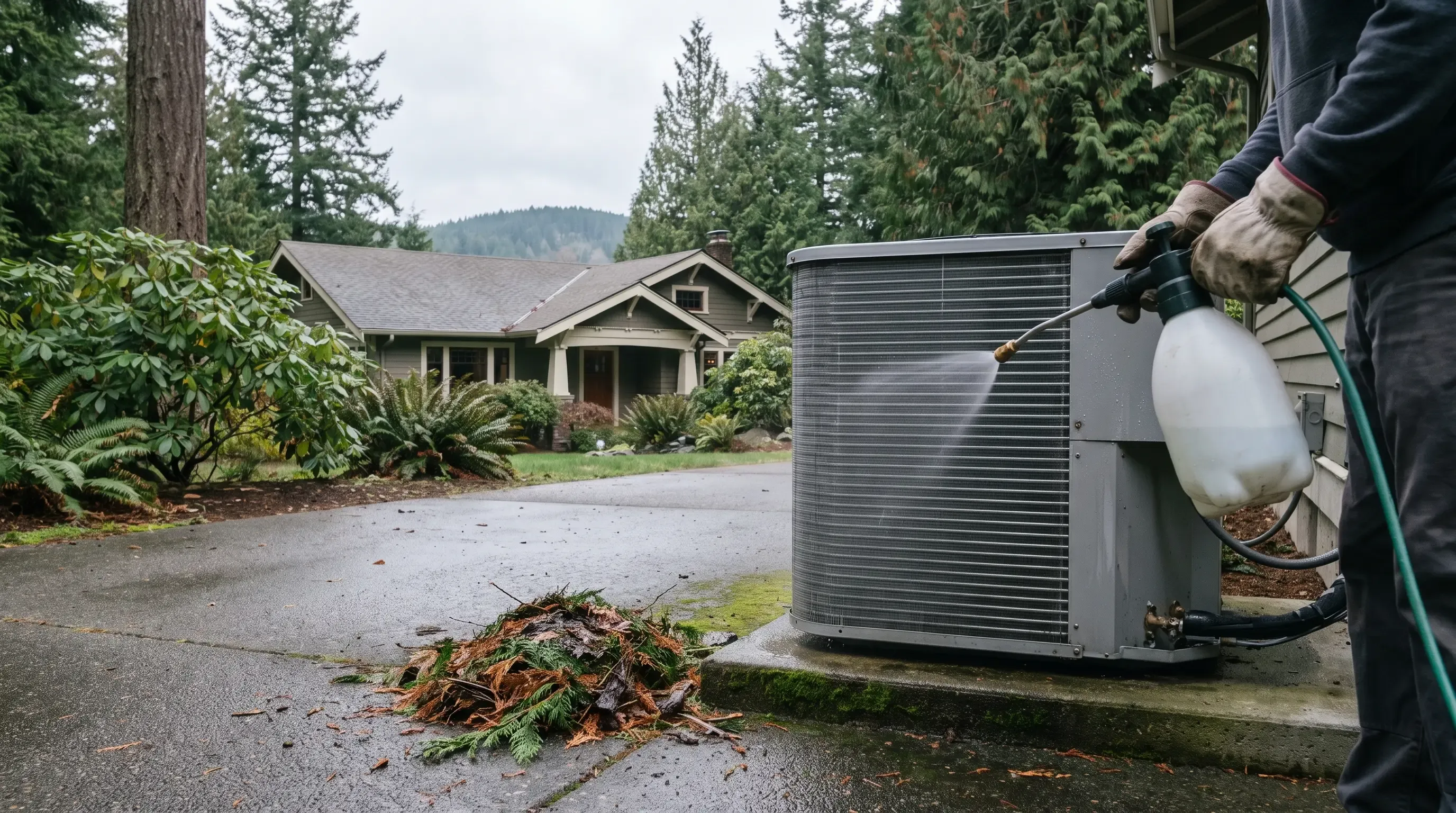
The outdoor coil gets rinsed clean of fir needles, cottonwood fluff and, near saltwater, the salt film that corrodes fins and cabinet fasteners. We check clearances, the pad and grade so meltwater drains away rather than back into the base, and look for the early corrosion that shows up first on coastal installs.
Your part: Cut back shrubs and stacked firewood to give the unit clearance on all sides. It is the one maintenance job that is genuinely yours.
-
Verify charge and check the electrical side
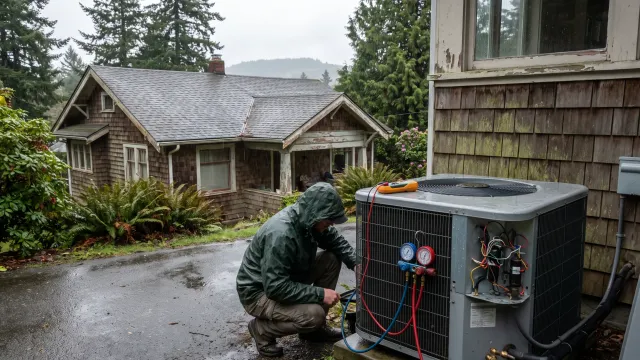
We confirm the refrigerant charge by the manufacturer’s method, taking superheat and subcool readings where the equipment calls for them, rather than adding refrigerant on principle. Capacitors are tested against their rating, contactors inspected for pitting, amp draw compared with nameplate, and the condensate path and float switch verified. A weak capacitor is a ten-minute part now and a no-heat call in January.
-
Prove defrost and the backup heat staging
In a 19°F design climate the defrost cycle and the auxiliary heat logic are what decide your winter bill. We force a defrost cycle to confirm it initiates and terminates properly. Then we check that the outdoor lockout for strip heat is still set at or below 35°F, and that the compressor is not being locked out early by a thermostat default. Settings drift when thermostats are replaced or reset.
-
Leave you the numbers and a realistic schedule
You get the measured values, what changed, and what is likely to need attention next. We recommend once a year, in autumn before the heating season, with a second airflow-focused visit in spring for households that run cooling hard or want filtration ready before wildfire smoke season. We do not sell a plan you do not need on a two-year-old system.
Your part: Keep the service sheets together; documented annual maintenance is what manufacturers ask for when a warranty claim comes up.
Permits
Maintenance is not permitted work. Permits enter the picture only when equipment is installed or replaced, at which point the mechanical permit comes from City of Bellingham Building Services inside city limits or Whatcom County Planning and Development Services for unincorporated addresses.
Equipment we install
Daikin
Aurora single-zone wall-mount and floor-mount heat pumps · Atmosphera R-32 single-zone wall-mount heat pumps · MXM and MXT multi-zone outdoor units · SkyAir light commercial split systems · Daikin FIT ducted inverter heat pumps and matched air handlers
Daikin is the line we install most often, for unglamorous reasons: the ductless equipment is good, the registered parts term is long, and the seasonal instant rebates are real money on a tightly priced job. It is not the strongest sub-zero machine on the market, and at a 19°F design temperature it does not need to be. Two honest cautions: Daikin runs a large dealer program in Whatcom County, so shop the installer and the scope of work rather than the logo on the brochure. And the industry move to R-32 means an older R-410A Daikin already in your house sits on a different parts path than anything current we would quote you.
Mitsubishi Electric
M-Series single-zone ductless systems · Hyper-Heating INVERTER (H2i) and H2i plus outdoor units · MXZ multi-zone outdoor units · SVZ air handlers and SEZ concealed ducted indoor units · P-Series light commercial equipment
This is the equipment to buy when the building is genuinely hard: a mountain cabin, a leaky 1920s four-square, or a multi-zone layout with long linesets and awkward head placement. The low-temperature engineering is the best documented in the industry, the controls are the best to live with, and the heat pump carries the load instead of handing off to strip heat every January. The counterpoint is money: on a tight, well-insulated house at 19°F you are paying a premium for capacity below zero that Bellingham weather will not request. The headline 12-year warranty is also gated behind a contractor program, so compare the ten-year reality against a Daikin or Fujitsu bid.
Fujitsu
Halcyon residential ductless systems · AIRSTAGE H-Series residential ductless systems · XLTH extra-low-temperature-heating outdoor units · AIRSTAGE Orion XLTH and Altair 500 R-32 single-zone wall mounts · AIRSTAGE Aquila multi-room outdoor units for two to five zones
Fujitsu is the value play in the ductless field and it is badly underexposed here, mainly because no Whatcom County contractor bothers to market it. The XLTH hardware suits a cold, snowy foothills site well, and a Fujitsu bid usually lands under a comparable Mitsubishi bid for similar published performance. The real drawback is logistics rather than engineering: fewer distributors here stock Fujitsu inverter boards and sensors, so a failed control board can mean waiting on a shipment instead of a same-week repair. The Halcyon-to-AIRSTAGE rebrand also makes parts lookups genuinely confusing when you are matching components to a unit installed five years ago.
Bosch
IDS Light inverter ducted split heat pumps · IDS Premium Connected inverter ducted split heat pumps · IDS Ultra cold-climate inverter ducted split heat pumps · Climate 5000 single-zone and multi-zone ductless systems · Matched air handlers and coils for the IDS family
Bosch is a ducted-retrofit brand and that is squarely where we would use it: a 1990s house with serviceable ductwork and a dying electric furnace. One modulating ducted unit beats hanging four heads on the walls of a house that already has a distribution system, the cabinet is compact, and the bid usually undercuts a comparable Daikin FIT. Two reservations, stated plainly: the Climate 5000 ductless line is not in the same conversation as Daikin, Mitsubishi or Fujitsu ductless, and we would not lead with it. The Bosch dealer footprint in Whatcom County is also thin, which is a parts-availability question you should put to anyone who quotes it, including us.
Sized for 19°F, not for a rule of thumb
Washington's energy code puts Bellingham's outdoor heating design temperature at 19°F — colder than Sea-Tac's 24°F. We size from a load calculation against that number and spec equipment on its capacity at 5°F, because that is the figure that decides whether your auxiliary heat strips run all winter.
Bellingham sits in climate zone 4C (marine): heating-dominated, damp, rarely below 10°F. It is close to ideal heat pump territory, provided the system is not oversized.
Questions Bellingham homeowners actually ask
- How often should heat pump maintenance be done?
- Once a year, in autumn before the heating season. A heat pump runs in both seasons, so it accumulates roughly twice the hours of a furnace, and here the heating hours dominate. Ductless systems benefit from a second look if you cook heavily, have pets, or run them hard for cooling.
- Is heat pump maintenance really worth the money?
- Yes, mostly because of airflow and capacitors. A loaded filter or a fouled blower wheel costs you capacity exactly when the outdoor temperature is near the design point. A weak capacitor is a cheap part on a scheduled visit and an emergency call in a cold snap. It is also what manufacturers point to when a warranty claim is made.
- What do you actually do during a tune-up?
- Airflow, cleaning, verification and settings. Filters and indoor coil, blower wheel and drain pan on ductless, the outdoor coil washed, charge verified by superheat and subcool rather than topped off, capacitors and contactors tested, amp draw compared with the nameplate, a forced defrost cycle, and a check that the auxiliary-heat lockout is still where it should be. You get the readings, not just a sticker.
- Do I need annual maintenance to keep my warranty?
- Manufacturers generally require documented annual maintenance as a condition of honouring a compressor or parts claim, so keep the paperwork. Registration matters too: many warranties drop from ten years to five if the equipment was never registered within the window after installation. If you inherited a system with the house, it is worth finding out where it stands before something fails.
- What maintenance can I do myself?
- Three things, and they are the three that matter most day to day: change or wash the filters on schedule, keep two to three feet of clearance around the outdoor unit, and make sure meltwater and condensate drain away from the base rather than pooling under it. Leave the sealed refrigerant system, the electrical components and the blower wheel to a technician, since two of those are hazardous and the third is easy to damage.
- My mini split smells musty when it starts. Can that be fixed?
- Yes, and it is one of the most common ductless complaints in a damp marine climate. The smell comes from biological growth on the blower wheel, the coil and the drain pan, and the wheel has to be removed or properly cleaned in place rather than sprayed through the louvres. Once it is clean, running fan-only or dry mode for a while after cooling season keeps the wheel from staying wet.
- When should I schedule, and does wildfire smoke change the answer?
- Autumn is the standard slot, before the heating season and before the cold-snap rush. If air quality matters to you, book a spring or early-summer visit as well so the filtration is sorted before the late-summer smoke episodes rather than during one. A ductless head with a clean filter is far more useful in smoke season than a window unit and a fan.
- Does maintenance qualify for any PSE rebate?
- No. PSE’s heat pump incentives pay for installing qualifying new equipment, not for servicing what you already own. What maintenance affects is whether that equipment still delivers the efficiency the rebate was based on.
- Will you maintain a system your company did not install?
- Yes, that is most of this work. We service ducted heat pumps and ductless systems from the major manufacturers and older equipment as well. On a first visit to an unfamiliar system we spend a little longer, because we are establishing a baseline of pressures, amp draws and settings that makes every future visit faster and more useful.
- Should I cover my outdoor unit in the winter?
- No. A heat pump runs in winter, so covering it blocks the airflow it needs and traps moisture against the coil and the electrical compartment. What helps instead is keeping the top and sides clear of leaves and snow, making sure the base drains, and trimming the shrubs or firewood stack that has crept in over the summer.
Before you decide
- Question How long does a heat pump last in a marine climate?
- Question Will a heat pump lower my electric bill?
- Guide Heat pump maintenance schedule for a marine climate
- Troubleshooting Heat pump runs constantly and never shuts off
- Troubleshooting Heat pump or mini split smells bad
- Troubleshooting Mini split has weak airflow
- Troubleshooting Winter electric bill is much higher than expected
Heat Pump Maintenance across Whatcom County
- Lynden, WA
- Ferndale, WA
- Birch Bay, WA
- Sudden Valley, WA
- Blaine, WA
- Marietta-Alderwood, WA
- Everson, WA
- Geneva, WA
In Bellingham
Get a quote for heat pump maintenance
Tell us what you have now. We will tell you what fits and what it costs.
Related work
Heat Pump Repair
Find out what is actually wrong, in plain language, with the repair price and the replacement price side by side.
Details →
Heat Pump Replacement
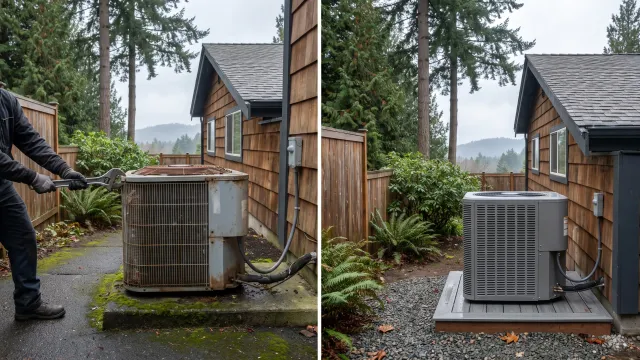
Replace a tired system once, correctly, instead of paying for a third repair on equipment that will not see another winter.
$2,793–$ 10,058 Details →
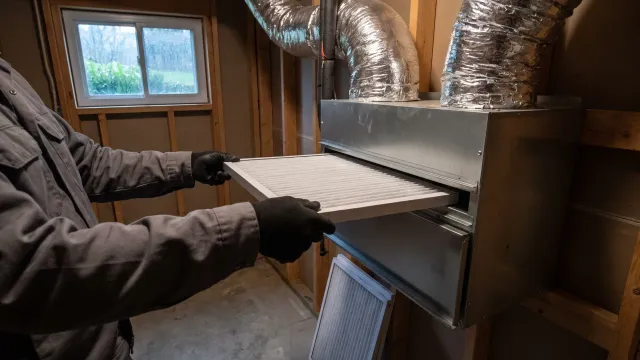
Indoor Air Quality and Ventilation
Ventilation and filtration matched to the two problems this climate actually creates: August smoke and winter moisture.
Details →
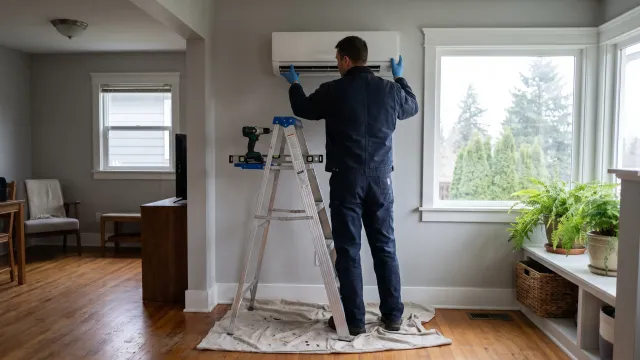
Ductless Mini Split Installation
Heat and cool the rooms you actually use, without tearing your house apart to add ductwork.
$3,000–$ 10,000 Details →
Ready for a straight answer on your house?
Tell us what you have now and what you want it to do. We will tell you what fits, what it costs, and which rebates you actually qualify for — before anyone comes out.
Monday–Friday, 8:00 AM – 5:30 PM · Emergency calls answered 24/7