
Guide
Heat pump maintenance in a marine climate: fir needles, moss and salt air
A maintenance schedule written for Whatcom County rather than for Phoenix. What the coil collects here, how often filters really need doing, and why coastal properties need a fresh-water rinse.
- WA L&I #BELLIHC808NM Active registration — verify it with the state
- $30,000 bonded Surety bond on file with L&I
- $1,000,000 insured General liability coverage
- Local since 2020 Owner-operated in Whatcom County
- We pull the permit City of Bellingham or Whatcom County, and we meet the inspector
Most heat pump maintenance advice is written for dry climates, and it does not describe what happens to equipment here. In Whatcom County the outdoor coil collects Douglas fir and cedar needles, maple leaves, moss and, within reach of the water, salt. The indoor side collects whatever is in the air, which in August includes wildfire smoke. None of that is exotic, but it does change the cadence: coil cleaning matters more here than filter changes do, and on a waterfront property a fresh-water rinse is genuinely useful rather than a make-work item.
What actually fouls equipment in Whatcom County
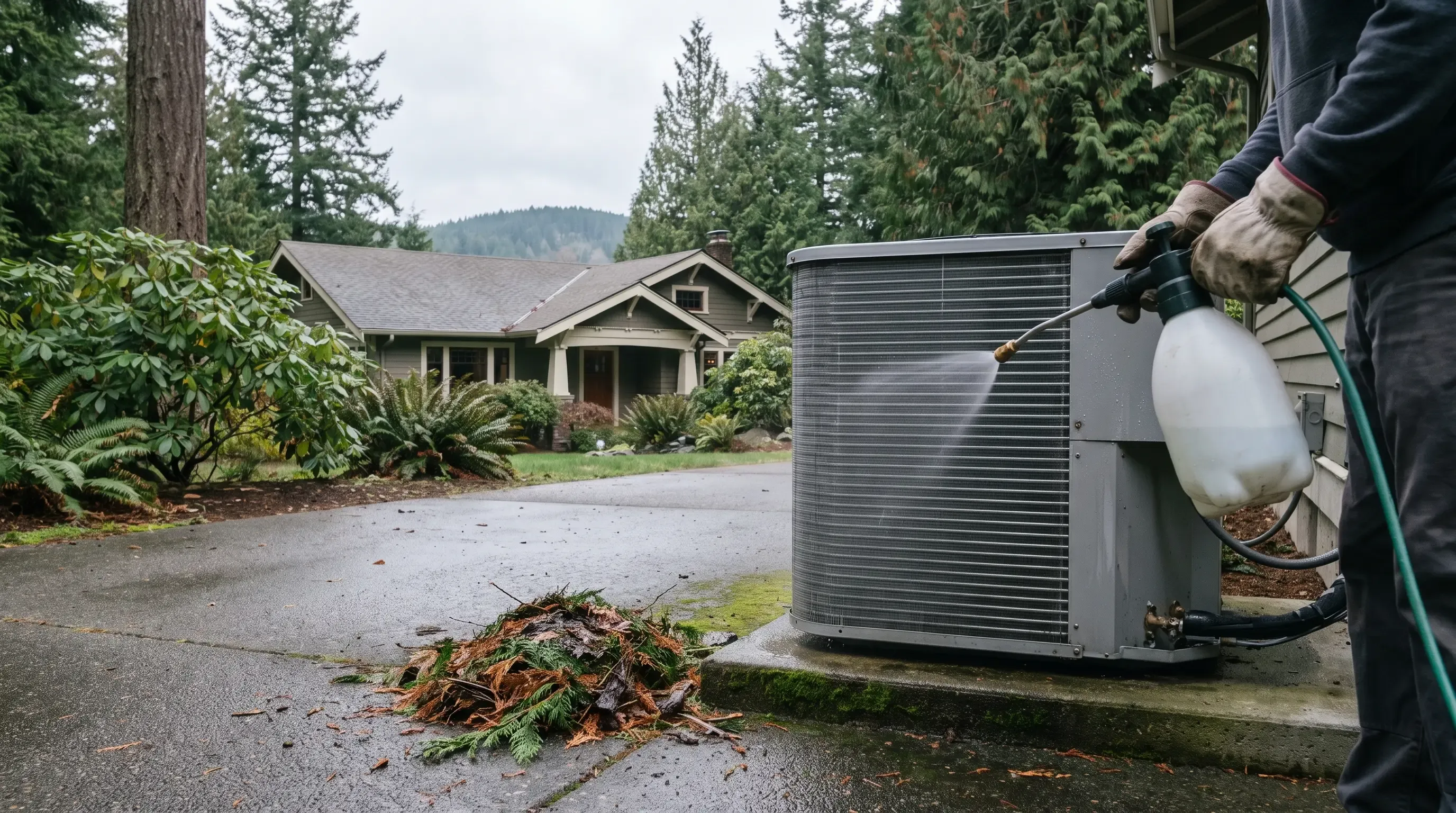
The outdoor coil is a fine aluminium fin pack with air pulled through it continuously, which makes it an efficient filter for everything the local trees produce. Douglas fir and cedar needles are the worst because they thread between the fins and stay there; leaves mat against the face; moss and algae grow anywhere that stays damp, which here means most of the winter.
A fouled coil reduces heat transfer, which shows up as lower capacity, longer runtime and higher bills. In heating mode it also makes defrost cycles less effective, so ice builds where it should melt. People interpret all of that as an ageing compressor when it is often four years of needles.
Within reach of salt air — Fairhaven, Edgemoor, Birch Bay, Blaine, Point Roberts, Lummi Island — there is a second mechanism. Salt deposits on aluminium fins and copper tubes drive corrosion that can shorten equipment life by two to four years without protection. Rinsing the deposits off before they sit through a season is the cheap intervention.
The schedule, with honest intervals
Intervals in manufacturer literature assume a generic environment. These are adjusted for what we see in Whatcom County houses, and the two that matter most are the seasonal coil clean and the annual professional service.
Filters are the most over-prescribed and under-performed item on any maintenance list. Ductless head filters are washable and take five minutes, and the honest interval is monthly during heavy use and during smoke season, quarterly otherwise. A central system’s deep pleated filter runs on a longer cycle but should be checked, not assumed.
What should never be skipped is the annual professional service. Refrigerant charge, superheat and subcooling, amp draw, electrical connections, defrost operation and condensate handling are not homeowner items and they are where a developing fault gets caught before it becomes a January failure.
| Task | Interval | Who does it | Why it matters here |
|---|---|---|---|
| Wash ductless head filters | Monthly in heavy use and in smoke season, quarterly otherwise | Homeowner | Thin filters load fast; a blocked filter starves airflow and cuts capacity |
| Check or replace central system filter | Check every one to three months | Homeowner | Deep pleated filters last longer but smoke season loads them quickly |
| Clear debris from around the outdoor unit | Monthly, and after every windstorm | Homeowner | Needle and leaf fall is continuous here; clearances matter to airflow |
| Rinse the outdoor coil with fresh water | Twice a year inland, quarterly within salt-air reach of the water | Homeowner, gently | Removes needles, moss and salt deposits before they drive corrosion |
| Professional coil clean, charge and electrical check | Annually, ideally in autumn before the heating season | Technician | Charge, amp draw, defrost operation and condensate are not homeowner items |
| Inspect condensate drain and pump | Annually, and at the start of cooling season | Technician, with a homeowner look | A blocked drain shows up as water in a Bellingham basement or ceiling |
| Check outdoor unit mounting, level and snow clearance | Annually before winter | Homeowner or technician | Frost heave and settling are real here; foothill sites need snow height maintained |
| Verify backup heat lockout settings | Annually | Technician | PSE rebate terms require resistance backup locked out via outdoor sensor, recommended at or below 35°F |
Cleaning the outdoor coil without wrecking it
The homeowner-safe version of coil cleaning is a garden hose at ordinary pressure, from the inside out where you can reach, with the power off at the disconnect. That is enough to remove needles, moss and salt film, and it is the single highest-value thing you can do for a heat pump in this climate.
What to avoid: a pressure washer, which bends fins and drives debris deeper; a wire brush, which does the same; and household cleaners, which can attack aluminium. If deposits will not rinse away, that is a job for a technician with proper coil cleaner and the knowledge of which chemistry suits which coil coating.
Do not skip the fan guard and the top of the unit, where leaves collect. And put the disconnect back on when you are done, which sounds obvious and is a genuinely common source of "the heat stopped working" calls.
Smoke season and the indoor side
August in the Pacific Northwest now regularly brings wildfire smoke, and it changes the indoor maintenance picture for a few weeks. Filters load far faster than usual, on both ductless heads and central systems, and a loaded filter starves airflow at exactly the moment you want the system recirculating.
The practical response is to check filters weekly during a smoke event rather than on the normal schedule, and to have a spare central filter on the shelf before the smoke arrives rather than shopping for one during it.
A central ducted system is a much better platform for smoke filtration than ductless heads, because the cabinet will accept a deep pleated or MERV-13 filter that a wall head cannot. If smoke is a significant concern and you are on ductless, a good portable HEPA unit in the room you occupy most is a more effective answer than expecting the head filters to do work they were not designed for.
Winter: defrost, ice and what is normal
A heat pump running in cold weather will frost its outdoor coil and periodically reverse to melt it. During a defrost cycle you will see steam, hear the reversing valve, and possibly see the fan stop. That is all normal and it is not a fault.
What is not normal is a block of ice encasing the coil, ice building in a tray beneath the unit, or ice that never clears between cycles. Those point to a drainage problem under the unit, a defrost control fault, restricted airflow from a fouled coil, or low refrigerant charge — and they are worth a call rather than a wait.
Also worth knowing: a unit sitting too low to grade builds an ice shelf beneath itself from its own meltwater, which is a siting problem rather than an equipment problem. Keeping the base clear and the drainage working through the winter is part of the maintenance, particularly in the foothills where a unit can end up in standing snowmelt.
What an annual service visit should include
A maintenance visit worth paying for measures things and writes them down. Refrigerant performance verified by superheat and subcooling rather than by gauge pressure alone. Compressor and fan motor amp draw against nameplate. Electrical connections checked and torqued. Contactor and capacitor condition.
On the air side: coil condition inside and out, blower wheel cleanliness, static pressure if the system is ducted, and condensate drain and pump function. On the controls: defrost operation confirmed, and the backup heat lockout settings verified — which matters both for your bill and because PSE’s rebate terms require resistance backup locked out via an outdoor ambient sensor, recommended at or below 35°F.
Ask for the numbers, not just a checkmark. A visit that produces amp draws and temperature splits gives you a baseline to compare against next year, which is how a slow refrigerant leak or a tiring compressor gets caught early instead of in a cold snap.
Questions Bellingham homeowners actually ask
- How often should I really clean the outdoor coil in Bellingham?
- Rinse it yourself twice a year inland, and quarterly if you are within reach of salt air on the water, plus a professional clean annually. Fir and cedar needles thread into the fins and do not blow out, and needles plus moss plus winter damp will quietly cost you capacity long before anything breaks.
- Can I pressure wash the coil?
- No. A pressure washer bends the fins and drives debris further in, and bent fins permanently reduce heat transfer. A garden hose at ordinary pressure with the power off at the disconnect is the right tool, and stubborn deposits are a job for a technician with proper coil cleaner.
- Is ice on the outdoor unit a problem?
- Frost that comes and goes with defrost cycles is normal. A coil encased in ice, ice building in a tray under the unit, or ice that never clears is not, and it usually points to drainage under the unit, a defrost fault, restricted airflow or low charge. Call rather than wait, because running in that condition damages equipment.
- Does salt air really shorten equipment life?
- By roughly two to four years without corrosion protection, according to published guidance for coastal Washington installations. On a waterfront property in Birch Bay, Blaine, Edgemoor or Point Roberts, specify the corrosion package at purchase and rinse the coil quarterly. Corrosion protection cannot be retrofitted later.
- Do I need a maintenance plan?
- You need an annual service; whether it comes as a plan or a phone call each autumn matters less. Book it before the heating season rather than during it, because the value is in catching a developing fault while you still have time. Regular hours are Monday to Friday, 8:00 AM to 5:30 PM, and emergency calls are answered 24/7.
Have us apply this to your house
Reading it is one thing. Send us the address, the panel size and what you heat with now, and we will tell you what it means for your project.
Ready for a straight answer on your house?
Tell us what you have now and what you want it to do. We will tell you what fits, what it costs, and which rebates you actually qualify for — before anyone comes out.
Monday–Friday, 8:00 AM – 5:30 PM · Emergency calls answered 24/7