
Guide
Wildfire smoke and your HVAC system: what actually helps
Smoke season now arrives most Augusts. What filtration is worth installing, why a window air conditioner is the wrong tool, what a mini split can and cannot do, and where an ERV fits.
- WA L&I #BELLIHC808NM Active registration — verify it with the state
- $30,000 bonded Surety bond on file with L&I
- $1,000,000 insured General liability coverage
- Local since 2020 Owner-operated in Whatcom County
- We pull the permit City of Bellingham or Whatcom County, and we meet the inspector
August in the Pacific Northwest now regularly brings days of wildfire smoke, and the equipment in most Bellingham houses was not chosen with that in mind. The mechanical response is straightforward once you separate the three jobs: keep smoke out of the building, filter what is already inside, and stay cool enough that you are not tempted to open a window. A window air conditioner is a hole in your envelope during exactly the wrong week. A ductless mini split lets you keep the house closed but has thin filters. A central ducted system is the best filtration platform you can own.
The three separate problems
Smoke management gets confused because people treat it as one problem. It is three, and different equipment solves each.
Keeping smoke out is an envelope problem: air sealing, closed windows, and not running exhaust fans that depressurise the house and pull outdoor air through every crack. Weatherization work you did for winter comfort pays off again here, and PSE’s air sealing instant rebate of $0.20 per square foot is the cheapest entry point.
Filtering what is inside is a filtration problem, and the answer depends on what equipment you have. Staying cool without opening windows is a cooling problem, which is where a heat pump earns its keep in a month it was not bought for.
Why a window air conditioner is the wrong tool
A window unit requires an open window with the sash resting on the chassis and foam panels filling the gaps either side. That assembly is a deliberate opening in your building envelope, and during a smoke event it is an opening in the worst possible place.
Worse, a window unit brings a small amount of outdoor air in by design and by leakage, and it has no meaningful filter — the mesh screen on the front is there to keep the coil clean, not to remove fine particulate.
So a household relying on a window unit for cooling has to choose between being hot and being smoked, in a week when both matter. That is the single strongest practical argument for a mini split in a house that currently cools with window units, over and above the fact that a mini split also heats.
What a ductless mini split can and cannot do
A mini split lets you keep every window closed and latched while the indoor heads recirculate and cool. That alone is a large improvement over the window-unit situation, and it is worth being clear that it is the sealing, not the filtration, doing most of the work.
The filters in a ductless head are thin washable screens. They keep the blower wheel and coil clean and they capture larger particles; they are not designed for fine particulate, and no wall head accepts a deep pleated filter. During a smoke event they load faster than usual, so check them weekly rather than monthly.
The practical complement to ductless in smoke season is a portable HEPA air cleaner in the rooms you occupy most, sized for the room rather than the house. That combination — sealed envelope, mini split for cooling, HEPA unit in the bedroom and living room — is more effective than anything you can do to the mini split itself.
Central systems: the best filtration platform you can own
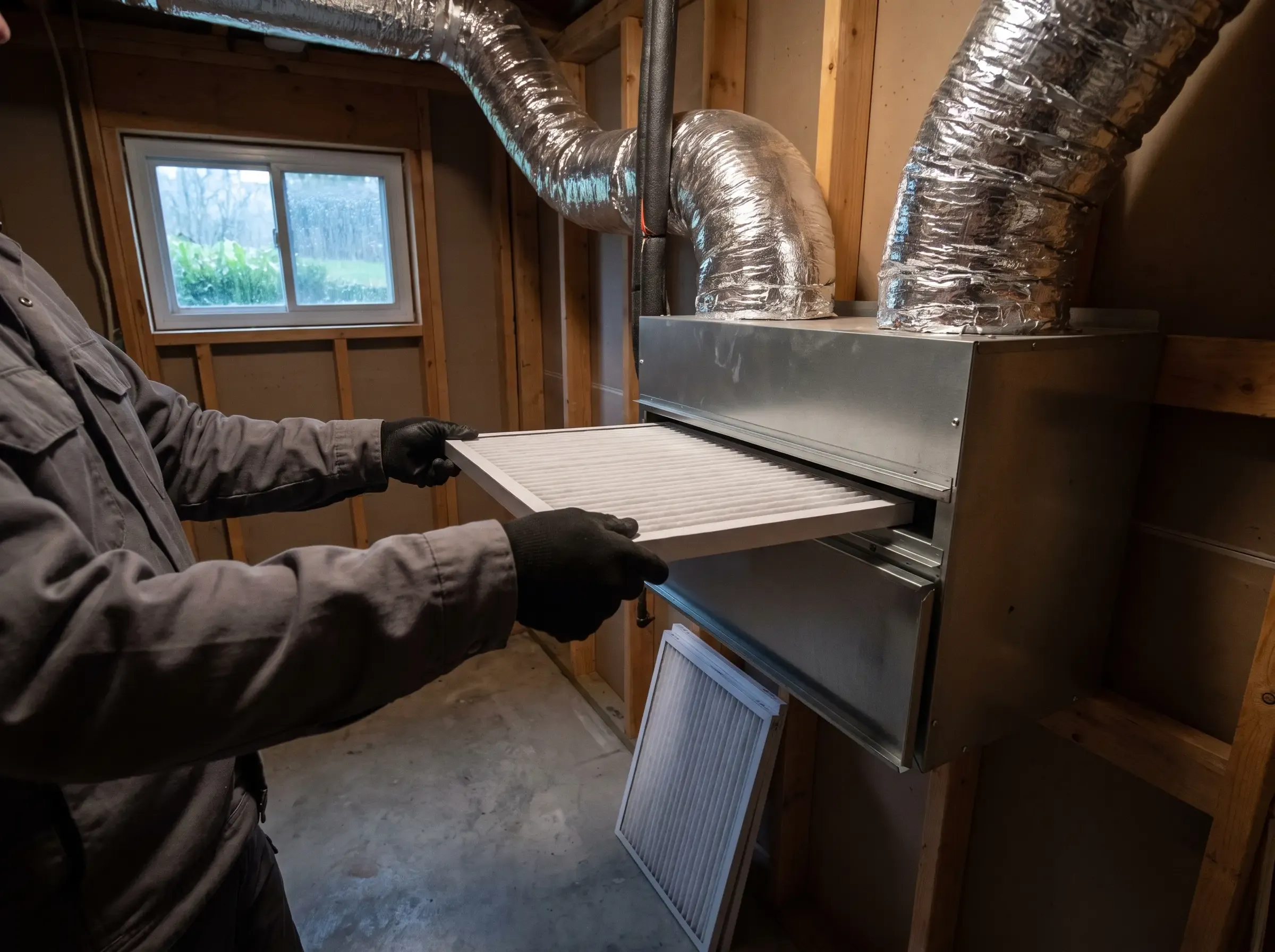
A ducted system has one advantage that ductless cannot match: a filter cabinet that will accept a deep pleated media filter capable of capturing fine particulate. That is a genuinely effective whole-house response to smoke, and it costs the price of a filter.
Two conditions apply. The filter has to fit the cabinet, and the system has to be able to move air through it — a denser filter raises static pressure, and a system already fighting undersized returns or restrictive ductwork may lose airflow it cannot spare. That is a question to ask at install time so the cabinet and the ductwork are specified for the filter you intend to use.
The second condition is that the blower has to run. Filtration only happens while air is moving, so during a smoke event set the fan to run continuously rather than only when there is a call for heating or cooling. A variable-speed blower makes that cheap; a single-speed one less so.
Where an ERV fits, and when to shut it off
An energy recovery ventilator brings in controlled outdoor air and exhausts stale indoor air, transferring heat and some moisture between the two streams. In a tight modern house it is how you get fresh air without opening windows, and it is a genuinely good thing to have in this climate.
During a smoke event, though, its job description works against you: it is a device for bringing outdoor air inside. Most units can be put into recirculation or simply shut down, and the filtration on the intake side is usually not rated for fine particulate unless it was specified that way.
So: install the ERV for the other fifty weeks, and know where its off switch is. If smoke resilience matters to you, specify a filter grade on the intake side at install rather than discovering the standard one is a coarse screen. Air quality indoors in a closed house degrades over days, not hours, so shutting the ERV down through a two- or three-day event is a reasonable trade.
- Before smoke season, buy a spare high-grade central filter and keep it on the shelf
- Confirm your filter cabinet accepts the filter grade you want and that the system can move air through it
- During an event, close and latch all windows and set the system fan to run continuously
- Check ductless head filters weekly during an event rather than monthly
- Avoid running kitchen and bath exhaust fans longer than necessary; they depressurise the house
- Put an ERV or fresh-air intake into recirculation, or shut it down for the duration
- Run a room-sized HEPA air cleaner in the bedroom and main living area, especially with ductless
- Rinse the outdoor coil after the event; ash and fine particulate foul it as effectively as needles do
- After the event, replace the loaded filter rather than getting a few more weeks out of it
What smoke does to the equipment itself
Ash and fine particulate foul an outdoor coil the same way fir needles do, and a smoke event deposits a lot of both. Rinsing the outdoor coil with a garden hose after the smoke clears is worth doing, with the power off at the disconnect.
Indoors, the blower wheel and the coil collect what gets past the filter, and a smoke season with a neglected filter is how a coil ends up needing a professional clean. That is the real cost of running a loaded filter: not just reduced airflow during the event but deposits on components that are much harder to clean than a filter is to replace.
If you ran the system hard through a smoke event, mention it at your next annual service. It is a useful piece of context for a technician looking at coil condition and static pressure, and it is exactly the kind of thing that gets forgotten by the following autumn.
Questions Bellingham homeowners actually ask
- Will my mini split filter wildfire smoke?
- Not effectively on its own. The filters in a ductless head are thin washable screens designed to keep the coil clean, and they do not capture fine particulate. What a mini split does well is let you keep every window closed while staying cool, which is most of the benefit. Add a room-sized HEPA air cleaner where you spend your time.
- What filter should I put in my central system during smoke season?
- The highest-grade deep pleated filter your cabinet accepts and your system can move air through, commonly a MERV-13. The constraint is static pressure: a dense filter in a system with undersized returns loses airflow. Ask us to check static pressure with the filter you want to use rather than assuming it will be fine.
- Should I run the fan continuously?
- Yes, during a smoke event. Filtration only happens while air is moving through the filter, so continuous fan operation is what turns your filter into an air cleaner. A variable-speed blower makes this cheap to do; on a single-speed system it costs more but is still worth it for the duration.
- Should I turn off my ERV when it is smoky?
- Generally yes, or put it into recirculation if it supports that. An ERV exists to bring outdoor air inside, which is the opposite of what you want during a smoke event unless its intake filtration was specifically specified for fine particulate. Indoor air quality in a closed house degrades over days rather than hours, so a two- or three-day shutdown is a reasonable trade.
- Does smoke damage the heat pump?
- It fouls it rather than damaging it, and fouling costs capacity. Ash and fine particulate deposit on the outdoor coil just as needles do, so rinse it with a hose once the air clears, with the power off at the disconnect. Indoors, replace the loaded filter rather than stretching it, because what gets past the filter lands on the blower wheel and the coil.
Have us apply this to your house
Reading it is one thing. Send us the address, the panel size and what you heat with now, and we will tell you what it means for your project.
Ready for a straight answer on your house?
Tell us what you have now and what you want it to do. We will tell you what fits, what it costs, and which rebates you actually qualify for — before anyone comes out.
Monday–Friday, 8:00 AM – 5:30 PM · Emergency calls answered 24/7