Bellingham & Whatcom County
Heat Pump Installation in Bellingham, WA
One system that heats through a Bellingham winter and cools through a smoke-season August, sized to your house rather than to a chart.
- WA L&I #BELLIHC808NM Active registration — verify it with the state
- $30,000 bonded Surety bond on file with L&I
- $1,000,000 insured General liability coverage
- Local since 2020 Owner-operated in Whatcom County
- We pull the permit City of Bellingham or Whatcom County, and we meet the inspector
What people call us about
Your electric furnace or your baseboards work, but the bill in January was $340 and you have started heating one room and closing doors. Or you already have ductwork, an air conditioner that only cools, and a heating system with nothing left in it. A heat pump is the right answer for most houses here with usable ducts, and the honest version of the pitch includes the electrical work and the sizing math.
This is your job if
- A mid-2000s two-storey with existing ductwork and an air conditioner that has reached the end of its life.
- A 1960s rambler with an original electric forced-air furnace and a crawlspace full of serviceable duct.
- A 1990s home where the ducts are fine but the equipment is on borrowed time.
- A manufactured or site-built home with an electric furnace and no gas main on the road.
- A house you are about to add air conditioning to, where a heat pump costs little more than a cooling-only condenser and covers both seasons.
What heat pump installation costs in Bellingham
installed ducted air-source heat pump where existing ductwork is serviceable. The $4,000–$8,000 range is the published Bellingham figure; the typical number is the low end of the $5,301–$6,973 typical band a Bellingham cost aggregator reports for completed heat pump jobs. Duct repair and electrical work are extra.
- Simple job
- $4,000
- Most homes
- $5,301
- Complex job
- $8,000
Installed price before rebates. The federal §25C tax credit contributes $0 in 2026 — it terminated for anything placed in service after December 31, 2025.
Range benchmarked 2026-09-04 against published local pricing. Your quote is fixed before work starts — no hourly surprises.
How long it takes: One to two days for a straight changeout on usable ducts. Add a day if duct repair is in scope, plus the electrician’s visit and the inspection.
Rebates that apply to this work
-
Electric Resistance to Air-Source Heat Pump Conversion
Puget Sound Energy
$1,500
Available now$2,400 with PSE Efficiency Boost for income-qualified households.
- Paperwork:
- We file it
- Deadline:
- No published end date — tariffed and subject to change
- Verified:
- 2026-09-04 · source
-
Efficiency Boost (income-qualified multiplier)
Puget Sound Energy
Raises other PSE rebates
Income-qualifiedHeat pump $1,500 → $2,400 · heat pump water heater $1,000 → $1,100 · smart thermostat $75 → $175.
- Paperwork:
- We file it
- Deadline:
- Ongoing
- Verified:
- 2026-09-04 · source
-
Midstream HVAC Equipment Discount
Puget Sound Energy (with ICF)
$300–$600
Available nowTier 1 $300 (SEER2 ≥15.2 / HSPF2 ≥8.1, retrofit only) · Tier 2 $400 (SEER2 ≥15.2 / HSPF2 ≥8.5) · Tier 3 $600 (SEER2 ≥16 / HSPF2 ≥9.5).
Bellingham note: Whether this discount can be combined with the $1,500 conversion rebate is unconfirmed: PSE’s conversion page says its rebate "cannot be combined with any other rebates except where noted", while PSE’s heating hub tells customers to ask their contractor. We quote it separately and confirm with a PSE Energy Advisor before counting it toward your total.
- Paperwork:
- Comes off the equipment price
- Deadline:
- No published end date
- Verified:
- 2026-09-04 · source
-
Daikin Instant Rebates — ductless
Daikin (administered by EGIA)
$450–$750
Available nowSkyAir (RZA outdoor with FTA indoor) $750 · MXM and Aurora MXT/MXTH $500 · Aurora RXT/RXP $450 · Atmosphera $450.
- Paperwork:
- We file it
- Deadline:
- Purchase by September 30, 2026; install by October 31, 2026
- Verified:
- 2026-09-04 · source
-
Community Energy Challenge — moderate income
Sustainable Connections + Opportunity Council
Up to $2,000
Income-qualifiedFor a ductless heat pump upgrade. Weatherization incentives average roughly 45% of project cost. Stated by CEC to be in addition to utility rebates.
- Paperwork:
- The program files it
- Deadline:
- Ongoing
- Verified:
- 2026-09-04 · source
-
Federal §25C Energy Efficient Home Improvement Credit
Internal Revenue Service
$0 — terminated
EndedHistorically 30% of cost, up to $2,000/year for heat pumps and heat pump water heaters. Gone. The One Big Beautiful Bill (P.L. 119-21, enacted July 4, 2025) accelerated its termination.
- Paperwork:
- You file it
- Deadline:
- Terminated — property placed in service after December 31, 2025 does not qualify
- Verified:
- 2026-09-04 · source
Price a heat pump installation for your house
A range, not a quote — and the arithmetic is shown so you can check it. Every band below is a published installed price, linked at the bottom.
Sources, all checked 2026-09-04: ductless by zone, ducted in Bellingham, local aggregator range, panel upgrade, dedicated circuit, heat pump water heater. Electrical work is performed and permitted by a licensed electrical contractor — we hold a general contractor registration, not an electrical one.
Check what you qualify for
Four questions. No email required, and the answer is sometimes “nothing” — we would rather tell you that now than after a sales visit.
How the job actually goes
-
Inspect the ducts before we talk about equipment
A heat pump moves more air at a lower temperature than a furnace does, so undersized or leaky ducts that got away with it for thirty years will not get away with it now. We measure trunk and branch sizing, look for crushed flex in the crawlspace, check return capacity, and tell you honestly if the duct system needs work or if ductless is the better buy.
Your part: Show us the crawlspace or attic access and mention any room that has always been the cold one.
-
Room-by-room load calculation at 19°F
We calculate the heating load against Bellingham’s 19°F design temperature from WAC 51-11C-80100 and the cooling load against 78°F, then pick equipment from the manufacturer’s low-temperature capacity table rather than the nameplate tons. Bellingham is colder than Seattle’s 24°F design temperature, so sizing copied from a Seattle rule of thumb comes out short here. We also identify the balance point, so you know at what outdoor temperature backup heat starts contributing.
Your part: Tell us about insulation upgrades, new windows, or an unheated bonus room. Each one moves the load and can move you down a size.
-
Electrical scope, quoted by a licensed electrical contractor
A ducted heat pump needs a dedicated outdoor circuit, a disconnect, and an air handler circuit, and if you are keeping electric backup heat strips the service load calculation has to support them. Panels in 1960s and 1970s homes are often 100 amp and frequently full. We do not hold an electrical contractor licence, so a licensed electrical contractor performs and permits all electrical work on the project, and you see that cost as its own line rather than buried in a total.
Your part: Decide with us whether to keep electric strip backup, which affects both the panel calculation and the rebate lockout settings.
-
Mechanical permit and inspection
We file the mechanical permit and meet the inspector on site. City of Bellingham addresses go through Building Services on the eTRAKiT portal; unincorporated addresses, including a lot of mail that says Bellingham, go through Whatcom County Planning and Development Services. We settle which applies with the City’s mapping tool before we order equipment.
-
Changeout day: set the pad, the air handler, and the lineset
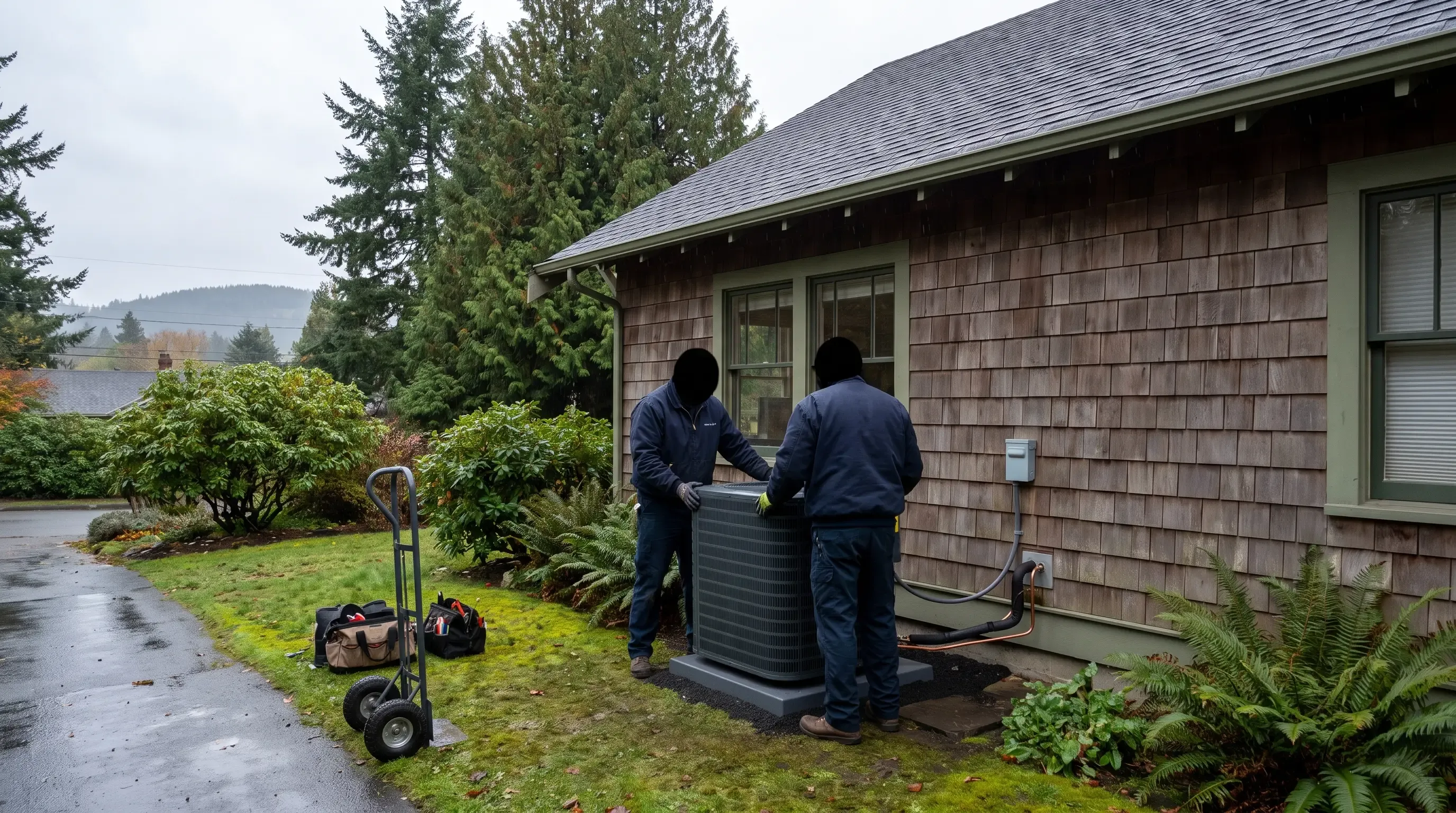
The outdoor unit goes on a level pad set above grade so it clears the standing water a Whatcom winter produces, with clearance for airflow and for service access on the valve side. Inside, the air handler or coil gets a properly sloped drain and a secondary pan where a leak would land on drywall, and the plenum transitions are built rather than taped together.
Your part: Clear a path to the equipment and keep pets inside; doors are open for part of the day.
-
Nitrogen pressure test, deep vacuum, weighed charge
The refrigerant circuit is pressure-tested with dry nitrogen and held, then evacuated and verified on a micron gauge with a standing decay test before any refrigerant is released. Charge is weighed in to the manufacturer’s figure adjusted for lineset length, not guessed at by feel on the suction line.
-
Commission, document, and set up the rebate paperwork
We check superheat and subcool against the manufacturer’s target, measure temperature rise and static pressure across the air handler, and confirm defrost operation. The outdoor-sensor lockout for backup heat is set at or below 35°F with the compressor lockout disabled, which is what the PSE conversion rebate requires. You get the AHRI certificate, the model and serial record, and the commissioning numbers. PSE requires the installing contractor to be in its network for its heat pump rebates, so ask us to confirm status for your project before you count on that money.
Your part: Bring household income information to the appointment if you want to be assessed for PSE’s Efficiency Boost amount, which the installer attests to on site.
Permits
We file the mechanical permit and meet the inspector; the licensed electrical contractor files the electrical permit for their portion. Jurisdiction depends on city limits, and plenty of addresses with Bellingham mail are in unincorporated Whatcom County, which moves the filing to Planning and Development Services. We confirm which one before ordering equipment.
Equipment we install
Daikin
Aurora single-zone wall-mount and floor-mount heat pumps · Atmosphera R-32 single-zone wall-mount heat pumps · MXM and MXT multi-zone outdoor units · SkyAir light commercial split systems · Daikin FIT ducted inverter heat pumps and matched air handlers
Daikin is the line we install most often, for unglamorous reasons: the ductless equipment is good, the registered parts term is long, and the seasonal instant rebates are real money on a tightly priced job. It is not the strongest sub-zero machine on the market, and at a 19°F design temperature it does not need to be. Two honest cautions: Daikin runs a large dealer program in Whatcom County, so shop the installer and the scope of work rather than the logo on the brochure. And the industry move to R-32 means an older R-410A Daikin already in your house sits on a different parts path than anything current we would quote you.
Bosch
IDS Light inverter ducted split heat pumps · IDS Premium Connected inverter ducted split heat pumps · IDS Ultra cold-climate inverter ducted split heat pumps · Climate 5000 single-zone and multi-zone ductless systems · Matched air handlers and coils for the IDS family
Bosch is a ducted-retrofit brand and that is squarely where we would use it: a 1990s house with serviceable ductwork and a dying electric furnace. One modulating ducted unit beats hanging four heads on the walls of a house that already has a distribution system, the cabinet is compact, and the bid usually undercuts a comparable Daikin FIT. Two reservations, stated plainly: the Climate 5000 ductless line is not in the same conversation as Daikin, Mitsubishi or Fujitsu ductless, and we would not lead with it. The Bosch dealer footprint in Whatcom County is also thin, which is a parts-availability question you should put to anyone who quotes it, including us.
Mitsubishi Electric
M-Series single-zone ductless systems · Hyper-Heating INVERTER (H2i) and H2i plus outdoor units · MXZ multi-zone outdoor units · SVZ air handlers and SEZ concealed ducted indoor units · P-Series light commercial equipment
This is the equipment to buy when the building is genuinely hard: a mountain cabin, a leaky 1920s four-square, or a multi-zone layout with long linesets and awkward head placement. The low-temperature engineering is the best documented in the industry, the controls are the best to live with, and the heat pump carries the load instead of handing off to strip heat every January. The counterpoint is money: on a tight, well-insulated house at 19°F you are paying a premium for capacity below zero that Bellingham weather will not request. The headline 12-year warranty is also gated behind a contractor program, so compare the ten-year reality against a Daikin or Fujitsu bid.
Fujitsu
Halcyon residential ductless systems · AIRSTAGE H-Series residential ductless systems · XLTH extra-low-temperature-heating outdoor units · AIRSTAGE Orion XLTH and Altair 500 R-32 single-zone wall mounts · AIRSTAGE Aquila multi-room outdoor units for two to five zones
Fujitsu is the value play in the ductless field and it is badly underexposed here, mainly because no Whatcom County contractor bothers to market it. The XLTH hardware suits a cold, snowy foothills site well, and a Fujitsu bid usually lands under a comparable Mitsubishi bid for similar published performance. The real drawback is logistics rather than engineering: fewer distributors here stock Fujitsu inverter boards and sensors, so a failed control board can mean waiting on a shipment instead of a same-week repair. The Halcyon-to-AIRSTAGE rebrand also makes parts lookups genuinely confusing when you are matching components to a unit installed five years ago.
Sized for 19°F, not for a rule of thumb
Washington's energy code puts Bellingham's outdoor heating design temperature at 19°F — colder than Sea-Tac's 24°F. We size from a load calculation against that number and spec equipment on its capacity at 5°F, because that is the figure that decides whether your auxiliary heat strips run all winter.
Bellingham sits in climate zone 4C (marine): heating-dominated, damp, rarely below 10°F. It is close to ideal heat pump territory, provided the system is not oversized.
Questions Bellingham homeowners actually ask
- Does a ducted heat pump keep up at 19°F in Bellingham?
- A properly sized cold-climate system does, and 19°F is the number to design against: it is Bellingham’s code heating design temperature under WAC 51-11C-80100, colder than Seattle’s 24°F. Capacity falls as it gets colder, so what matters is rated output at 19°F rather than at 47°F. Below the balance point, backup heat covers the gap, which is a design decision we make with you rather than a failure.
- What size heat pump do I need for my house?
- The only honest answer comes from a room-by-room load calculation, not from square footage. Two 1,800 square foot houses, one a 1950s box with original single-pane windows and one a mid-2000s build to code, can differ by more than a full ton. Oversizing a heat pump is worse than oversizing a furnace, because the compressor spends its life short-cycling and never reaches its efficient operating range.
- Can I use my existing ductwork?
- Often yes, and we check before quoting. Heat pumps deliver air at a lower temperature and higher volume, so a duct system that was marginal with a furnace can leave you with rooms three or four degrees apart. Crushed flex duct in the crawlspace, undersized returns and long uninsulated runs to a bonus room are what we find most in Whatcom County homes, and all three are fixable.
- What happens in a power outage?
- A heat pump stops, the same as a gas furnace with an electric blower stops. Nothing about a heat pump makes an outage worse than the electric furnace or baseboards it replaced. If you want genuine outage resilience, plan a generator interlock with a licensed electrical contractor as a separate project.
- How long does a heat pump installation take?
- One to two days for a changeout with usable ducts. Duct repair, a new pad location, or a lineset rerun adds a day. The electrical work and the mechanical inspection are separately scheduled, so the full calendar from deposit to signed-off permit is usually a couple of weeks.
- Do I need a permit, and who pulls it?
- Yes, a mechanical permit is required, and we pull it and meet the inspector. City of Bellingham Building Services handles addresses inside city limits through eTRAKiT, and Whatcom County Planning and Development Services handles unincorporated ones. The electrical permit is filed by the licensed electrical contractor who does that part of the job.
- What does heat pump installation actually cost in Bellingham?
- Published local ranges for a ducted system run $4,000 to $8,000 installed, and a Bellingham cost aggregator puts typical completed jobs at $5,301 to $6,973. The spread is driven by home size, duct condition, efficiency tier, and how much electrical work your panel needs. We quote the equipment, the mechanical work, and the electrical scope as separate lines so you can see which part of the number you are arguing with.
- Which rebates apply if my house has baseboard heat now?
- The PSE electric-resistance-to-heat-pump conversion rebate is the big one, at $1,500 or $2,400 with Efficiency Boost for income-qualified households, and it covers ducted as well as ductless. PSE also runs a midstream equipment discount of $300 to $600 by SEER2 and HSPF2 tier, passed through the distributor; whether that stacks with the $1,500 is unconfirmed and we will say so rather than promise it. PSE requires the installing contractor to be in its network, so ask us to confirm status before you count on the rebate.
- Is there still a federal tax credit for a heat pump in 2026?
- No. §25C and §25D terminated for property placed in service after December 31, 2025 under P.L. 119-21, and IRS FS-2025-05 confirms it. Any bid or advertisement still showing a $2,000 federal credit for a 2026 install is out of date, and there is no Washington sales-tax exemption on heat pumps to replace it either, despite how often that gets repeated.
- Do I need to keep backup heat?
- Usually yes, at least a modest amount. Below the balance point a heat pump needs help, and in a 19°F design climate that help is either electric strips in the air handler, an existing furnace, or a wood or propane appliance you already own. Keeping backup also lets us set the outdoor lockout PSE’s rebate requires, which stops the strips from running whenever the thermostat gets impatient.
- Do SEER2 and HSPF2 ratings matter, or is that just marketing?
- They matter for two practical reasons: rebate tiers and winter running cost. PSE’s midstream equipment discount is tiered by SEER2 and HSPF2, so the rating decides the dollar amount, and HSPF2 is the heating-season number that predicts your bill in a heating-dominated climate zone 4C like ours. Chasing the top tier stops paying once the price premium outruns the rebate plus the savings, and we will show you where that line falls.
Before you decide
- What it costs Heat Pump Cost in Bellingham, WA — Installed Prices for 2026
- What it costs Electrical Panel Upgrade Cost for a Heat Pump in Bellingham
- What it costs Heat Pump Cost Per Month to Run in Bellingham — With the Maths
- Question Do heat pumps work in the Pacific Northwest?
- Question Do heat pumps work in cold weather in Bellingham?
- Question What size heat pump do I need?
- Question Do I need a permit for a heat pump in Bellingham?
- Question Do I need backup heat with a heat pump in Bellingham?
- Question Where should the outdoor unit go?
- Compare Heat pump vs. gas furnace in Bellingham
- Compare Ductless mini split vs. central ducted heat pump
- Compare Heat pump vs. propane furnace
- Compare Heat pump vs. oil furnace
- Compare Cold-climate vs. standard heat pump
- Guide How to size a heat pump in Bellingham
- Guide Heat pump buying guide for Whatcom County
- Guide Where to put the outdoor unit
- Guide Electrical requirements for a heat pump
Heat Pump Installation across Whatcom County
- Lynden, WA
- Ferndale, WA
- Birch Bay, WA
- Sudden Valley, WA
- Blaine, WA
- Marietta-Alderwood, WA
- Everson, WA
- Geneva, WA
In Bellingham
Get a quote for heat pump installation
Tell us what you have now. We will tell you what fits and what it costs.
Related work
Ductless Mini Split Installation
Heat and cool the rooms you actually use, without tearing your house apart to add ductwork.
$3,000–$ 10,000 Details →
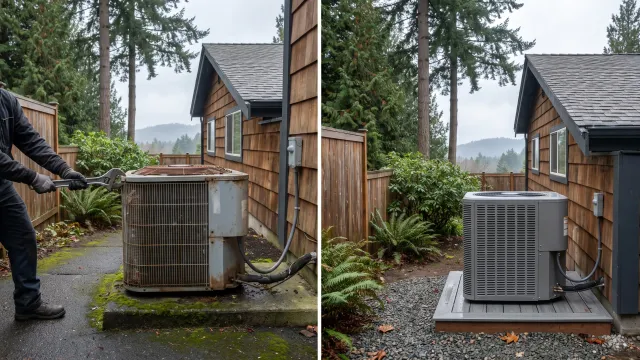
Heat Pump Replacement
Replace a tired system once, correctly, instead of paying for a third repair on equipment that will not see another winter.
$2,793–$ 10,058 Details →
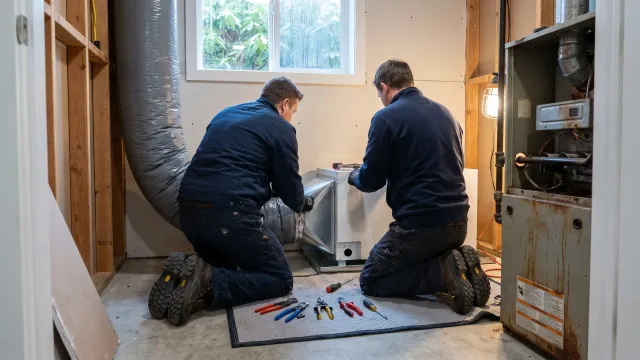
Furnace to Heat Pump Conversion
Use the ductwork you already have to get efficient heating plus air conditioning, and keep the furnace only if it is genuinely earning its place.
$4,000–$ 8,000 Details →
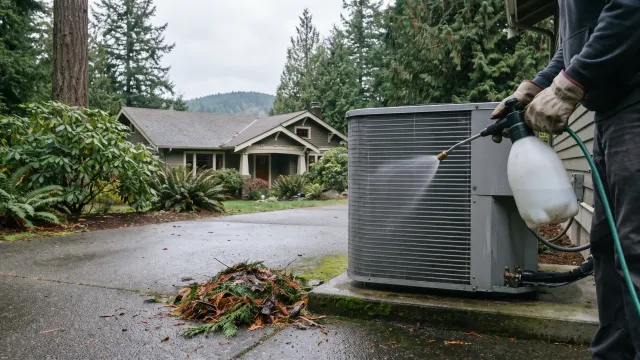
Heat Pump Maintenance
An hour of attention each year keeps the capacity you paid for and finds the cheap failures before they become the expensive ones.
Details →
Ready for a straight answer on your house?
Tell us what you have now and what you want it to do. We will tell you what fits, what it costs, and which rebates you actually qualify for — before anyone comes out.
Monday–Friday, 8:00 AM – 5:30 PM · Emergency calls answered 24/7