Skip to content
Bellingham Heating & Cooling — Bellingham's Energy Savings Team
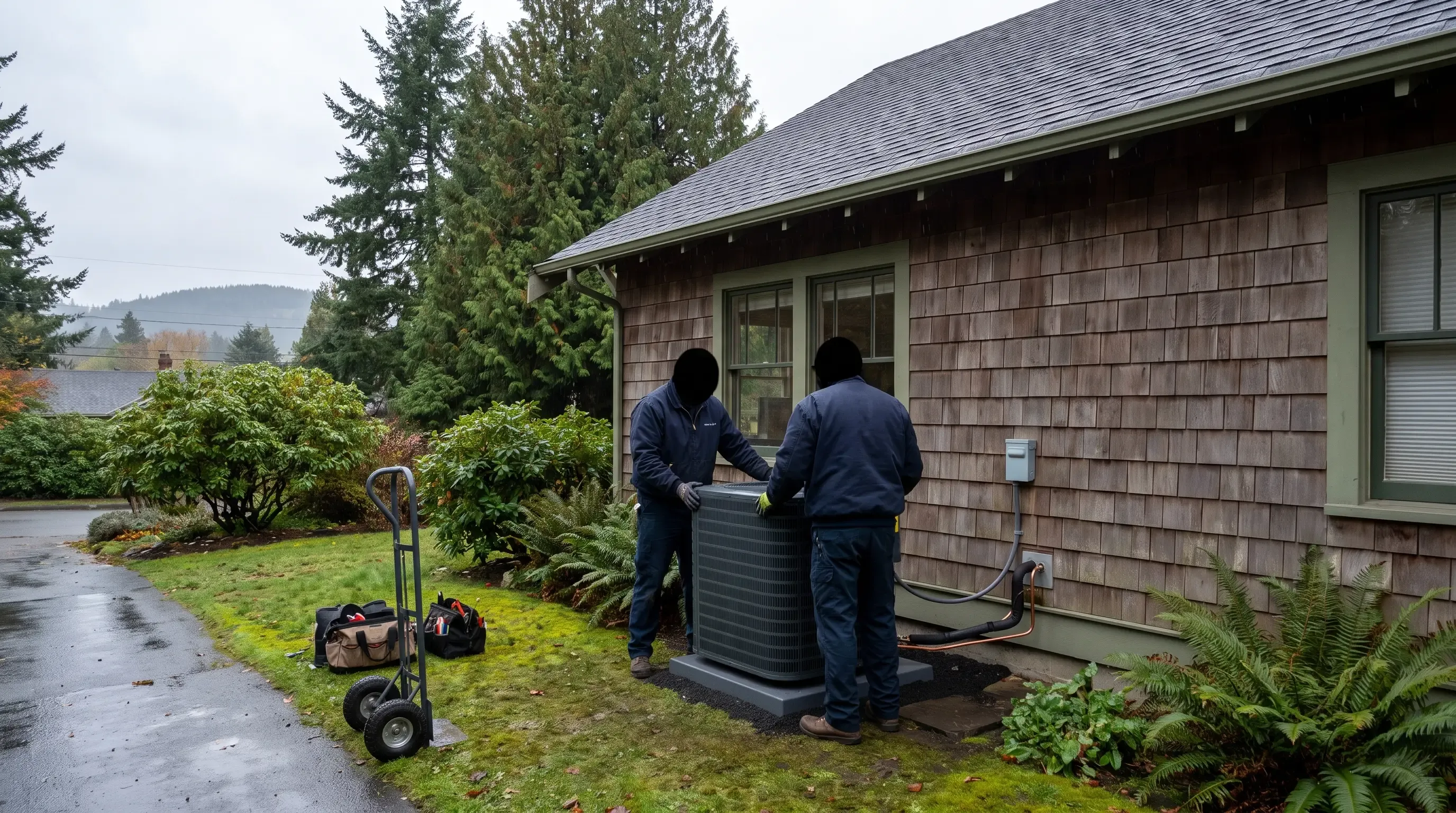
Outdoor heat pump condenser set on a raised pad with service clearance on the valve side

Installed price · verified 2026-09-04

What a heat pump costs per month to run in Bellingham

$29–$116 Derived, not quoted, and here is the derivation. PSE Schedule 7 residential energy charge effective 2026-01-29 is $0.141598 per kWh for the first 600 kWh and $0.161015 per kWh above that, plus a $7.49 basic charge; heating is marginal usage, so the $0.161015 tier applies. Seasonal COP is taken as 2.78, which is HSPF2 9.5 ÷ 3.412 — HSPF2 9.5 being PSE’s own Tier 3 midstream efficiency threshold. Applied to 500, 1,200 and 2,000 kWh of delivered heat per month: 500 ÷ 2.78 × $0.161015 = $29; 1,200 ÷ 2.78 × $0.161015 = $70; 2,000 ÷ 2.78 × $0.161015 = $116. Assumption stated openly: the heat-delivery figures are illustrative monthly loads, and the tariff energy charge is the base rate before PSE’s adjustment schedules, so your all-in cents per kWh will be somewhat higher., before rebates. Here is what decides where in that range your house lands.

Heat Pump Cost Per Month to Run in Bellingham — With the Maths in Bellingham

Derived, not quoted, and here is the derivation. PSE Schedule 7 residential energy charge effective 2026-01-29 is $0.141598 per kWh for the first 600 kWh and $0.161015 per kWh above that, plus a $7.49 basic charge; heating is marginal usage, so the $0.161015 tier applies. Seasonal COP is taken as 2.78, which is HSPF2 9.5 ÷ 3.412 — HSPF2 9.5 being PSE’s own Tier 3 midstream efficiency threshold. Applied to 500, 1,200 and 2,000 kWh of delivered heat per month: 500 ÷ 2.78 × $0.161015 = $29; 1,200 ÷ 2.78 × $0.161015 = $70; 2,000 ÷ 2.78 × $0.161015 = $116. Assumption stated openly: the heat-delivery figures are illustrative monthly loads, and the tariff energy charge is the base rate before PSE’s adjustment schedules, so your all-in cents per kWh will be somewhat higher.

Simple job
$29
Most homes
$70
Complex job
$116

Installed price before rebates — equipment, labour, materials, permit and startup. The federal §25C tax credit contributes $0 in 2026: it terminated for anything placed in service after December 31, 2025.

Range benchmarked 2026-09-04 against published local pricing. Your quote is fixed before work starts — no hourly surprises.

  • WA L&I #BELLIHC808NM Active registration — verify it with the state
  • $30,000 bonded Surety bond on file with L&I
  • $1,000,000 insured General liability coverage
  • Local since 2020 Owner-operated in Whatcom County
  • We pull the permit City of Bellingham or Whatcom County, and we meet the inspector

What moves your number

Most impactful first. These are the questions we ask on the phone, and they are the reason a range exists at all.

The electricity rate you actually pay
every cent per kWh moves a 700 kWh heating month by about $7
PSE’s Schedule 7 residential tariff effective January 29, 2026 charges $0.141598 per kWh for the first 600 kWh in a month and $0.161015 per kWh for everything above, on top of a $7.49 basic charge. Heating is the marginal load in winter, so the higher tier is the honest one to use. Those are base tariff energy charges before PSE’s adjustment schedules, which is why a bill divided by kWh comes out higher than the tariff line.
Coefficient of performance, which is the whole point of a heat pump
a COP of 2.78 cuts the cost of the same heat to 36% of baseboard
Baseboard electric heat is COP 1.0 by definition: one kWh in, one kWh of heat out. A heat pump moves heat rather than making it, so one kWh in yields several out. Using HSPF2 9.5 — PSE’s Tier 3 midstream threshold — divided by 3.412 gives a seasonal COP of 2.78, meaning heat costs $0.161015 ÷ 2.78 = 5.8 cents per kWh delivered instead of 16.1 cents. That is a 64% reduction on the same heat.
How cold it gets, and what that does to COP
the coldest mornings are the least efficient hours of the year
Bellingham’s heating design temperature is 19°F under WAC 51-11C-80100 Table C-1, colder than Seattle’s 24°F, and Glacier designs to 13°F. Efficiency falls as it gets colder, which is why seasonal figures beat single-point figures for budgeting. For the cold end, PSE’s own cold-climate threshold is instructive: a qualifying unit must deliver a COP of at least 1.75 at 5°F. Even on the worst morning of a Whatcom winter that is 1.75 units of heat per unit of electricity, against baseboard’s one.
How much heat your house needs in the first place
linear — halve the load, halve the bill
Nothing about a heat pump changes the physics of a leaky envelope. For scale, EIA reports Washington households averaging 955 kWh per month across all uses in 2024, and in an electrically heated Bellingham house the winter months sit well above that while the summer months sit below. Attic and floor insulation with PSE’s instant rebates — attic at $1.75 per sq ft up to $3,500, floor and wall at $2.50 per sq ft up to $5,000 — cut the load before you buy the equipment.
Auxiliary heat and how it is locked out
strip heat running unnecessarily can erase most of the saving
Electric resistance backup is COP 1.0, so every hour it runs is an hour at baseboard prices. This is where badly commissioned systems lose their savings: a thermostat that calls for emergency heat on a recovery from setback, or a control that never had its lockout set. PSE requires backup heat locked out by an outdoor sensor, recommended at 35°F or below, and the compressor lockout disabled or set to 0°F or below. Those settings are commissioning work, and they are worth checking on a system you already own.
Thermostat behaviour
deep setbacks can cost more than they save on a heat pump
A furnace recovers from a big setback with a short blast of expensive heat. A heat pump recovers slowly and, if pushed, by calling the strip heat, which is the expensive mode. Modest, steady setpoints usually beat aggressive scheduling here, which is the opposite of the advice most people carry over from a gas furnace.

What appears on a real quote

Line by line, the way we scope it. If a quote you are holding is a single lump sum, this is the list to ask them to break out.

Heat Pump Cost Per Month to Run in Bellingham — With the Maths quote line items and typical ranges in Bellingham, WA
Line item Typical range What it is
PSE residential energy charge, first 600 kWh per month $0.141598 per kWh PSE Schedule 7, effective 2026-01-29. Base tariff rate before adjustment schedules.
PSE residential energy charge, all kWh over 600 per month $0.161015 per kWh PSE Schedule 7. This is the marginal tier heating falls into.
PSE residential basic charge $7.49 per month, single phase PSE Schedule 7. Paid whether you heat with a heat pump or with baseboard.
Assumed seasonal COP 2.78 HSPF2 9.5 ÷ 3.412. HSPF2 9.5 is PSE’s Tier 3 midstream equipment threshold.
Cost of one kWh of delivered heat, heat pump 5.8 cents $0.161015 ÷ 2.78.
Cost of one kWh of delivered heat, electric baseboard 16.1 cents $0.161015 ÷ 1.0. Resistance heat is COP 1.0 by definition.
Cost of one kWh of delivered heat at PSE’s 5°F cold-climate floor 9.2 cents $0.161015 ÷ 1.75, using PSE’s minimum COP at 5°F. The worst case is still better than baseboard.
Washington household average, all electric uses, for scale 955 kWh per month EIA 2024 Table 5A. Not a heating figure; context for judging whether an estimate is plausible.

Line items are quoted against your house, not averaged. Your written quote is fixed before work starts.

Three worked examples

Same work, three different houses. The arithmetic runs from the installed price, through the programs that apply, to what you write a cheque for.

Shoulder month — October or April, 500 kWh of heat delivered

Installed price
Electric baseboard: 500 × $0.161015 = $81
Rebates applied
  • Heat pump at COP 2.78: 500 ÷ 2.78 = 180 kWh, × $0.161015 = $29
You pay
$29 for the heat pump, a $52 monthly saving

Arithmetic shown so you can substitute your own numbers. Change the COP or the rate and the answer moves proportionally.

Typical winter month — 1,200 kWh of heat delivered in a mid-sized Bellingham home

Installed price
Electric baseboard: 1,200 × $0.161015 = $193
Rebates applied
  • Heat pump at COP 2.78: 1,200 ÷ 2.78 = 432 kWh, × $0.161015 = $70
You pay
$70 for the heat pump, a $123 monthly saving

For scale, EIA puts the average Washington household at 955 kWh per month across all uses, so a 432 kWh heating draw is a plausible winter increment rather than a whole bill.

Cold January month — 2,000 kWh of heat delivered, several mornings near the 19°F design temperature

Installed price
Electric baseboard: 2,000 × $0.161015 = $322
Rebates applied
  • Heat pump at COP 2.78: 2,000 ÷ 2.78 = 719 kWh, × $0.161015 = $116
You pay
$116 for the heat pump, a $206 monthly saving

The real January figure sits a little above this because efficiency drops in the cold. Even at PSE’s minimum qualifying COP of 1.75 at 5°F, the same 2,000 kWh of heat costs $184 rather than $322, so the heat pump still wins on the worst day of the year.

No example includes a federal tax credit, because there is none to include for a 2026 install. The largest single line in most of these is Puget Sound Energy's $1,500 electric-resistance conversion rebate, which is contractor-gated — PSE requires the installer to be inside its network, so ask us to confirm status for your project before you count on it.

Rebates that come off this price

  • $1,500

    Available now

    $2,400 with PSE Efficiency Boost for income-qualified households.

    Paperwork:
    We file it
    Deadline:
    No published end date — tariffed and subject to change
    Verified:
    2026-09-04 · source
  • Raises other PSE rebates

    Income-qualified

    Heat pump $1,500 → $2,400 · heat pump water heater $1,000 → $1,100 · smart thermostat $75 → $175.

    Paperwork:
    We file it
    Deadline:
    Ongoing
    Verified:
    2026-09-04 · source
  • $0.20–$2.50 per sq ft

    Available now

    Attic R11-or-less → R49 $1.75/sq ft up to $3,500 · wall R0 → R13 $2.50/sq ft up to $5,000 · floor → R30 $2.50/sq ft up to $5,000 · air sealing $0.20/sq ft up to $400 each for attic and floor · duct sealing up to $1,000.

    Paperwork:
    We file it
    Deadline:
    No published end date
    Verified:
    2026-09-04 · source
  • Smart Thermostat Rebate

    Puget Sound Energy

    $75

    Available now

    $175 with Efficiency Boost.

    Bellingham note: This rebate requires a single-thermostat centralized system. A multi-zone ductless mini split controlled by handsets generally is not one, so do not assume it applies to a ductless project — confirm the specific model against PSE’s list first.

    Paperwork:
    You file it
    Deadline:
    Install and connect by December 31, 2026
    Verified:
    2026-09-04 · source

Every Bellingham rebate, with the source and the date we checked it →

Run your own numbers

A range, not a quote — and the arithmetic is shown so you can check it. Every band below is a published installed price, linked at the bottom.

Sources, all checked 2026-09-04: ductless by zone, ducted in Bellingham, local aggregator range, panel upgrade, dedicated circuit, heat pump water heater. Electrical work is performed and permitted by a licensed electrical contractor — we hold a general contractor registration, not an electrical one.

The work itself

Heat Pump Installation

One system that heats through a Bellingham winter and cools through a smoke-season August, sized to your house rather than to a chart.

See how we do it — process, permits, equipment and timeline →

Talk it through — (360) 592-3824

Heat Pump Cost Per Month to Run in Bellingham — With the Maths — questions we get asked

What does a heat pump cost per month to run in Bellingham?
Roughly $29 in a shoulder month, $70 in a typical winter month and $116 in a cold January, for the heating portion of your bill. That is derived from PSE’s Schedule 7 energy charge of $0.161015 per kWh above 600 kWh and a seasonal COP of 2.78, applied to 500, 1,200 and 2,000 kWh of delivered heat.
How does that compare with electric baseboard?
The same heat from baseboard costs $81, $193 and $322 in those three months, because resistance heat is COP 1.0 and every kWh you buy is one kWh of heat. A heat pump at COP 2.78 delivers the same heat for 36% of the electricity, which is a 64% reduction on the heating portion of the bill.
Where do your numbers come from?
Two sources and one stated assumption. The rate is PSE’s Schedule 7 residential tariff effective January 29, 2026: $0.141598 per kWh for the first 600 kWh, $0.161015 above, plus a $7.49 basic charge. The efficiency figure is HSPF2 9.5 — PSE’s Tier 3 midstream threshold — divided by 3.412 to give a seasonal COP of 2.78. The monthly heat-delivery figures of 500, 1,200 and 2,000 kWh are illustrative loads, stated as assumptions rather than measurements.
Will my actual bill match this?
Your heating cost will be in this neighbourhood and your total bill will be higher, for two reasons we would rather state than hide. The tariff energy charges above are base rates before PSE’s adjustment schedules, so your all-in cents per kWh is somewhat higher. And your bill includes everything else in the house: EIA puts the average Washington household at 955 kWh per month across all uses.
What happens on the coldest mornings?
Efficiency drops, and the heat pump still beats baseboard. PSE’s cold-climate threshold requires a COP of at least 1.75 at 5°F with rated capacity at 5°F of at least 70% of capacity at 47°F. At a COP of 1.75, heat costs 9.2 cents per kWh against baseboard’s 16.1 cents, and Bellingham’s design temperature of 19°F is well above 5°F anyway.
Does the backup heat wreck the savings?
It can, if it is set up badly. Electric resistance backup is COP 1.0, so every hour it runs costs baseboard prices. PSE requires backup locked out by an outdoor sensor, recommended at 35°F or below, and the compressor lockout disabled or set to 0°F or below. If you already have a heat pump and your winter bills look wrong, those settings are the first place to look.
Should I set the thermostat back at night?
Only modestly. Deep setbacks work well with a furnace and badly with a heat pump, because the recovery either takes hours or triggers the expensive strip heat. Steady setpoints with small overnight reductions generally cost less here, which surprises people coming from gas heat.
What reduces this number the most?
Insulation and air sealing, because they reduce the amount of heat you have to buy at all. PSE pays instant rebates of $1.75 per sq ft up to $3,500 for attic insulation, $2.50 per sq ft up to $5,000 for floor and wall, and $0.20 per sq ft for air sealing. Doing the envelope before sizing the equipment sometimes also buys you a smaller, cheaper heat pump.

Get the number for your house

A range tells you whether to keep reading. Tell us about the house and we will tell you which end of it you are at, what the rebates take off, and what the written quote will say.

Or call or text (360) 592-3824. Estimates carry the standard $89.99 trip charge, refunded as company credit when you accept the bid. We do not sell or share your details.

Range benchmarked 2026-09-04 against published local pricing · All published cost ranges

Ready for a straight answer on your house?

Tell us what you have now and what you want it to do. We will tell you what fits, what it costs, and which rebates you actually qualify for — before anyone comes out.

Monday–Friday, 8:00 AM – 5:30 PM · Emergency calls answered 24/7

Call now Text us