
Guide
Where to put the outdoor unit: siting a heat pump condenser in Bellingham
Airflow clearance, snow and leaf load, salt air, noise to the neighbour, setbacks and HOA review. The siting decisions that determine whether your heat pump lasts, made specific to Whatcom County.
- WA L&I #BELLIHC808NM Active registration — verify it with the state
- $30,000 bonded Surety bond on file with L&I
- $1,000,000 insured General liability coverage
- Local since 2020 Owner-operated in Whatcom County
- We pull the permit City of Bellingham or Whatcom County, and we meet the inspector
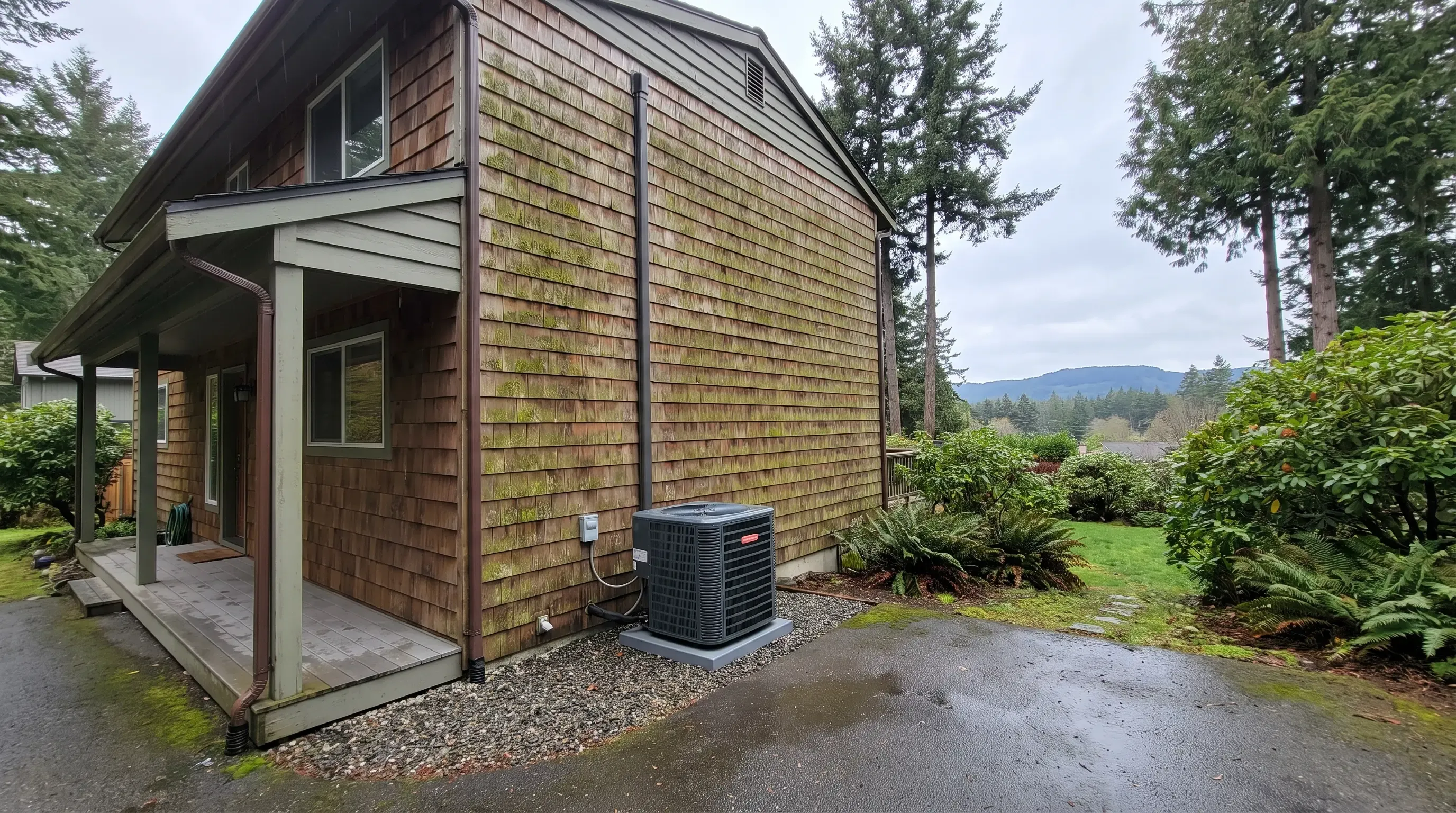
The outdoor unit location is decided in about four minutes on a site visit and then lives with you for fifteen years. Get it right and the unit breathes freely, drains properly, stays out of the leaf fall and the snow line, and does not annoy anybody. Get it wrong and you get a coil packed with fir needles by November, a defrost cycle standing in its own ice, or a complaint from the neighbour whose bedroom window is eight feet away.
Airflow clearance comes first
A heat pump outdoor unit is a heat exchanger with a fan. It needs to draw ambient air across the coil and discharge it somewhere it will not immediately re-enter. Every manufacturer publishes minimum clearances for the coil faces, the discharge side and the service access side, and those are minimums rather than targets.
The failure mode to avoid is recirculation: warm discharge air in cooling, or cold discharge air in heating, looping straight back into the intake. Tucking a unit into a narrow side-yard alcove between a house wall and a fence is the classic way to build that in, and it shows up as a system that never quite performs to spec in the weather that matters.
Service access is the clearance people skip. A technician needs room to remove a panel, get gauges on the service ports and get a meter into the electrical compartment. A unit wedged against a fence costs you money on every visit for the rest of its life.
Get it off the ground, and know why
In heating mode the outdoor coil runs below freezing and periodically defrosts, and the meltwater has to go somewhere. If the unit sits low, that water pools, refreezes and eventually builds an ice shelf under the coil that blocks airflow.
The fix is height and drainage. A pad or brackets that lift the unit clear of grade, a bed of drain rock beneath it, and no depression that holds water. In the foothills — Deming, Kendall, Maple Falls, Glacier — add height for snow, because a unit at grade in a valley that gets real snowfall will be buried at the exact moment you need it.
Wall brackets are a good answer on tight lots and where grade is a problem, and they are common on steep sites. They need solid structural attachment and vibration isolation, and they need to not put the unit outside a bedroom window one floor up.
Trees, needles and moss: the marine-climate coil killer
Bellingham is a city of mature Douglas fir, cedar and big-leaf maple, and everything those trees shed ends up in a heat pump coil. Fir needles are the worst offender because they thread into the fins and do not blow out, and moss grows on anything that stays damp, which in our winters is everything.
So the siting rule is: not directly under a conifer canopy, not under a roof valley that dumps needles and debris, and not in the spot where leaves drift and sit. If the only viable location is under trees, plan on more frequent coil cleaning and say so in the maintenance handover.
Avoid mounting directly under an unguttered eave, where roof runoff lands on the unit all winter. And leave yourself the physical access to actually clean the coil, because in Whatcom County that is the single highest-value maintenance task there is.
- Manufacturer clearances met on all coil faces, the discharge side and the service side
- No recirculation path: discharge air is not looping back into the intake
- Unit raised clear of grade on a level pad or structural brackets, with drain rock beneath
- Above the expected snow line for the elevation, with extra height in the foothills
- Out from under conifer canopy, roof valleys and unguttered eaves where debris collects
- Room to remove panels, reach service ports and open the electrical compartment
- Not directly outside a bedroom window, yours or the neighbour’s
- Setbacks confirmed for the jurisdiction, and HOA or design review approval in hand if applicable
- Lineset and condensate route walked and agreed, including where any exterior lineset cover runs
- Corrosion protection specified if the site is within salt-air reach of the water
Salt air changes the specification, not just the location
On the water — Fairhaven, Edgemoor, Birch Bay, Blaine, Point Roberts, Lummi Island — salt air can shorten equipment life by two to four years without corrosion protection. That is not a marketing figure; it is the reason coastal-duty coil coatings and stainless fasteners exist.
Siting helps but does not solve it. Putting the unit on the leeward side of the house, away from direct exposure to onshore wind and spray, buys you something. So does rinsing the coil with fresh water as part of routine maintenance, which is a genuinely useful habit on a waterfront property and pointless three miles inland.
The real answer on a coastal site is to specify the corrosion package at purchase. Retrofitting corrosion protection is not a thing; you either bought it or you did not.
Noise, neighbours and the eight-foot problem
A modern inverter-driven outdoor unit running at part load is quiet. The same unit at full output on a 19°F morning, or in a defrost cycle, is not silent, and the distance to the nearest window is what decides whether anyone minds.
Bellingham’s older neighbourhoods have narrow side yards, and an infill lot can put your side yard eight feet from someone else’s bedroom. Think about that before install day rather than after the first cold snap.
Practical mitigations: choose the elevation with the most distance to a habitable window, and avoid a location that reflects sound off a hard wall back toward a neighbour. Use isolation pads or grommets to keep vibration out of the structure, and never bolt a unit directly to a shared wall or a bedroom wall. A properly sized system also helps, because an oversized unit spends more of its life at high output.
Setbacks, review boards and who says yes
Mechanical equipment placement is subject to the zoning setbacks of whichever jurisdiction you are in, and in Whatcom County that is genuinely ambiguous at a lot of addresses. Many mailing addresses that read "Bellingham" are in unincorporated Whatcom County, which changes both the permit authority and the applicable setbacks.
Inside city limits the permit runs through City of Bellingham Building Services; outside it, Whatcom County Planning and Development Services. We pull the mechanical permit and meet the inspector either way, and we confirm the jurisdiction before we design the layout rather than after.
Private review is the other gate. Sudden Valley is an HOA community at Lake Whatcom with architectural review, and Lake Whatcom is Bellingham’s drinking-water reservoir, which constrains site work in the watershed. Several condominium and townhouse associations elsewhere in the county also require approval for exterior equipment. Where review applies, the practical consequence is usually one condenser rather than three, in a pre-approved location.
Questions Bellingham homeowners actually ask
- Can the outdoor unit go under the deck or in a crawl access well?
- Almost never. Both create recirculation, both collect debris and standing water, and both make service access miserable. If the only apparent location is enclosed, the better answer is usually wall brackets on an exposed elevation or a different corner of the house, even if the lineset run gets longer.
- How high off the ground should it be?
- High enough that defrost meltwater drains away rather than pooling and refreezing, and in the foothills high enough to stay above the snow. There is no single number because it depends on your grade, your drainage and your elevation, which is exactly why it gets decided on site with a tape rather than on the phone.
- Will it bother my neighbour?
- It depends almost entirely on distance to the nearest habitable window and whether the unit is bolted to something that transmits vibration. On a tight infill lot, tell us where the neighbour’s bedroom is and we will site around it. Isolation pads and a correctly sized system that runs at part load do most of the rest.
- Do I need HOA approval?
- If you are in Sudden Valley, assume yes — it has architectural review. Several other associations in the county do too. Get the approval before the equipment is ordered, because the approved location sometimes forces a single-condenser design that changes the whole equipment selection.
- Does a longer lineset hurt performance?
- Yes, past a point. Manufacturers publish maximum total line length and maximum vertical separation, and capacity falls as runs get long. A siting decision that adds thirty feet of lineset to gain ten feet of distance from a bedroom window is usually still worth it; one that pushes the system to its published limit is not.
Have us apply this to your house
Reading it is one thing. Send us the address, the panel size and what you heat with now, and we will tell you what it means for your project.
Ready for a straight answer on your house?
Tell us what you have now and what you want it to do. We will tell you what fits, what it costs, and which rebates you actually qualify for — before anyone comes out.
Monday–Friday, 8:00 AM – 5:30 PM · Emergency calls answered 24/7