
Whatcom County, Washington
Heat Pump Maintenance in Geneva, WA
An hour of attention each year keeps the capacity you paid for and finds the cheap failures before they become the expensive ones.
- 19°F heating design temperature (nearest code station: Bellingham 2 N)
- Electricity: Puget Sound Energy
- Gas: None — propane, oil or all-electric
- Permits: Whatcom County Planning & Development Services
- WA L&I #BELLIHC808NM Active registration — verify it with the state
- $30,000 bonded Surety bond on file with L&I
- $1,000,000 insured General liability coverage
- Local since 2020 Owner-operated in Whatcom County
- We pull the permit City of Bellingham or Whatcom County, and we meet the inspector
What heat pump maintenance means in Geneva
Geneva is the older, non-HOA side of Lake Whatcom: 1940s–60s lake cabins that became year-round homes, 1970s split-levels up the hillside off Lakeway, and newer custom builds squeezed onto the remaining lots. Most were heated electrically or with a wood stove, and many have gained a room or a daylight basement since without the heating ever being resized. Steep driveways and long, narrow lots mean lineset runs here are routinely longer than a system’s factory charge assumes.
Geneva shares Bellingham’s 19°F design temperature but not its exposure — it sits in the bowl at the north end of Lake Whatcom, where cold air pools on still nights and the lake keeps humidity high. Douglas fir cover shades roofs and outdoor units most of the day, which slows drying and lets moss and needles build up in the coil fins. Snow lingers on the upper Lakeway grades several days longer than it does downtown.
The install wrinkle here
Geneva is unincorporated Whatcom County, so the permit and inspection come from the county Permit Center even though the address reads Bellingham. Lake Whatcom is the city’s drinking-water source, and watershed rules constrain excavation and condensate handling on lakeside parcels. There is no gas main, so existing heat is electric, propane or oil — and if there is still an oil tank in the crawlspace, decommissioning it needs to be planned rather than discovered on install day.
Your utilities decide your rebates
Geneva takes its electricity from Puget Sound Energy, which is what makes the PSE heat pump rebates reachable at all — PSE serves every address in Whatcom County. There is no natural gas main to most of Geneva, so homes here run on propane, oil, wood, or electric resistance heat. That is actually good news for rebates: PSE's $1,500 conversion rebate pays specifically to replace electric-resistance heat, and it rises to $2,400 for income-qualified households.
Who issues the permit
Mechanical work in Geneva is permitted through Whatcom County Planning & Development Services via its Whatcom County Permit Center application, online or in person. We pull the permit and meet the inspector. Worth knowing: a great many mailing addresses that read "Bellingham" are physically in unincorporated Whatcom County, which changes the permitting authority. We check the parcel before we file.
Getting there
We work out of Larrabee Avenue in south Bellingham, roughly 12 minutes from Geneva — near Geneva Elementary School and Lake Whatcom. We also cover Geneva, the Lakeway Drive corridor, Cable Street, the Lake Whatcom north shore.
How a Geneva job runs
-
Ask what the system has been doing
Before touching anything we ask about run times, auxiliary heat, noises, smells, and whether any room has drifted from the others. Those answers decide where we spend the visit. A system that has been fine for a year gets a different hour than one that has been quietly running its strips since November.
Your part: Note anything odd during the year, including the month it started. Seasonal timing is a real diagnostic clue.
-
Airflow first: filters, blower wheel, coil
Airflow problems cause more heat pump complaints than refrigerant does. We check and replace filters, inspect and clean the indoor coil, and on ductless systems clean the blower wheel and drain pan properly rather than spraying the visible louvres. That wheel is where the mildew smell in a damp house lives, and cleaning it is the most valuable thing a mini split gets each year.
Your part: Tell us the filter size you buy, or ask us to write it down so you are not guessing at the hardware store.
-
Wash and inspect the outdoor unit
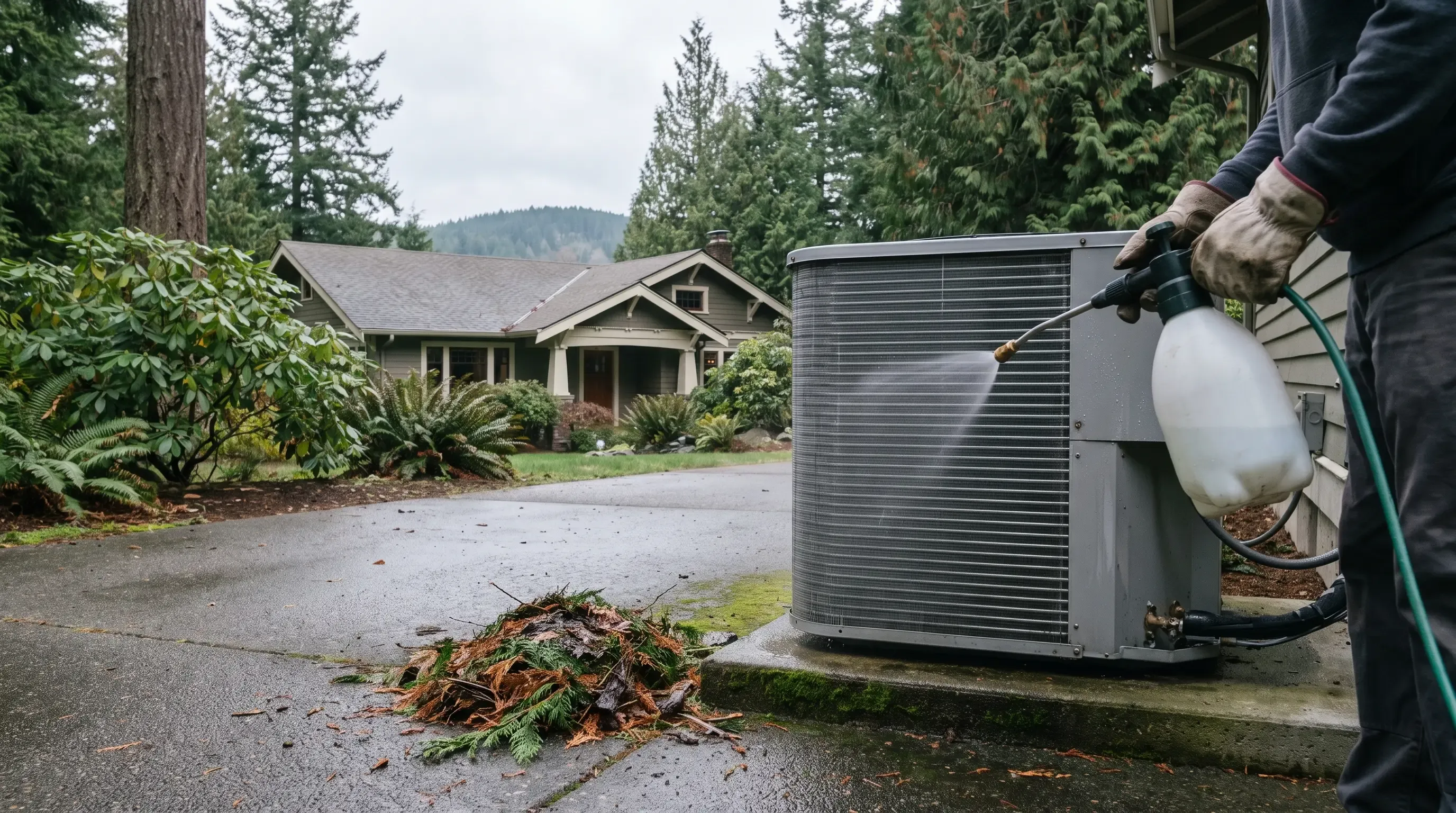
The outdoor coil gets rinsed clean of fir needles, cottonwood fluff and, near saltwater, the salt film that corrodes fins and cabinet fasteners. We check clearances, the pad and grade so meltwater drains away rather than back into the base, and look for the early corrosion that shows up first on coastal installs.
Your part: Cut back shrubs and stacked firewood to give the unit clearance on all sides. It is the one maintenance job that is genuinely yours.
-
Verify charge and check the electrical side
We confirm the refrigerant charge by the manufacturer’s method, taking superheat and subcool readings where the equipment calls for them, rather than adding refrigerant on principle. Capacitors are tested against their rating, contactors inspected for pitting, amp draw compared with nameplate, and the condensate path and float switch verified. A weak capacitor is a ten-minute part now and a no-heat call in January.
-
Prove defrost and the backup heat staging
In a 19°F design climate the defrost cycle and the auxiliary heat logic are what decide your winter bill. We force a defrost cycle to confirm it initiates and terminates properly. Then we check that the outdoor lockout for strip heat is still set at or below 35°F, and that the compressor is not being locked out early by a thermostat default. Settings drift when thermostats are replaced or reset.
-
Leave you the numbers and a realistic schedule
You get the measured values, what changed, and what is likely to need attention next. We recommend once a year, in autumn before the heating season, with a second airflow-focused visit in spring for households that run cooling hard or want filtration ready before wildfire smoke season. We do not sell a plan you do not need on a two-year-old system.
Your part: Keep the service sheets together; documented annual maintenance is what manufacturers ask for when a warranty claim comes up.
Heat Pump Maintenance questions from Geneva
- How often should heat pump maintenance be done?
- Once a year, in autumn before the heating season. A heat pump runs in both seasons, so it accumulates roughly twice the hours of a furnace, and here the heating hours dominate. Ductless systems benefit from a second look if you cook heavily, have pets, or run them hard for cooling.
- Is heat pump maintenance really worth the money?
- Yes, mostly because of airflow and capacitors. A loaded filter or a fouled blower wheel costs you capacity exactly when the outdoor temperature is near the design point. A weak capacitor is a cheap part on a scheduled visit and an emergency call in a cold snap. It is also what manufacturers point to when a warranty claim is made.
- What do you actually do during a tune-up?
- Airflow, cleaning, verification and settings. Filters and indoor coil, blower wheel and drain pan on ductless, the outdoor coil washed, charge verified by superheat and subcool rather than topped off, capacitors and contactors tested, amp draw compared with the nameplate, a forced defrost cycle, and a check that the auxiliary-heat lockout is still where it should be. You get the readings, not just a sticker.
- Do I need annual maintenance to keep my warranty?
- Manufacturers generally require documented annual maintenance as a condition of honouring a compressor or parts claim, so keep the paperwork. Registration matters too: many warranties drop from ten years to five if the equipment was never registered within the window after installation. If you inherited a system with the house, it is worth finding out where it stands before something fails.
- What maintenance can I do myself?
- Three things, and they are the three that matter most day to day: change or wash the filters on schedule, keep two to three feet of clearance around the outdoor unit, and make sure meltwater and condensate drain away from the base rather than pooling under it. Leave the sealed refrigerant system, the electrical components and the blower wheel to a technician, since two of those are hazardous and the third is easy to damage.
- My mini split smells musty when it starts. Can that be fixed?
- Yes, and it is one of the most common ductless complaints in a damp marine climate. The smell comes from biological growth on the blower wheel, the coil and the drain pan, and the wheel has to be removed or properly cleaned in place rather than sprayed through the louvres. Once it is clean, running fan-only or dry mode for a while after cooling season keeps the wheel from staying wet.
- When should I schedule, and does wildfire smoke change the answer?
- Autumn is the standard slot, before the heating season and before the cold-snap rush. If air quality matters to you, book a spring or early-summer visit as well so the filtration is sorted before the late-summer smoke episodes rather than during one. A ductless head with a clean filter is far more useful in smoke season than a window unit and a fan.
- Does maintenance qualify for any PSE rebate?
- No. PSE’s heat pump incentives pay for installing qualifying new equipment, not for servicing what you already own. What maintenance affects is whether that equipment still delivers the efficiency the rebate was based on.
- Will you maintain a system your company did not install?
- Yes, that is most of this work. We service ducted heat pumps and ductless systems from the major manufacturers and older equipment as well. On a first visit to an unfamiliar system we spend a little longer, because we are establishing a baseline of pressures, amp draws and settings that makes every future visit faster and more useful.
- Should I cover my outdoor unit in the winter?
- No. A heat pump runs in winter, so covering it blocks the airflow it needs and traps moisture against the coil and the electrical compartment. What helps instead is keeping the top and sides clear of leaves and snow, making sure the base drains, and trimming the shrubs or firewood stack that has crept in over the summer.
Get a Geneva estimate
Tell us your address or ZIP — 98229 are all in our regular route.
Before you decide
- Question How long does a heat pump last in a marine climate?
- Question Will a heat pump lower my electric bill?
- Guide Heat pump maintenance schedule for a marine climate
- Troubleshooting Heat pump runs constantly and never shuts off
- Troubleshooting Heat pump or mini split smells bad
- Troubleshooting Mini split has weak airflow
- Troubleshooting Winter electric bill is much higher than expected
Ready for a straight answer on your house?
Tell us what you have now and what you want it to do. We will tell you what fits, what it costs, and which rebates you actually qualify for — before anyone comes out.
Monday–Friday, 8:00 AM – 5:30 PM · Emergency calls answered 24/7