
Answers
Can I install a mini split myself?
You can do the mounting, coring and routing. Refrigerant work is federally regulated and the electrical is a licensed trade.
The short answer
Partly, and we will meet you where you stop. Mounting, coring the wall and routing lines are genuinely homeowner-doable. Refrigerant handling is federally regulated under EPA Section 608, the electrical circuit is a licensed trade, and the mechanical permit still applies. We sell DIY kits and commission them properly, which an unusual thing for a contractor to offer.
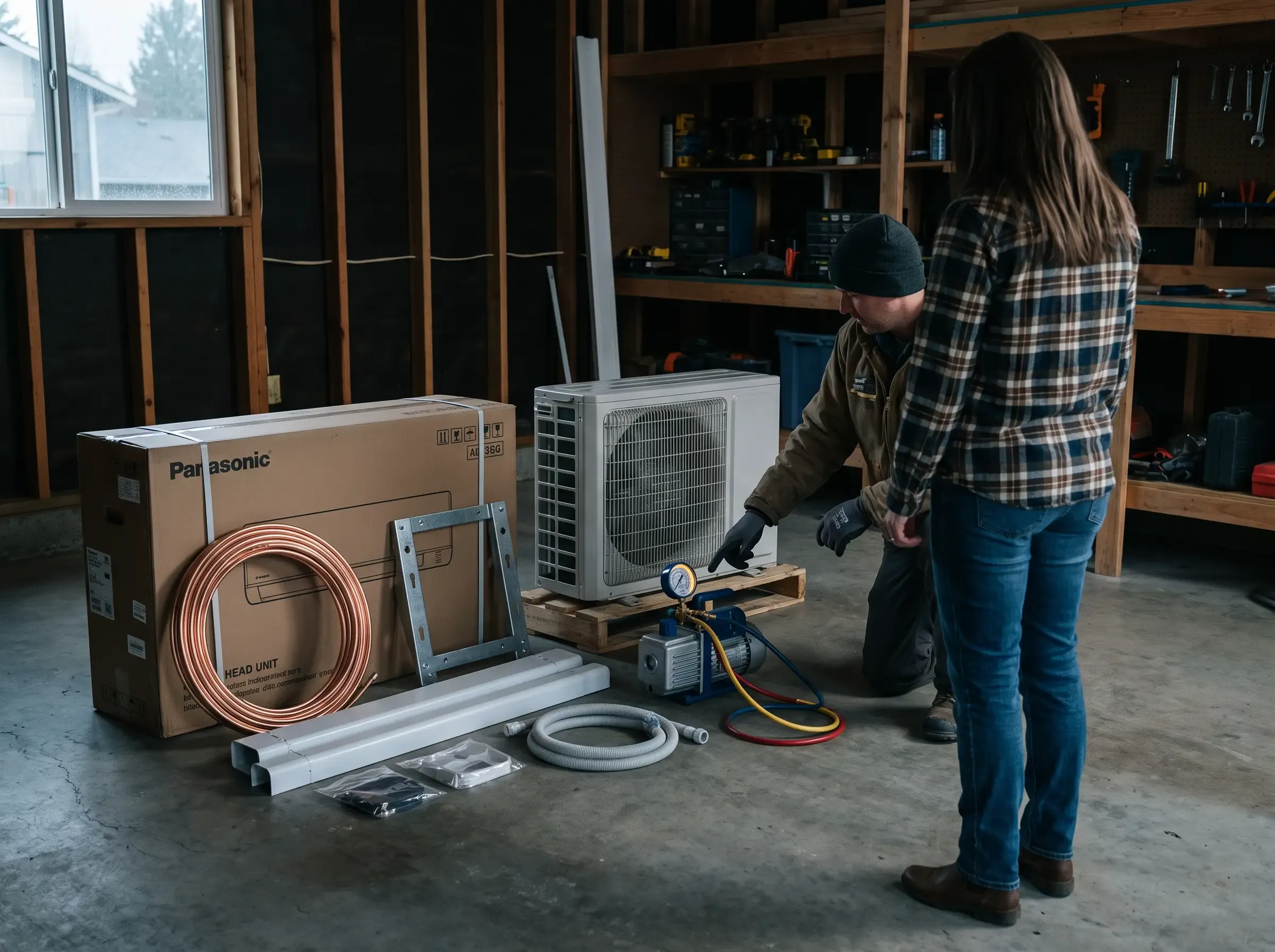
What you can realistically do yourself
Set the wall bracket or pad, hang the indoor mounting plate level, core the wall penetration and slope it outward for condensate, and route the lineset and drain along the exterior. That is careful, physical, unglamorous work and there is no reason a competent homeowner cannot do it. Doing it well saves you real labor cost on a job where labor is most of the bill.
What requires tools you do not own
A proper commissioning needs a nitrogen pressure test to find leaks before refrigerant goes in, and a vacuum pump with a micron gauge to pull moisture and non-condensables out of the lines. It also needs a torque wrench for flare fittings and a manifold and scale to weigh in any charge adjustment for lineset length. A guess-and-hope charge is the most common way a DIY mini split dies early, and it usually shows up as a compressor failure two winters later.
Refrigerant and electrical are not optional rules
EPA Section 608 regulates the handling of refrigerants and requires certification to open a sealed refrigerant circuit; the requirement and its details are published at epa.gov, and it applies regardless of who bought the equipment. The dedicated circuit, disconnect and any panel work are performed by a licensed electrical contractor, not by us and not by you. And a mechanical permit is still required, which is worth knowing before the inspector meets your work.
The honest trade-off against the PSE rebate
PSE’s conversion rebate requires installation by a PSE Trade Ally or Recommended Energy Professional and explicitly excludes do-it-yourself installs. So the DIY path can save you labor and cost you $1,500, or $2,400 with Efficiency Boost. Run that arithmetic for your own project before you buy a kit; sometimes DIY still wins, and sometimes it plainly does not. We will tell you which, and we would rather you end up with a working system than pay us for labor you could do.
Read next
The pages that carry the detail behind this answer.
Get this answered for your house
Tell us what you have now and what you want it to do. We will tell you what fits, what it costs, and which rebates actually apply.
Ready for a straight answer on your house?
Tell us what you have now and what you want it to do. We will tell you what fits, what it costs, and which rebates you actually qualify for — before anyone comes out.
Monday–Friday, 8:00 AM – 5:30 PM · Emergency calls answered 24/7