
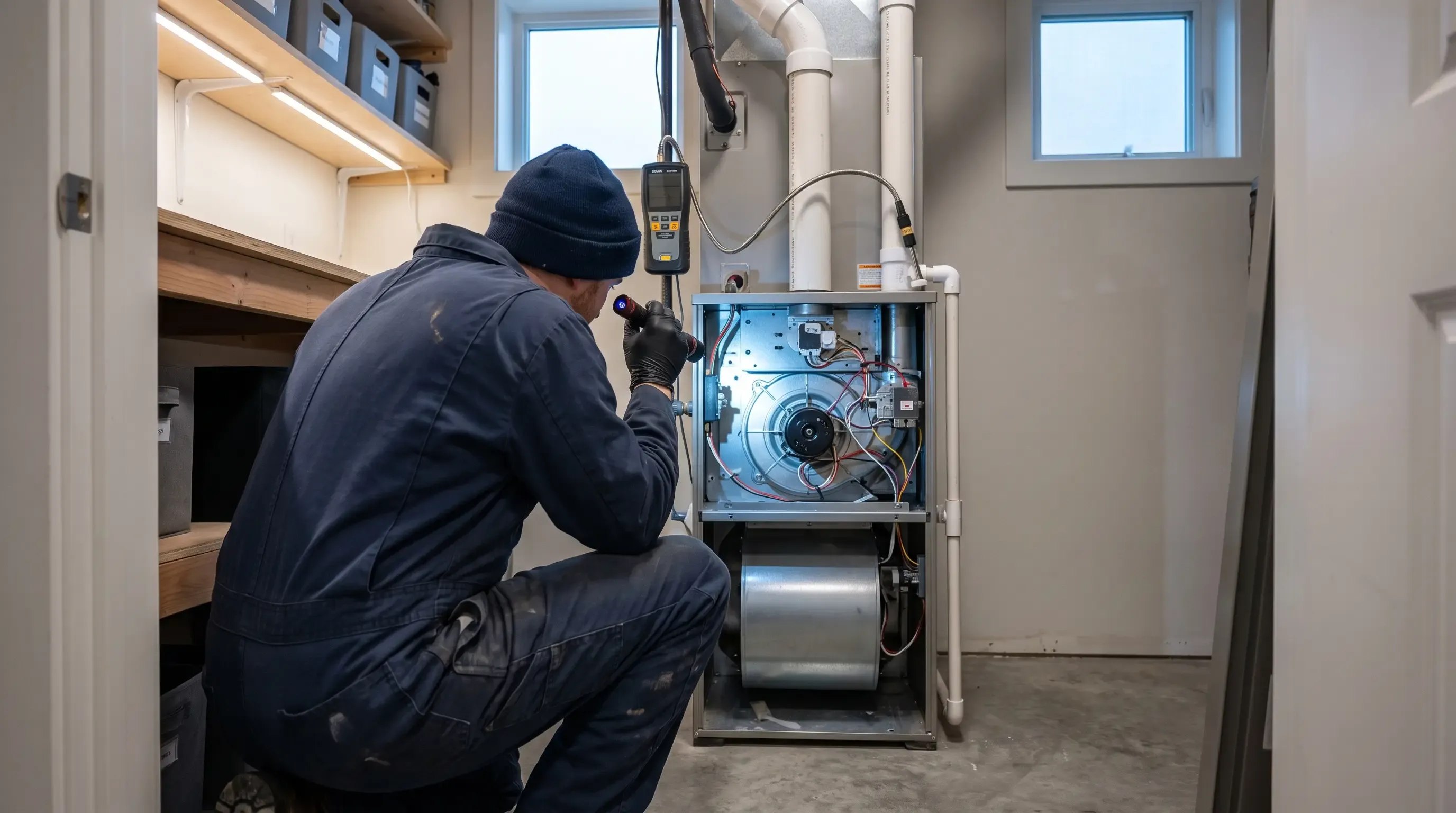
furnace troubleshooting
Furnace will not ignite
What it probably is, what you can safely check yourself, and the point where it becomes our job.
Do not wait this one out. Shut the system down and phone us — running it in this state usually turns a repair into a replacement.
What is most likely going on
A furnace that cycles the inducer and then gives up is almost always a failed hot-surface ignitor, a dirty flame sensor, or a pressure switch held open by a blocked flue or condensate line. None of those are homeowner repairs, but a few checks tell us which to expect.
Likely causes, most common first
- 1
Failed hot-surface ignitor
The ignitor is a fragile silicon carbide element that fails from age and thermal cycling, and it is one of the most frequently replaced furnace parts. You will hear the sequence run and hear the gas valve not open, or open and immediately shut. It is a routine part swap for a technician with the correct component.
- 2
Dirty flame sensor
The flame sensor proves flame to the control board, and an oxide film on the rod makes the board see no flame, so it shuts the gas valve within seconds. The classic symptom is lighting, running briefly, then dropping out, over and over. Cleaning it is quick, and it belongs inside a burner compartment nobody should be opening themselves.
- 3
Pressure switch open from a blocked flue or condensate line
The furnace will not attempt ignition until it proves draft. A bird nest in a sidewall vent, a screen iced over during a cold snap, or a plugged condensate trap on a high-efficiency unit all hold that switch open. Whatcom County wind and wet snow make blocked intake and exhaust terminations a genuinely seasonal cause.
- 4
No gas supply or a closed valve
A shut-off valve left closed after other work, a propane tank that has run out, or a utility interruption produces a furnace that tries perfectly and never lights. On propane out in the county, checking the tank gauge before calling anyone is worth the walk.
- 5
Control board or transformer failure
If nothing at all happens on a call for heat, no inducer, no clicks, the fault is more likely power, a blown low-voltage fuse, a transformer, or the board itself. A furnace door switch left open by a filter change also produces total silence and is worth ruling out first.
What you can safely check yourself
Work down the list before you book anything. Plenty of calls end here, and we would rather you keep the money.
- Confirm the furnace switch and the breaker are on, and that the service panel door on the furnace is fully closed so the door switch engages.
- Replace the filter if it is dirty, since restricted airflow trips limits and interrupts the ignition sequence.
- Confirm the thermostat is set to Heat with a setpoint above room temperature, and replace its batteries if it has them.
- Look at the outdoor intake and exhaust terminations for a nest, debris, ice or snow blocking them, and clear what you can reach safely.
- On propane, check the tank gauge; on natural gas, check whether other gas appliances in the house are working.
What is deliberately not on that list
Nothing above involves refrigerant, gas piping, or opening a live electrical panel. Refrigerant work is federally regulated and needs recovery equipment. Gas work done wrong kills people. An energised panel turns a $300 repair into a hospital visit. Electrical work on the circuit itself is done by a licensed electrical contractor. If a step you have read elsewhere involves any of those three, stop and call instead.
When to call us
Call now if the furnace tries and fails repeatedly, and stop resetting it after two attempts, because repeated ignition attempts on an unresolved fault are not something to keep forcing. Never open the burner compartment yourself. Emergency calls are answered 24/7 at (360) 592-3824. If you smell gas, leave the building first and call your gas utility from outside.
Monday–Friday, 8:00 AM – 5:30 PM · Emergency calls answered 24/7
Tell us what it is doing
Describe the symptom and we will tell you what it takes to fix, what it is likely to cost, and whether it is worth fixing at all.
Monday–Friday, 8:00 AM – 5:30 PM · Emergency calls answered 24/7