
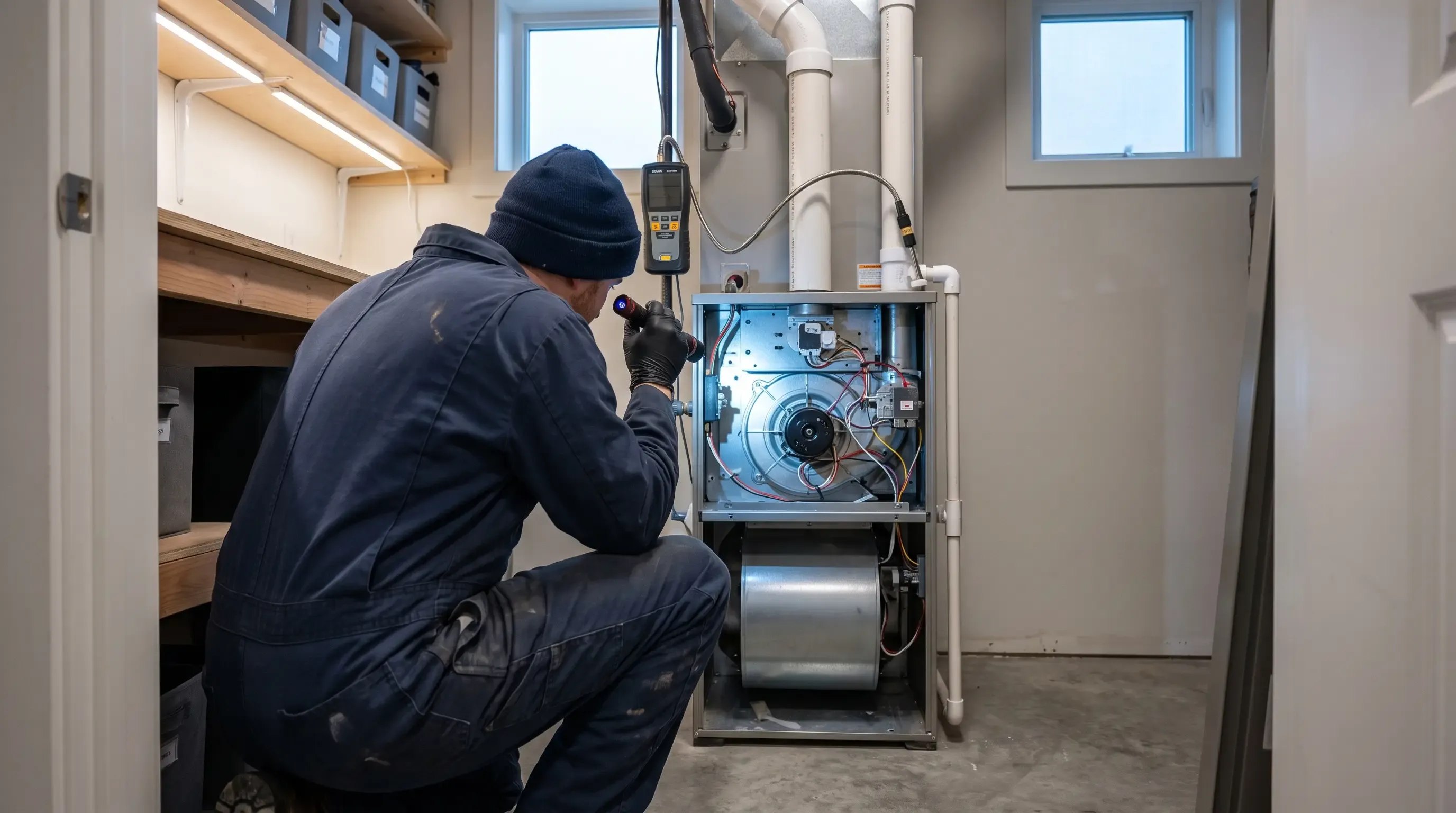
furnace troubleshooting
Furnace starts and stops every few minutes
What it probably is, what you can safely check yourself, and the point where it becomes our job.
It is still running, so you have a few days. It is not going to fix itself, and the part that failed rarely fails alone.
What is most likely going on
Short cycling means the burner is cut before the house is satisfied. The usual causes are overheating on the high limit, a flame-proof failure, or a furnace too large for the load, and all three shorten the life of the heat exchanger.
Likely causes, most common first
- 1
High limit trip from restricted airflow
A blocked filter, undersized or crushed return ducting, or closed registers let the heat exchanger climb until the limit opens. The furnace runs three or four minutes, quits, cools, and starts again. In older Bellingham houses with retrofitted ductwork in a tight crawlspace, undersized returns are a recurring cause.
- 2
Flame sensor or ignition control dropping the burner
A furnace that lights and then loses flame proof will retry on a fixed schedule, which looks identical to short cycling from the hallway. The difference is audible: you hear ignition each time rather than a long run that ends early. Cleaning or replacing the sensor is straightforward service work.
- 3
Oversized furnace
A furnace with far more output than the house needs satisfies the thermostat quickly and shuts down, then repeats, never reaching steady-state efficiency. Replacement furnaces have historically been sized by rule of thumb rather than by load calculation, which is how a modest bungalow ends up with a very large appliance. It is a design problem, not a settings problem.
- 4
Thermostat placement or differential
A thermostat in sunlight, above a woodstove, or beside a supply register reads a temperature the house does not have and cuts the call early. A differential set too tight does the same. These are cheap to correct and worth eliminating before anyone talks about equipment.
- 5
Draft or condensate fault tripping mid-cycle
A partially blocked flue, a plugged condensate trap, or a marginal inducer can open the pressure switch part way through a run. That produces a repeatable cycle length, which is useful information, so note how many minutes it runs before quitting.
What you can safely check yourself
Work down the list before you book anything. Plenty of calls end here, and we would rather you keep the money.
- Replace the filter and confirm every supply register and return grille in the house is open and unobstructed.
- Time the cycles and note how many minutes of run and rest, and whether you hear ignition at the start of each.
- Note the thermostat location and anything nearby that could bias it: sun, a stove, a register, an exterior wall.
- Confirm the thermostat fan setting is Auto and the mode is Heat.
- Check the vent terminations outside for blockage from snow, ice or nesting material.
What is deliberately not on that list
Nothing above involves refrigerant, gas piping, or opening a live electrical panel. Refrigerant work is federally regulated and needs recovery equipment. Gas work done wrong kills people. An energised panel turns a $300 repair into a hospital visit. Electrical work on the circuit itself is done by a licensed electrical contractor. If a step you have read elsewhere involves any of those three, stop and call instead.
When to call us
Call us if cycles stay short after a filter change and register check, especially if you hear ignition on every cycle. Repeated limit trips stress the heat exchanger and that is the expensive part of a furnace. Reach us at (360) 592-3824.
Monday–Friday, 8:00 AM – 5:30 PM · Emergency calls answered 24/7
Tell us what it is doing
Describe the symptom and we will tell you what it takes to fix, what it is likely to cost, and whether it is worth fixing at all.
Monday–Friday, 8:00 AM – 5:30 PM · Emergency calls answered 24/7