
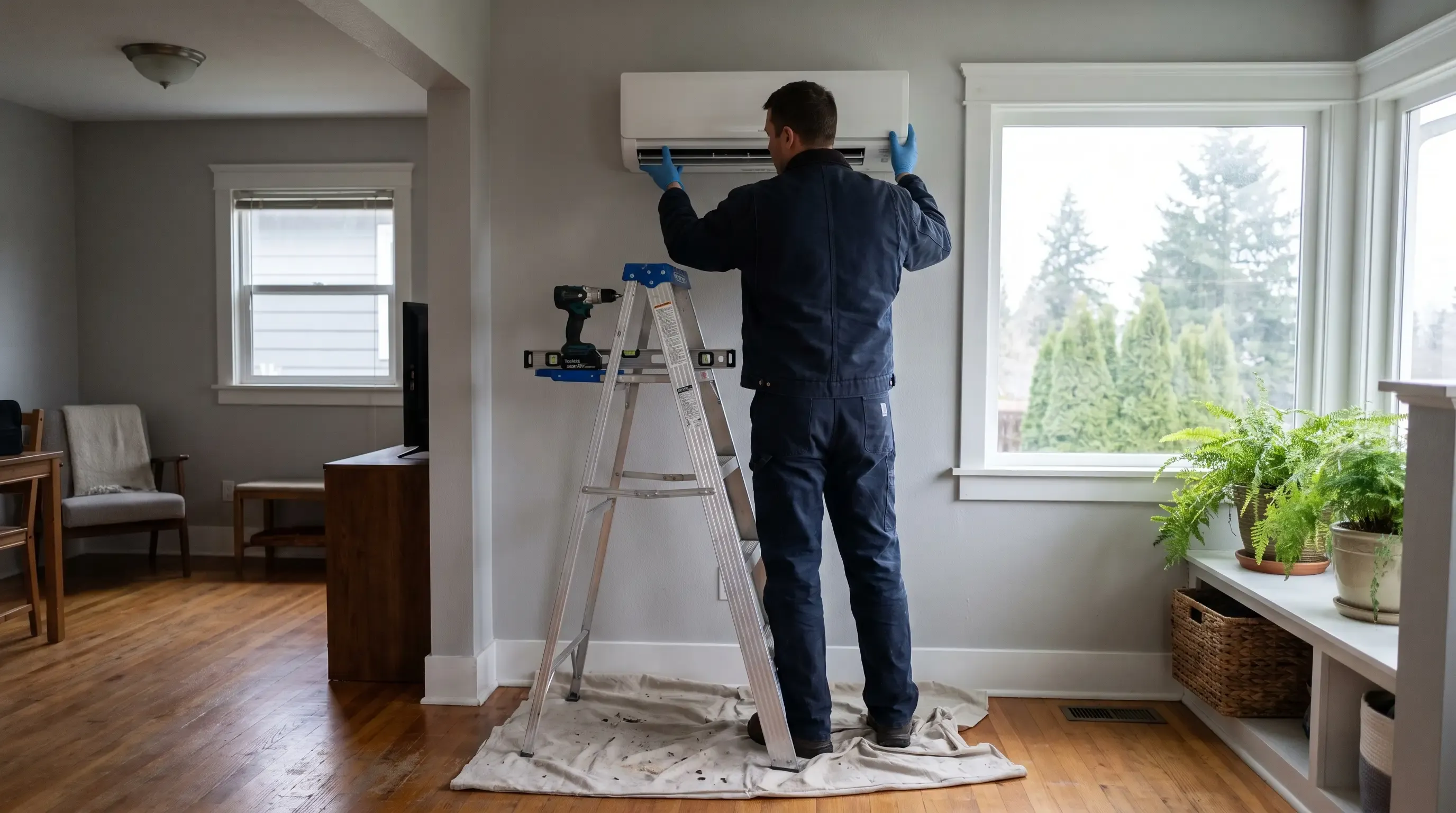
mini split troubleshooting
Mini split is not responding to the remote
What it probably is, what you can safely check yourself, and the point where it becomes our job.
Nothing is at risk today. Worth solving before the next cold snap, when everyone else is calling too.
What is most likely going on
Start with the remote, because that is where the fault usually is: dead batteries, an infrared emitter that needs line of sight to the head, or a child-lock or timer setting nobody meant to enable. If the head responds to its own manual button, the equipment is fine and the remote is the problem.
Likely causes, most common first
- 1
Dead or corroded remote batteries
Infrared remotes lose range before they lose function entirely, so the first symptom is having to stand closer, then having to aim carefully. Battery contacts also corrode in a damp Bellingham house, especially in a garage or basement space. Fresh alkaline batteries and a clean contact solve a large share of these calls.
- 2
Blocked line of sight to the indoor head
These remotes are infrared, not radio, so the signal needs an unobstructed path to the receiver window on the head. A new bookshelf, a tall plant, an open door, or bright afternoon sun washing across the receiver can all defeat it. You should hear a confirmation beep from the head when a command lands.
- 3
Child lock, timer, or a scheduled program is active
Most heads support a lock function and one or more timers, and both are easy to enable by accident and hard to notice. A unit that ignores every command but shows a small lock or clock symbol on the display is telling you exactly what happened. The manufacturer’s manual has the specific button combination to clear it.
- 4
The unit is refusing a mode rather than ignoring you
On a multi-zone system, all heads share one outdoor unit and cannot run in opposite modes, so a head asked to cool while another is heating will accept the command and do nothing. This confuses people every spring and fall. It is a design constraint of shared-circuit multi-splits, not a fault.
- 5
Receiver board or control fault in the head
If the manual button on the head also does nothing and the unit has power, the fault is in the indoor unit’s control or receiver rather than in the remote. That is a service call, and it is worth confirming power and the breaker first so we are not driving out for a tripped circuit.
What you can safely check yourself
Work down the list before you book anything. Plenty of calls end here, and we would rather you keep the money.
- Put fresh batteries in the remote and check the contacts for corrosion.
- Stand within a few feet of the head, aim at the receiver window, and listen for the confirmation beep.
- Look for a lock, timer or clock symbol on the remote display and clear it using the manual for your model.
- Press the manual on/off button on the indoor head itself; if it runs, the remote is your problem.
- Check the breaker for the system and confirm the disconnect at the outdoor unit is on.
What is deliberately not on that list
Nothing above involves refrigerant, gas piping, or opening a live electrical panel. Refrigerant work is federally regulated and needs recovery equipment. Gas work done wrong kills people. An energised panel turns a $300 repair into a hospital visit. Electrical work on the circuit itself is done by a licensed electrical contractor. If a step you have read elsewhere involves any of those three, stop and call instead.
When to call us
Call us if the manual button on the head does nothing with power confirmed, or if one head on a multi-zone system is unresponsive while the others work. Replacement remotes are model-specific, so have the model number off the indoor unit label ready. Reach us at (360) 592-3824, Monday–Friday 8:00 AM–5:30 PM.
Monday–Friday, 8:00 AM – 5:30 PM · Emergency calls answered 24/7
Tell us what it is doing
Describe the symptom and we will tell you what it takes to fix, what it is likely to cost, and whether it is worth fixing at all.
Monday–Friday, 8:00 AM – 5:30 PM · Emergency calls answered 24/7