
water heater troubleshooting
Not enough hot water, or it runs out too fast
What it probably is, what you can safely check yourself, and the point where it becomes our job.
Nothing is at risk today. Worth solving before the next cold snap, when everyone else is calling too.
What is most likely going on
Running out early usually means a failed lower element on an electric tank, sediment eating usable capacity, or a household that has outgrown its tank. A heat pump water heater in a heat-pump-only mode also recovers more slowly than a resistance tank by design.
Likely causes, most common first
- 1
Failed lower heating element
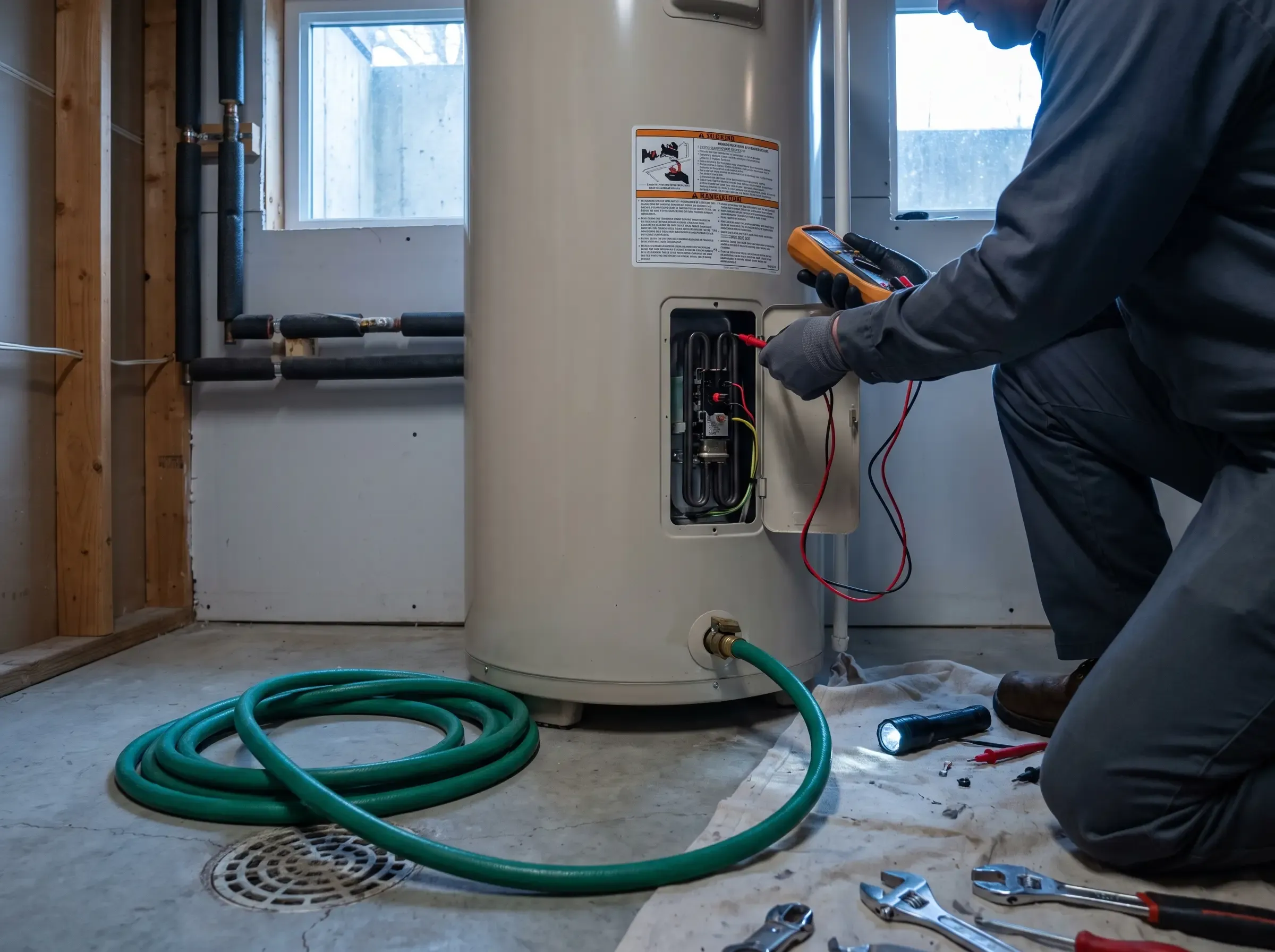
On an electric tank the lower element does most of the heating, so when it fails you get a modest amount of hot water from the upper element and then cold. It is a very specific symptom and a common repair. If the element failed early, sediment or a thermostat fault is usually behind it.
- 2
Sediment accumulation in the tank bottom
Minerals settle out and insulate the lower element or burner from the water, stealing capacity and efficiency. Households on private wells see this faster than city-water customers, which is one more reason well water testing is worth doing. Annual flushing is the preventive step.
- 3
Thermostat set low, or set high and mixing
A tank thermostat set low simply cannot deliver much usable hot water, and a tank set high with a failed mixing valve can behave unpredictably. Setting a tank higher to squeeze out more capacity is a scald risk without proper mixing, so it is not a free adjustment.
- 4
Hot and cold crossover
A failed single-handle fixture cartridge or a stuck check valve lets cold water into the hot line, which dilutes hot water throughout the house and looks exactly like a failing tank. Isolating fixtures one at a time finds it. That work is plumbing scope, handled by a licensed plumbing contractor.
- 5
Tank size no longer matches the household
Two more people, a soaking tub, or a new high-flow shower head can outrun a tank that was adequate for years, and no repair fixes an undersized appliance. That is the point where a larger tank, a heat pump water heater, or tankless becomes the real conversation. PSE pays $1,000, or $1,100 with Efficiency Boost, on qualifying heat pump water heaters.
What you can safely check yourself
Work down the list before you book anything. Plenty of calls end here, and we would rather you keep the money.
- Time how long a single shower runs hot, since a very short window points at the lower element.
- Check the temperature setting on the tank and, on a heat pump water heater, check which operating mode it is in.
- Note whether the shortage affects the whole house or only one fixture, which separates a tank problem from a crossover.
- Check the breaker for the water heater and reset it exactly once if it has tripped.
- Look for signs of heavy mineral scale on fixtures, which suggests sediment is likely in the tank as well.
What is deliberately not on that list
Nothing above involves refrigerant, gas piping, or opening a live electrical panel. Refrigerant work is federally regulated and needs recovery equipment. Gas work done wrong kills people. An energised panel turns a $300 repair into a hospital visit. Electrical work on the circuit itself is done by a licensed electrical contractor. If a step you have read elsewhere involves any of those three, stop and call instead.
When to call us
Call us if you get a small amount of hot water and then cold, or if capacity has been shrinking over a season. We will give you a straight recommendation on tank versus heat pump versus tankless. Reach us at (360) 592-3824, Monday–Friday 8:00 AM–5:30 PM.
Monday–Friday, 8:00 AM – 5:30 PM · Emergency calls answered 24/7
Tell us what it is doing
Describe the symptom and we will tell you what it takes to fix, what it is likely to cost, and whether it is worth fixing at all.
Monday–Friday, 8:00 AM – 5:30 PM · Emergency calls answered 24/7