
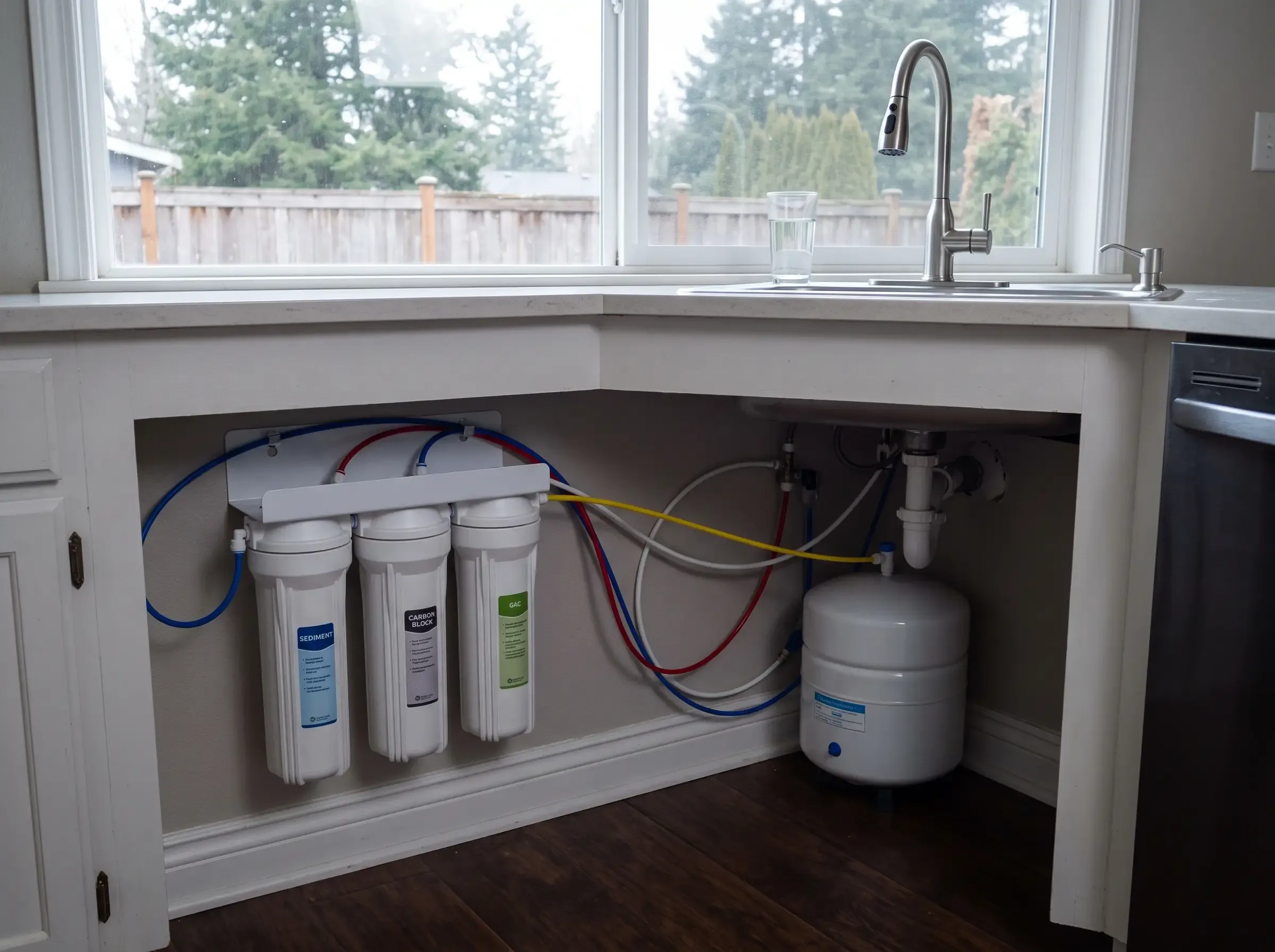
Reverse osmosis system vs. Carbon filter
Reverse osmosis vs. carbon filter: which one your water actually needs
Carbon fixes taste, smell and chlorine. Reverse osmosis removes dissolved minerals and nitrate. On Bellingham city water carbon is often enough; on north-county well water, test before you choose.
- WA L&I #BELLIHC808NM Active registration — verify it with the state
- $30,000 bonded Surety bond on file with L&I
- $1,000,000 insured General liability coverage
- Local since 2020 Owner-operated in Whatcom County
- We pull the permit City of Bellingham or Whatcom County, and we meet the inspector
The short answer
They solve different problems, so match the technology to your test results. Carbon handles chlorine, taste and odour, which is what most Bellingham city-water complaints are. Reverse osmosis is what removes dissolved contaminants such as nitrate, and that is a well-water question. Test first, then buy.
Reverse osmosis system vs. Carbon filter, line by line
Where one option is genuinely better for a Bellingham house, the cell is marked. Where it is a wash, we say so.
| What you are comparing | Reverse osmosis system | Carbon filter |
|---|---|---|
| Chlorine taste and smell | Removes it, though the carbon prefilter in the system is what is doing that particular job. | Exactly what carbon is for, at a fraction of the cost and complexity. better |
| Dissolved minerals and salts | The membrane rejects the great majority of dissolved solids. This is the reason RO exists. better | Carbon does not remove dissolved minerals at all. It is an adsorption filter, not a membrane. |
| Nitrate from agricultural land | A reverse osmosis membrane is the standard residential answer to nitrate at a drinking tap. better | Carbon does not reduce nitrate, and believing otherwise is a consequential mistake. |
| Bacteria and coliform | Not a disinfection method. A positive coliform result calls for shock chlorination and a repeat test, not a filter. | Also not a disinfection method, and a saturated carbon block can become a place bacteria live. |
| Cost and complexity | Published installed ranges run roughly $300 to $950 under-sink, and $4,800 to $8,000 whole-house. | Cartridges and a housing. The cheapest meaningful water treatment available. better |
| Water wasted | Sends several gallons to drain for each gallon produced, which is worth knowing on a well with a limited pump. | None. Everything that goes in comes out the tap. better |
| Flow rate at the tap | Slow production, so it fills a storage tank and serves a dedicated faucet rather than the whole house. | Full flow. Carbon can sit in the main line and serve every fixture. better |
| Maintenance | Prefilters, postfilter and a membrane on separate schedules, plus a storage tank to keep sanitary. | Change the cartridge. That is the whole job. better |
Rows with no mark are close enough that the difference will not decide your project.
Choose Reverse osmosis system if
- Your well test came back with nitrate, or with dissolved solids high enough to affect taste. Carbon will not touch either.
- You are on north-county well water, where dairy and berry farming make nitrate a question worth asking rather than assuming.
- You want drinking and cooking water treated to a specific standard at one tap, rather than the whole house treated approximately.
- You are filling an ice maker, a coffee machine or an aquarium where dissolved minerals cause visible problems.
Choose Carbon filter if
- You are on Bellingham city water and the complaint is chlorine taste or smell. That is a carbon cartridge, not a membrane.
- You want treated water at every fixture, including showers, which an under-sink RO cannot do and a whole-house RO does at ten times the cost.
- You are on a well with a limited pump or a small pressure tank and cannot afford the water RO sends to drain.
- You want the simplest thing that could work while you wait for lab results, so you are not committing capital before you know what you have.
What changes this answer in Bellingham
Bellingham city water comes from Lake Whatcom, a treated and chlorinated surface supply, and the complaints we actually hear about it are taste and chlorine smell — a carbon problem, not a membrane problem. The picture changes the moment you leave the city water system: north-county farmland is dairy and raspberry country on private wells, and that is where nitrate belongs on your test list. Foothill and Lake Whatcom-area wells more often produce iron, manganese and hardness, which stain fixtures, taste metallic, and need different equipment than either carbon or RO. Get a lab test in hand first, because buying treatment equipment before you know what is in the water is how households end up with a system that fixes nothing.
Washington's energy code puts Bellingham's outdoor heating design temperature at 19°F, against 24°F at Sea-Tac, in climate zone 4C (marine). We size from a load calculation against that number, not from the square footage of the house.
Questions Bellingham homeowners actually ask
- Does a carbon filter remove nitrate?
- No. Carbon works by adsorbing organic compounds, chlorine and some taste and odour compounds, and nitrate passes straight through it. If nitrate appears on your well test, reverse osmosis at the drinking tap is the standard residential answer, and a carbon-only system gives you false confidence.
- Do I need reverse osmosis on Bellingham city water?
- Usually not. City water is treated surface water from Lake Whatcom, and the common complaints are chlorine taste and smell, which a carbon filter handles for a small fraction of the cost. RO becomes worth considering if you want mineral-free water for a specific use, or if a test of your own tap shows something carbon cannot address.
- Should I test my water before buying anything?
- Yes, and it is the single most useful thing you can do. Ask a certified lab for coliform bacteria, nitrate, iron, manganese and hardness at minimum, and take the sample the way the lab instructs. The results tell you whether you need carbon, reverse osmosis, iron and manganese removal, softening, or nothing at all.
- Will RO make my water taste flat?
- Some people find it does, because it removes the dissolved minerals that give water its character along with everything else. Remineralising postfilters exist and are a matter of taste rather than health. If flat water bothers you and your test is clean, carbon is the better fit.
- How much does each one cost installed?
- Published ranges put an under-sink reverse osmosis system at roughly $300 to $950 installed and a whole-house reverse osmosis system at roughly $4,800 to $8,000. A carbon cartridge system is considerably less than the under-sink RO figure. We will quote your specific plumbing rather than a range, and the $89.99 trip charge is refunded as company credit if you accept the bid.
Next steps on this decision
Get this priced both ways
We will quote the option that fits your house and tell you what the other one would have cost, so the comparison is yours to make, not ours.
Ready for a straight answer on your house?
Tell us what you have now and what you want it to do. We will tell you what fits, what it costs, and which rebates you actually qualify for — before anyone comes out.
Monday–Friday, 8:00 AM – 5:30 PM · Emergency calls answered 24/7