
Guide
Well water testing: what to test for before you buy any filtration
Iron, manganese, hardness, nitrate and coliform each need different equipment. On a Whatcom County well, a lab test costs a fraction of the wrong system. What to ask for and how to read it.
- WA L&I #BELLIHC808NM Active registration — verify it with the state
- $30,000 bonded Surety bond on file with L&I
- $1,000,000 insured General liability coverage
- Local since 2020 Owner-operated in Whatcom County
- We pull the permit City of Bellingham or Whatcom County, and we meet the inspector
The most expensive mistake in residential water treatment is buying equipment before you know what is in the water. Carbon does not remove nitrate. Reverse osmosis is not disinfection. A softener does nothing about iron staining. Each of those is a different problem with a different answer, and the only way to know which you have is a laboratory test of your own well. In Whatcom County the questions worth asking depend on where you are: agricultural land around Lynden, Everson, Nooksack, Sumas and Custer raises nitrate as a real question, while foothill and lakeside wells more often produce iron, manganese and hardness.
Test first. This is not negotiable.
A water test from a certified laboratory is inexpensive relative to any treatment equipment, and it is the difference between solving your problem and buying a system that addresses something you do not have.
We get called to houses with an under-sink reverse osmosis unit installed because the water tasted metallic, when the actual issue was iron and manganese that needed whole-house treatment, and the RO membrane was being destroyed by it. We also get called to houses where a whole-house carbon filter was sold as protection against nitrate, which carbon does not touch at all.
So the sequence is: test, read, then specify. If a salesperson offers to test your water for free with a kit in their van and quotes you equipment in the same visit, get an independent laboratory result before you sign anything.
What to ask the lab for
A basic private-well panel for a Whatcom County house should cover bacteriological and chemical basics. Ask for total coliform and E. coli, nitrate, iron, manganese, hardness, pH and total dissolved solids at minimum.
Add arsenic if the well is deep or if neighbouring wells have a history, and add anything your county health department or your well log suggests for your area. If the water has an obvious smell, say so when you order the test so the lab can advise on the right parameters.
Use a laboratory accredited for drinking water analysis, and follow their sampling instructions exactly. Bacteriological samples in particular are easy to contaminate and time-sensitive — sterile bottle, do not rinse it, sample from a tap you have run and disinfected as instructed, and get it to the lab within their stated hold time.
| Parameter | What it looks or tastes like | What it actually needs |
|---|---|---|
| Total coliform or E. coli | Nothing. You cannot taste or see it. | Disinfection and investigation of the well itself, not a filter. Retest after shock chlorination. |
| Nitrate | Nothing. Also invisible and tasteless. | Reverse osmosis at the drinking tap. Carbon and softeners do nothing for it. |
| Iron | Orange-brown staining in toilets, sinks and laundry; metallic taste | Whole-house oxidation and filtration. Placed ahead of any RO to protect the membrane. |
| Manganese | Black specks and grey-black staining; bitter taste | Whole-house treatment, often the same equipment as iron but tuned differently. |
| Hardness | Scale on kettles and fixtures, soap that will not lather, short water heater life | Ion-exchange softening or scale control, whole-house, upstream of the water heater. |
| pH outside neutral range | Corroded fixtures and blue-green staining if low; scaling if high | Neutralising or pH adjustment, whole-house, before other treatment. |
| Total dissolved solids | Flat, salty or mineral taste | Reverse osmosis at the drinking tap for the water you consume. |
Whatcom County’s geography changes the question
Where your well is matters. The north-county farmland around Lynden, Everson, Nooksack, Sumas and Custer is flat, intensively agricultural dairy and berry country, and nitrate belongs on the test list there rather than being assumed absent. That is not a claim about any particular well; it is the reason the parameter is worth the fee.
Foothill and Mount Baker corridor wells in Deming, Kendall, Maple Falls and Glacier more commonly show up as iron, manganese and hardness problems, with staining and taste complaints rather than health parameters.
Properties around Lake Whatcom, including Sudden Valley and Geneva, sit in the watershed that supplies Bellingham’s drinking water, and that carries constraints on ground disturbance worth knowing about before any installation involving trenching or drains. And inside Bellingham city limits you are on treated Lake Whatcom surface water rather than a well, where the usual complaint is chlorine taste and the usual answer is a carbon cartridge.
Reading the report without panicking
A laboratory report gives you a result and a reference value for each parameter. The reference is either a federal primary standard, which is health-based, or a secondary standard, which concerns taste, odour and staining rather than health.
That distinction is the most useful thing on the page. Iron and manganese are secondary parameters: exceeding them means your laundry stains and your water tastes metallic, not that anyone is being harmed. Nitrate and bacteriological results are primary: those are health parameters and they deserve prompt action.
A single result is a snapshot. Wells vary seasonally, and a spring result after heavy rain can differ from a late-summer one. If a result is near a threshold, retest before spending money, and if a bacteriological result is positive, shock chlorinate, investigate the wellhead and casing, and retest rather than installing a filter and hoping.
Matching equipment to results, in order
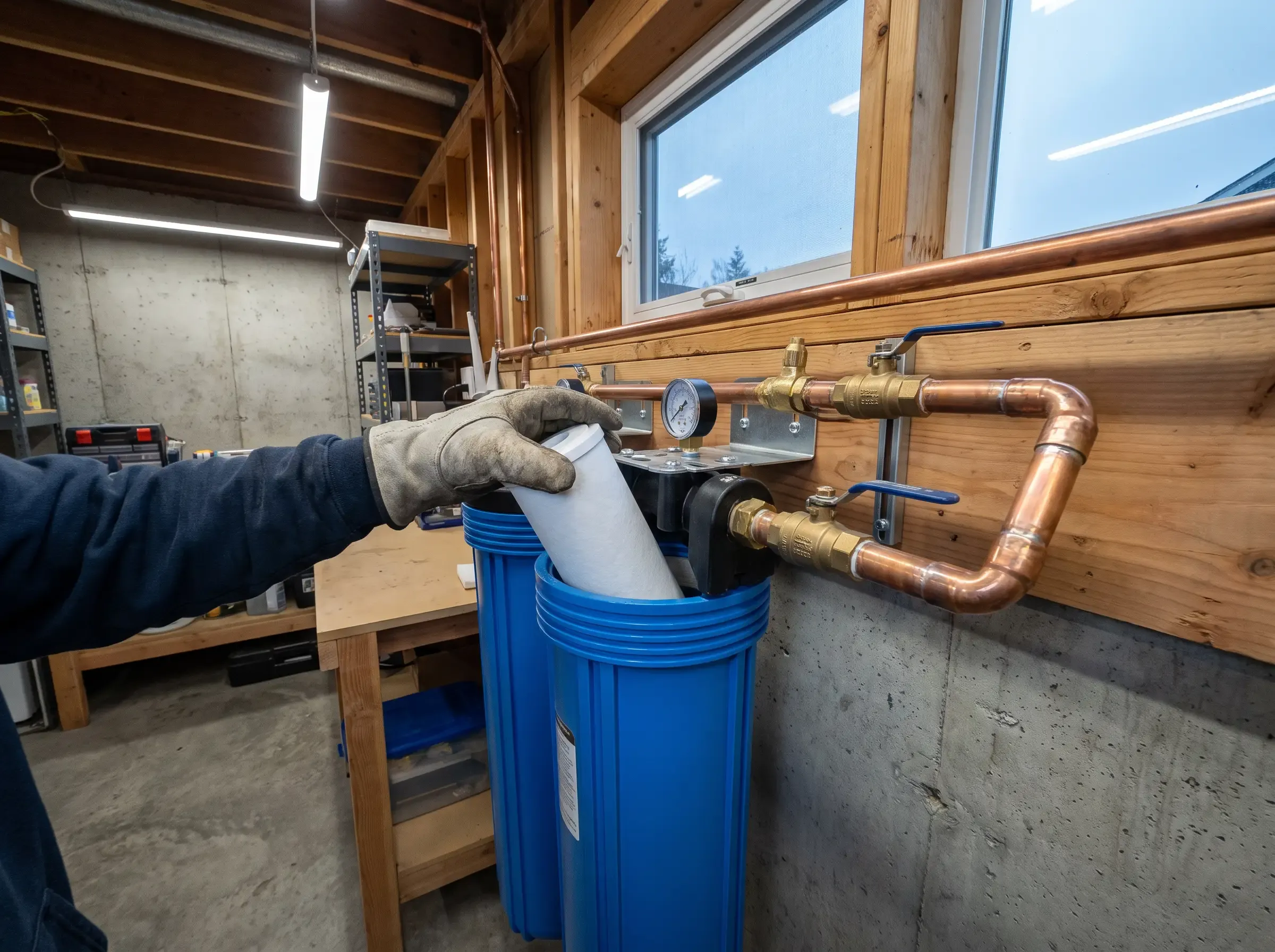
Treatment goes in sequence, and the order is determined by physics rather than preference. Sediment first, because grit destroys everything downstream. Then oxidation and filtration for iron and manganese, because those foul membranes and resin beds.
Then pH adjustment if needed, then softening if hardness warrants it, then carbon for taste, odour and chlorine. Reverse osmosis goes last and usually at a single drinking tap rather than whole-house, because published figures put an under-sink system at roughly $300 to $950 installed against roughly $4,800 to $8,000 for whole-house.
Disinfection is its own category and not a filter. A positive coliform result calls for addressing the well — cap, casing, seal, surrounding drainage — and shock chlorination, with retesting to confirm. Continuous disinfection equipment is a discussion to have after the source problem has been investigated, not instead of it.
What treatment does to the rest of your mechanical systems
Water quality is a heating and cooling question too, which is why we care about it. Hardness scales the inside of a water heater and shortens its life, and on a tankless unit descaling stops being maintenance advice and becomes a requirement — on hard well water, skipping it will end the unit early.
Iron and manganese stain fixtures and shorten the life of anything with a valve or a seal. Sediment abrades pumps and fills aerators. All of that argues for whole-house treatment sized to your actual results if you are about to install a new water heater on well water.
On a heat pump water heater there is one extra consideration: it needs condensate drainage of several gallons a day, so the location has to reach a floor drain or a pump. In a rural utility room that shares space with a pressure tank and a filter train, plan the drainage and the layout together rather than sequentially.
Questions Bellingham homeowners actually ask
- What should I test my well for?
- At minimum total coliform and E. coli, nitrate, iron, manganese, hardness, pH and total dissolved solids, from a laboratory accredited for drinking water analysis. Add arsenic where the well is deep or the area has a history. Follow the lab’s sampling instructions precisely, particularly for the bacteriological sample, which is easy to contaminate.
- How often should I retest?
- Annually for bacteriological and nitrate on a private well is a sensible baseline, and immediately after any work on the well, flooding, or a change in taste, smell or appearance. Wells vary seasonally, so a result taken after heavy spring rain and one from late summer can differ meaningfully.
- Will a filter fix a positive coliform result?
- No, and treating it as a filtration problem is the wrong response. A positive coliform result points at the well and its surroundings — the cap, the casing, the seal, surface drainage — and the sequence is investigate, shock chlorinate, retest. Continuous disinfection is a conversation to have after that, not instead of it.
- Do I need whole-house treatment or just a drinking tap system?
- Follow the results. Staining, scale and taste at every fixture are whole-house problems by definition. Nitrate and total dissolved solids are efficiently handled at the single tap you drink from, because treating the water you flush toilets with to drinking standard costs an order of magnitude more. Many Whatcom County wells need one of each, in that order.
- Can hard water really kill a tankless water heater?
- It shortens its life substantially if you skip descaling, because scale forms directly on the heat exchanger where the heat transfer happens. On hard well water, either commit to the descaling schedule or install whole-house scale control ahead of the unit. This is one of the better arguments for testing before you choose a water heater type at all.
Have us apply this to your house
Reading it is one thing. Send us the address, the panel size and what you heat with now, and we will tell you what it means for your project.
Ready for a straight answer on your house?
Tell us what you have now and what you want it to do. We will tell you what fits, what it costs, and which rebates you actually qualify for — before anyone comes out.
Monday–Friday, 8:00 AM – 5:30 PM · Emergency calls answered 24/7