
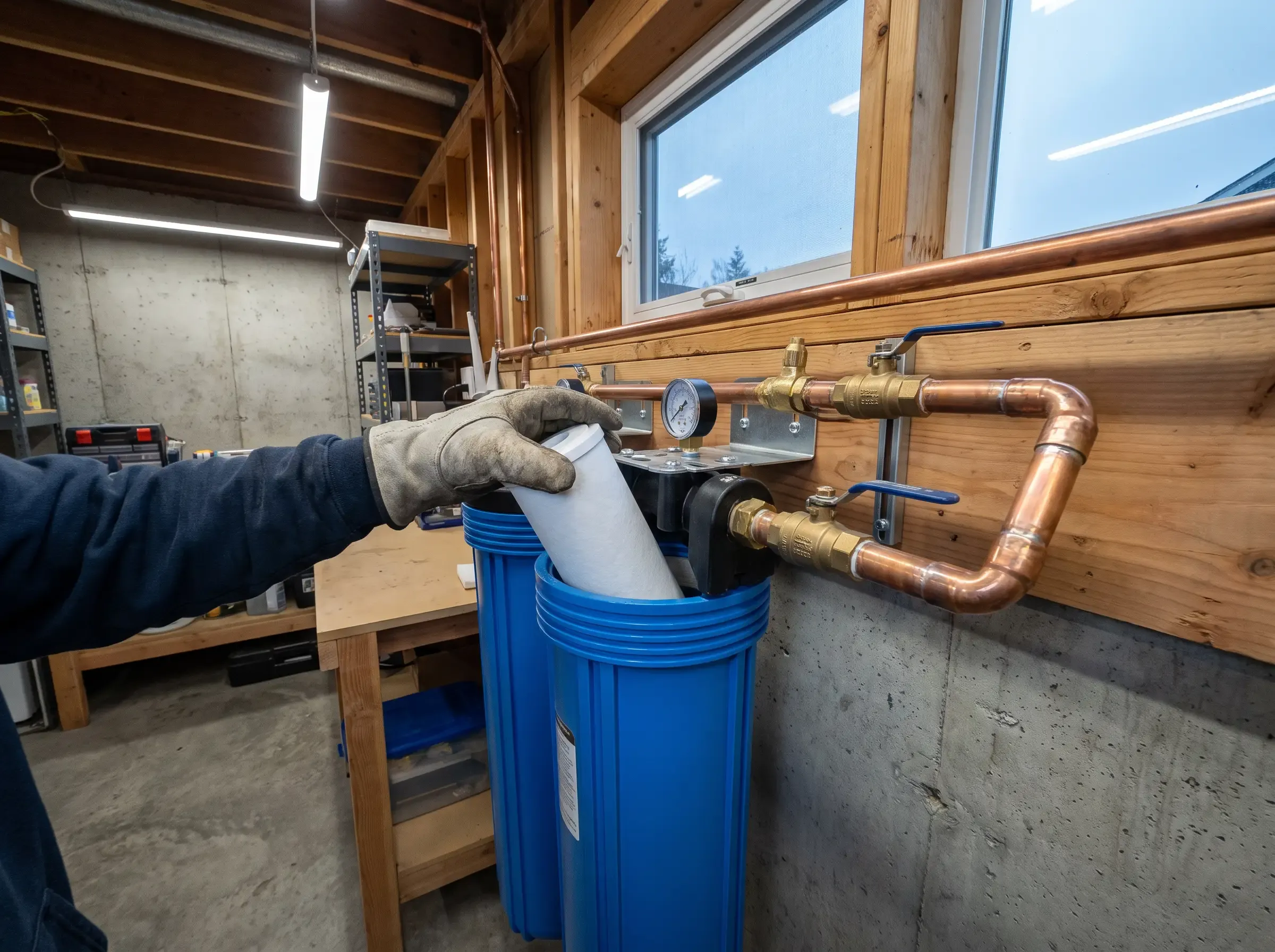
Whole-home filtration vs. Under-sink reverse osmosis
Whole-home filtration vs. under-sink RO: treat the house or treat the tap?
Whole-home filtration protects fixtures, appliances and showers. Under-sink RO treats the water you drink, for a tenth of the price. Most Whatcom County wells need one of each, in that order.
- WA L&I #BELLIHC808NM Active registration — verify it with the state
- $30,000 bonded Surety bond on file with L&I
- $1,000,000 insured General liability coverage
- Local since 2020 Owner-operated in Whatcom County
- We pull the permit City of Bellingham or Whatcom County, and we meet the inspector
The short answer
They are not competitors, they are a sequence. Whole-home filtration protects plumbing, fixtures and appliances from sediment, iron and manganese; under-sink reverse osmosis polishes the water you actually drink. If the budget only stretches to one, treat the whole house when staining is the problem and treat the tap when drinking water is.
Whole-home filtration vs. Under-sink reverse osmosis, line by line
Where one option is genuinely better for a Bellingham house, the cell is marked. Where it is a wash, we say so.
| What you are comparing | Whole-home filtration | Under-sink reverse osmosis |
|---|---|---|
| What it protects | Every fixture, the water heater, the dishwasher, the washing machine and the shower you stand in. better | One faucet, and whatever you plumb to it such as an ice maker or a coffee machine. |
| Cost | A whole-house reverse osmosis installation runs roughly $4,800 to $8,000 by published figures; sediment, iron and carbon whole-house filtration is less but still a project. | Roughly $300 to $950 installed by published figures. An order of magnitude cheaper. better |
| Iron and manganese staining | This is the case whole-home treatment exists for. Rust-orange toilet rings and black specks are plumbing-wide problems. better | Does nothing for the rest of the house. Your laundry keeps staining. |
| Nitrate at the drinking tap | Whole-house RO would address it, at a cost most households will not accept for water they mostly flush. | The efficient answer. Treat the two gallons a day you drink, not the two hundred you do not. better |
| Water wasted | Whole-house RO sends a large volume to drain, which can outrun a modest well pump. | Wastes several gallons per gallon produced, but the absolute volume is small. better |
| Space required | A tank, a filter train and often a backwash drain, usually in a garage, utility room or crawlspace. | Under the sink, plus a dedicated faucet through the countertop. better |
| Hardness and scale in the water heater | Whole-home treatment is the only place softening or scale control can protect the appliance. better | No effect on the water heater, so a tankless unit still needs descaling. |
| Maintenance burden | Media replacement, backwash cycles, and periodic sanitising of a larger system. | Three cartridges and a membrane on a predictable schedule. better |
Rows with no mark are close enough that the difference will not decide your project.
Choose Whole-home filtration if
- Your fixtures, laundry and toilet tanks are staining. That is iron, manganese or sediment, and it is a whole-house problem by definition.
- You are on a north-county or foothill well and want to protect a new water heater and appliances from sediment and scale.
- Everyone in the household showers in the water, and the concern is what they are bathing in rather than only what they drink.
- You are building or re-plumbing, so putting a filter train and a drain in the utility room is cheap now and expensive later.
Choose Under-sink reverse osmosis if
- The concern is drinking and cooking water only, which is the honest scope for most households.
- Your test flagged nitrate or high dissolved solids. Treating the drinking tap addresses it for a small fraction of whole-house cost.
- Your well pump or pressure tank cannot support the reject flow of a whole-house membrane system.
- You are renting or expect to move, and want treatment you could reasonably take with you.
What changes this answer in Bellingham
Which of these you need in Whatcom County is largely a function of whether you are on a public system or a private well. Inside Bellingham, city water from Lake Whatcom arrives treated, and the honest recommendation is usually a carbon cartridge or an under-sink system rather than a whole-house project. Out in the farmland and up in the foothills private wells are the norm and the complaints change character: staining from iron and manganese, hardness that scales a new water heater, and in agricultural areas nitrate that belongs on the test list. That makes the sequence obvious: whole-home treatment to stop the staining and protect the equipment, under-sink reverse osmosis for the water you drink. Around Lake Whatcom and Sudden Valley there is one extra constraint — the lake is Bellingham’s drinking-water reservoir, so drain and site work deserves a conversation before installation rather than after.
Washington's energy code puts Bellingham's outdoor heating design temperature at 19°F, against 24°F at Sea-Tac, in climate zone 4C (marine). We size from a load calculation against that number, not from the square footage of the house.
Questions Bellingham homeowners actually ask
- Do I need both a whole-home filter and an under-sink RO?
- On a Whatcom County well, frequently yes, and in that order. Whole-home filtration removes the sediment, iron and manganese that stain fixtures and shorten appliance life, and it also protects the RO membrane downstream. The under-sink unit then handles what remains in the water you drink. On city water, the under-sink unit alone is usually enough.
- Is a whole-house reverse osmosis system a good idea?
- Rarely, for a single-family home. Published installed figures run roughly $4,800 to $8,000, it sends a lot of water to drain, and it treats the water you flush toilets with to drinking standard. Unless a test shows a house-wide problem only a membrane can solve, treating the drinking tap and filtering the whole house conventionally is the better use of the money.
- Will whole-home filtration soften my water?
- Not by itself. Sediment, iron and carbon filtration and softening are different processes, and hardness needs either an ion-exchange softener or a scale-control device. Your lab report for hardness is what determines whether you need one, and it is worth having before you buy anything.
- Where does the equipment go?
- Whole-home filtration goes where the water service enters — a garage, utility room, basement or crawlspace — and it needs space, service access and often a drain for backwash. Under-sink RO goes in the sink cabinet with a dedicated faucet drilled through the counter. In older Bellingham houses the drain is usually the constraint rather than the space.
- How often do the filters need changing?
- Under-sink RO prefilters and postfilters typically run on a schedule of months and the membrane on a schedule of years, and hard or high-sediment water shortens both. Whole-house media has its own interval and its own backwash cycle. We set the schedule against your actual water rather than the box instructions, because a private well and a treated city tap are not the same problem.
Next steps on this decision
Get this priced both ways
We will quote the option that fits your house and tell you what the other one would have cost, so the comparison is yours to make, not ours.
Ready for a straight answer on your house?
Tell us what you have now and what you want it to do. We will tell you what fits, what it costs, and which rebates you actually qualify for — before anyone comes out.
Monday–Friday, 8:00 AM – 5:30 PM · Emergency calls answered 24/7