
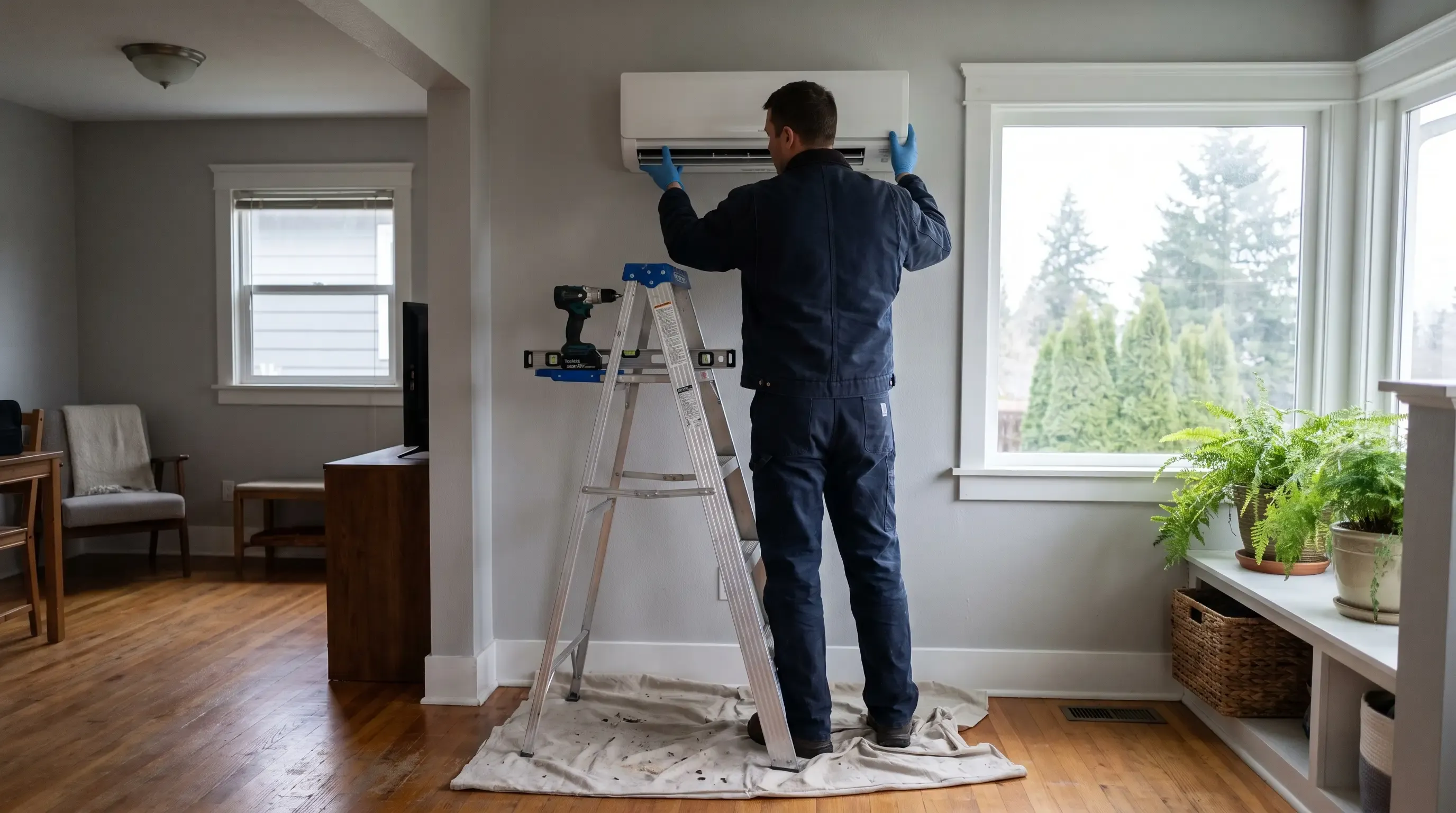
Single-zone system vs. Multi-zone system
Single-zone vs. multi-zone mini split: how many outdoor units do you want?
Two single-zone systems often beat one two-zone multi. Better part-load behaviour, independent failure, sometimes similar money. Where a multi-zone genuinely wins, and what the PSE rules require.
- WA L&I #BELLIHC808NM Active registration — verify it with the state
- $30,000 bonded Surety bond on file with L&I
- $1,000,000 insured General liability coverage
- Local since 2020 Owner-operated in Whatcom County
- We pull the permit City of Bellingham or Whatcom County, and we meet the inspector
The short answer
For two or three rooms, separate single-zone systems usually beat one multi-zone: better part-load efficiency, independent failure, simpler diagnostics. Multi-zone wins when you need four or more heads, when there is only one legal spot for an outdoor unit, or when lineset routing to a second location is genuinely impossible.
Single-zone system vs. Multi-zone system, line by line
Where one option is genuinely better for a Bellingham house, the cell is marked. Where it is a wash, we say so.
| What you are comparing | Single-zone system | Multi-zone system |
|---|---|---|
| Part-load efficiency | One compressor serving one head modulates cleanly down to a small load, which is most of a Bellingham shoulder season. better | A multi compressor serving one open head often cannot turn down far enough, so it cycles and loses efficiency. |
| Cost for two rooms | Two outdoor units, two pads, two circuits. More electrical, but each system is a simple install. | One outdoor unit and one circuit, but branch boxes or a manifold and longer refrigerant runs. |
| Cost for four or more rooms | Four outdoor units and four circuits gets expensive and starts to consume your yard and your panel. | One larger outdoor unit serving four heads is clearly cheaper and tidier at this count. better |
| What happens when something fails | One room loses heat. The rest of the house does not notice. better | A compressor or board failure takes every head with it, which is a bad day in January. |
| Outdoor space and appearance | Multiple pads and multiple lineset covers on the exterior, which matters on a tight lot or under HOA architectural review. | One unit, one pad, one set of penetrations. Far easier to site and to get approved. better |
| Simultaneous heating and cooling | Each system does what its room needs. Cool the west-facing office while the north bedroom heats. better | Most multi-zone systems run all heads in the same mode. One person wins the argument. |
| PSE ductless rebate | Qualifies if it meets the rules: variable speed, inverter, minimum three-quarter ton in heating mode, and at least one head in the main living area. | Qualifies under the same rules, and the rebate is one per residence either way, so more zones does not mean more rebate. |
| Diagnostics and repair | A simple circuit with one indoor and one outdoor unit. Faults are quick to isolate. better | Branch boxes, multiple expansion devices and shared refrigerant charge make a leak or a charge problem harder to chase. |
Rows with no mark are close enough that the difference will not decide your project.
Choose Single-zone system if
- You are conditioning one or two spaces and want each to be independent — a main living area now, an office later.
- The rooms have very different loads or schedules, like a south-facing bonus room and a north bedroom.
- You value being able to keep heating the rest of the house when one system needs a part ordered.
- You are starting with the room that actually bothers you and want the option to add a second system next year rather than committing to a manifold today.
Choose Multi-zone system if
- You need four or more heads. At that point one outdoor unit is cheaper, quieter and easier to site than four.
- There is exactly one place an outdoor unit can legally and sensibly go: a narrow side yard, a wall bracket over a basement, the one HOA-approved location.
- Panel capacity is tight and one circuit is much easier than four in a 100-amp pre-1960 service.
- Exterior appearance is being reviewed by someone other than you, and one condenser is the approvable answer.
What changes this answer in Bellingham
Zone count decisions in Bellingham are driven by floor plans rather than by square footage. A 1,100 square foot rambler with an open living-dining area is often a genuine single-zone job, and the local advertised entry price near $2,200 with electrical not included refers to exactly that configuration. A two-storey house with small rooms and a closed stair is a three- or four-head job, and that is where multi-zone starts to make sense. Two constraints show up here more than elsewhere: outdoor unit siting on tight downtown infill lots, and architectural review in Sudden Valley’s HOA at Lake Whatcom, both of which push toward one condenser. Note also that PSE’s rebate is one per residence, so a four-zone project does not earn four rebates, and the ductless rules require at least one head in the main living area regardless of how many zones you buy.
Washington's energy code puts Bellingham's outdoor heating design temperature at 19°F, against 24°F at Sea-Tac, in climate zone 4C (marine). We size from a load calculation against that number, not from the square footage of the house.
Money that moves this decision
-
Electric Resistance to Air-Source Heat Pump Conversion
Puget Sound Energy
$1,500
Available now$2,400 with PSE Efficiency Boost for income-qualified households.
- Paperwork:
- We file it
- Deadline:
- No published end date — tariffed and subject to change
- Verified:
- 2026-09-04 · source
-
Daikin Instant Rebates — ductless
Daikin (administered by EGIA)
$450–$750
Available nowSkyAir (RZA outdoor with FTA indoor) $750 · MXM and Aurora MXT/MXTH $500 · Aurora RXT/RXP $450 · Atmosphera $450.
- Paperwork:
- We file it
- Deadline:
- Purchase by September 30, 2026; install by October 31, 2026
- Verified:
- 2026-09-04 · source
-
Midstream HVAC Equipment Discount
Puget Sound Energy (with ICF)
$300–$600
Available nowTier 1 $300 (SEER2 ≥15.2 / HSPF2 ≥8.1, retrofit only) · Tier 2 $400 (SEER2 ≥15.2 / HSPF2 ≥8.5) · Tier 3 $600 (SEER2 ≥16 / HSPF2 ≥9.5).
Bellingham note: Whether this discount can be combined with the $1,500 conversion rebate is unconfirmed: PSE’s conversion page says its rebate "cannot be combined with any other rebates except where noted", while PSE’s heating hub tells customers to ask their contractor. We quote it separately and confirm with a PSE Energy Advisor before counting it toward your total.
- Paperwork:
- Comes off the equipment price
- Deadline:
- No published end date
- Verified:
- 2026-09-04 · source
-
Efficiency Boost (income-qualified multiplier)
Puget Sound Energy
Raises other PSE rebates
Income-qualifiedHeat pump $1,500 → $2,400 · heat pump water heater $1,000 → $1,100 · smart thermostat $75 → $175.
- Paperwork:
- We file it
- Deadline:
- Ongoing
- Verified:
- 2026-09-04 · source
Questions Bellingham homeowners actually ask
- Is one multi-zone system cheaper than two single-zone systems?
- At two zones, usually not by much, and the difference often disappears once branch boxes and longer refrigerant runs are priced. At four or more zones the multi-zone is clearly cheaper. Ask for both quotes at two and three zones, because the answer flips depending on lineset routing in your particular house.
- Do more zones get me more PSE rebate money?
- No. PSE’s electric-resistance conversion rebate is one per residence, so a single-zone and a five-zone install earn the same $1,500, or $2,400 with Efficiency Boost. Daikin ductless instant rebates of $450 to $750 are equipment-based, so check with us how they apply to the specific system you are buying.
- Why do multi-zone systems sometimes run less efficiently than advertised?
- Because a multi compressor sized for all heads at once has a minimum output, and when only one head calls for heat it may not be able to turn down that far. In our long, mild shoulder season that is a lot of hours, so it matters more here than in a climate with sharp seasons. Single-zone systems avoid the problem structurally.
- Can I add a zone to a multi-zone system later?
- Only if the outdoor unit was specified with a spare port and enough capacity, so tell us at design time if a future zone is likely. Retrofitting a fifth head onto a four-port unit is not possible, and the usual answer at that point is to add a separate single-zone system for the new space.
- How many heads does my house need?
- It is a function of how many doors close, not of floor area. We count conditioned spaces that cannot see each other, run a room-by-room load at Bellingham’s 19°F design temperature, and size each head to its own room. That process is what stops you from buying a head twice the size the room needs.
Next steps on this decision
Get this priced both ways
We will quote the option that fits your house and tell you what the other one would have cost, so the comparison is yours to make, not ours.
Ready for a straight answer on your house?
Tell us what you have now and what you want it to do. We will tell you what fits, what it costs, and which rebates you actually qualify for — before anyone comes out.
Monday–Friday, 8:00 AM – 5:30 PM · Emergency calls answered 24/7