
Whatcom County, Washington
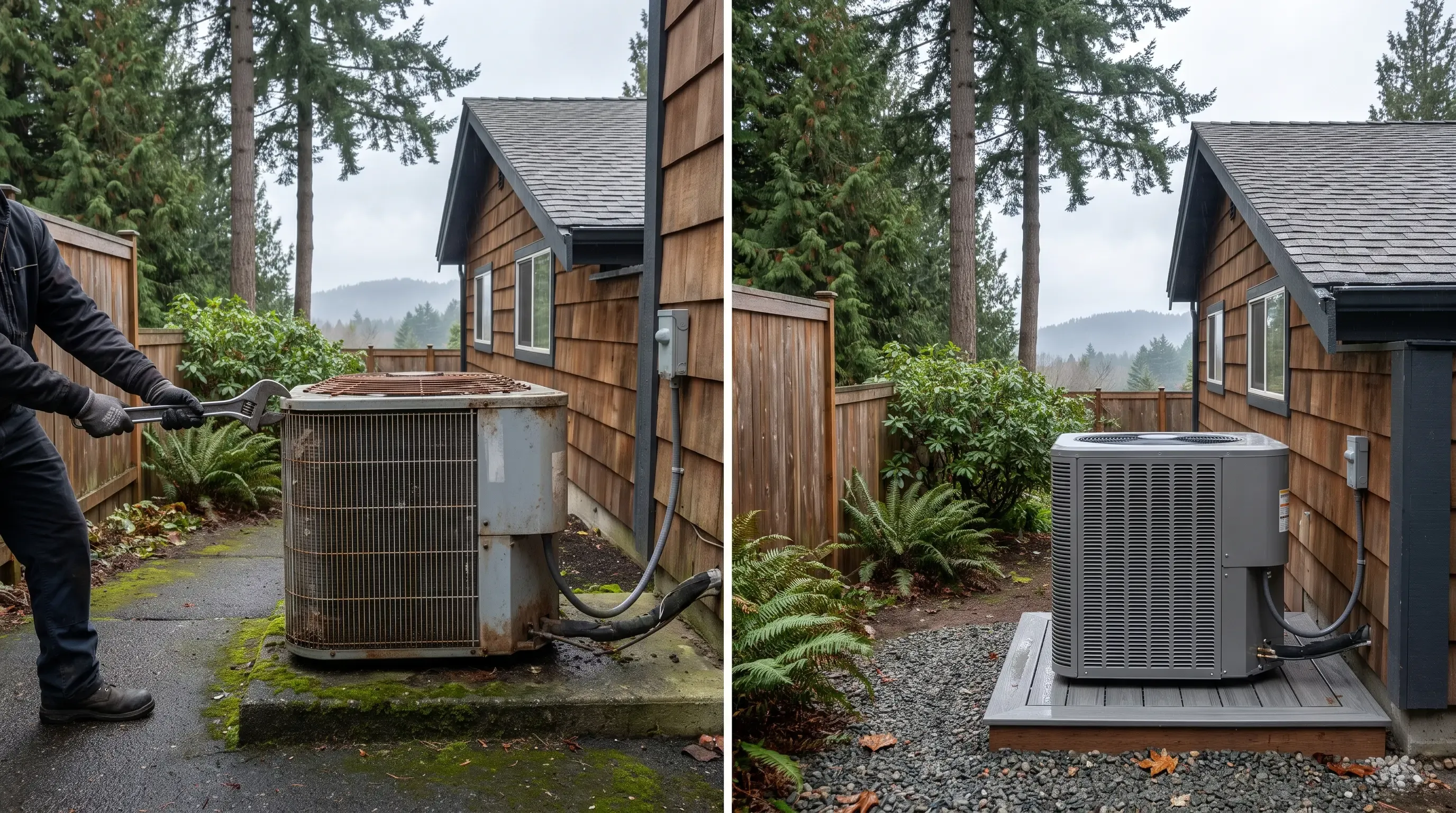
Heat Pump Replacement in Lynden, WA
Replace a tired system once, correctly, instead of paying for a third repair on equipment that will not see another winter.
- 17°F heating design temperature (nearest code station: Blaine)
- Electricity: Puget Sound Energy
- Gas: Cascade Natural Gas
- Permits: City of Lynden Building Division
- WA L&I #BELLIHC808NM Active registration — verify it with the state
- $30,000 bonded Surety bond on file with L&I
- $1,000,000 insured General liability coverage
- Local since 2020 Owner-operated in Whatcom County
- We pull the permit City of Bellingham or Whatcom County, and we meet the inspector
What heat pump replacement means in Lynden
Lynden splits between a compact older core near Front Street — 1910s–1940s frame houses on small lots — and a wide ring of 1990s onward site-built and manufactured homes out toward Badger and Double Ditch roads. In town you meet a lot of 80% gas furnaces on the Cascade main; on the farm parcels it is propane, oil or an electric furnace, and outbuildings got whatever heat was cheapest at the time. Heated shops and barn offices are a real share of the work here, and those are almost always a single-zone ductless job.
Lynden is not in the state energy code’s design-temperature table, so we size to Blaine’s 17°F, the nearest listed station and the honest choice for flat north-county ground. Wind matters more than raw cold: there is nothing between the Fraser gap and a raspberry field to slow a northeast outflow event, so outdoor unit orientation and a stand that keeps the coil above drifted snow both earn their keep. Summer afternoons over open farmland run warmer than the Bellingham waterfront, which is why cooling actually gets used out here.
The install wrinkle here
Inside city limits the mechanical permit is filed with the City of Lynden Building Division at 300 4th Street, not with Whatcom County — get that wrong and the inspection never gets scheduled. Lynden has a Cascade Natural Gas main, so a gas-to-heat-pump discussion is possible, but PSE’s hybrid and moderate-income fuel-switching rebates require PSE natural gas service and therefore do not reach here; the rebate that does apply is the electric-resistance conversion. Many surrounding addresses are on well water, which changes the water heater and filtration side of a project.
Your utilities decide your rebates
Lynden takes its electricity from Puget Sound Energy, which is what makes the PSE heat pump rebates reachable at all — PSE serves every address in Whatcom County. Natural gas here comes from Cascade Natural Gas, not PSE. That costs Lynden homeowners money: PSE's hybrid heat pump rebate and its $4,000 moderate-income fuel-switching rebate both require the household to be a PSE gas customer, so neither is available at a Cascade address.
Who issues the permit
Mechanical work in Lynden is permitted through City of Lynden Building Division via its Online Permit Center, or in person at City Hall, 300 4th Street. We pull the permit and meet the inspector. Worth knowing: a great many mailing addresses that read "Bellingham" are physically in unincorporated Whatcom County, which changes the permitting authority. We check the parcel before we file.
Getting there
We work out of Larrabee Avenue in south Bellingham, roughly 30 minutes from Lynden — near Front Street and the Lynden Dutch Village and Northwest Washington Fairgrounds. We also cover Downtown Lynden, Badger Road, Double Ditch Road, the Guide Meridian corridor.
Heat Pump Replacement pricing for Lynden
installed heat pump in Bellingham per an aggregator’s completed-job data, whose typical band is $5,301–$6,973. We quote the top of that band for replacements because a changeout normally adds refrigerant recovery, old-equipment disposal, a matched indoor coil, and electrical corrections that a new install on fresh construction does not.
- Simple job
- $2,793
- Most homes
- $6,973
- Complex job
- $10,058
Installed price before rebates, benchmarked across Whatcom County. Gas-heated homes here have fewer rebates available than baseboard-heated homes — see below. The federal §25C credit contributes $0 in 2026.
Range benchmarked 2026-09-04 against published local pricing. Your quote is fixed before work starts — no hourly surprises.
Rebates a Lynden household can use
-
Heat Pump to Heat Pump Upgrade
Puget Sound Energy
$1,500
Available now$2,400 with Efficiency Boost. Ducted systems only — ductless is not eligible.
- Paperwork:
- We file it
- Deadline:
- No published end date — tariffed and subject to change
- Verified:
- 2026-09-04 · source
-
Electric Resistance to Air-Source Heat Pump Conversion
Puget Sound Energy
$1,500
Available now$2,400 with PSE Efficiency Boost for income-qualified households.
- Paperwork:
- We file it
- Deadline:
- No published end date — tariffed and subject to change
- Verified:
- 2026-09-04 · source
-
Efficiency Boost (income-qualified multiplier)
Puget Sound Energy
Raises other PSE rebates
Income-qualifiedHeat pump $1,500 → $2,400 · heat pump water heater $1,000 → $1,100 · smart thermostat $75 → $175.
- Paperwork:
- We file it
- Deadline:
- Ongoing
- Verified:
- 2026-09-04 · source
-
Midstream HVAC Equipment Discount
Puget Sound Energy (with ICF)
$300–$600
Available nowTier 1 $300 (SEER2 ≥15.2 / HSPF2 ≥8.1, retrofit only) · Tier 2 $400 (SEER2 ≥15.2 / HSPF2 ≥8.5) · Tier 3 $600 (SEER2 ≥16 / HSPF2 ≥9.5).
Bellingham note: Whether this discount can be combined with the $1,500 conversion rebate is unconfirmed: PSE’s conversion page says its rebate "cannot be combined with any other rebates except where noted", while PSE’s heating hub tells customers to ask their contractor. We quote it separately and confirm with a PSE Energy Advisor before counting it toward your total.
- Paperwork:
- Comes off the equipment price
- Deadline:
- No published end date
- Verified:
- 2026-09-04 · source
-
Federal §25C Energy Efficient Home Improvement Credit
Internal Revenue Service
$0 — terminated
EndedHistorically 30% of cost, up to $2,000/year for heat pumps and heat pump water heaters. Gone. The One Big Beautiful Bill (P.L. 119-21, enacted July 4, 2025) accelerated its termination.
- Paperwork:
- You file it
- Deadline:
- Terminated — property placed in service after December 31, 2025 does not qualify
- Verified:
- 2026-09-04 · source
How a Lynden job runs
-
Diagnose first, then talk about replacement
We find out what actually failed before recommending a changeout, because a bad reversing valve solenoid and a dead compressor are very different conversations. You get the failed component, the repair cost, the age of the equipment and the refrigerant it uses, and then you decide. If the repair is the better buy, we will tell you.
Your part: Dig out the age of the system, past invoices, and any warranty paperwork. Registered equipment sometimes still has parts coverage.
-
Re-run the load rather than matching the old nameplate
Replacing like for like repeats whatever the last installer assumed. We calculate the load against Bellingham’s 19°F design temperature, and if the house has had new windows, attic insulation or an addition since, the right size has changed. Homes where one floor never kept up usually have a duct or sizing problem, and a new outdoor unit on the same bad geometry disappoints the same way.
Your part: List every efficiency improvement since the last system went in, and name the rooms that were never right.
-
Decide what gets reused and what does not
Pads, disconnects and some duct transitions often carry over. Linesets sometimes can, if the diameters match the new equipment and the line can be properly flushed or replaced where the old system burned out a compressor. Indoor coils and air handlers usually have to be replaced as a matched pair for the efficiency rating and the warranty to mean anything.
Your part: Ask us to be explicit about reuse in the quote; reusing a lineset that should have been replaced is a cheap bid with an expensive ending.
-
Electrical check by a licensed electrical contractor
New equipment frequently has different minimum circuit ampacity and breaker requirements than the unit it replaces, and strip heat sizing may change too. We do not hold an electrical contractor licence; a licensed electrical contractor verifies and updates the circuit, disconnect and any panel work, under their own permit. On older installs we also find outdoor disconnects that were never to code.
-
Permit, recover the old refrigerant, remove the old equipment
We pull the mechanical permit with the City of Bellingham through eTRAKiT or with Whatcom County Planning and Development Services, then recover the refrigerant from the old system as federal rules require before anything is cut. The old equipment leaves with us, including the coil.
-
Pressure test, evacuate, and charge the new circuit
The new circuit is nitrogen pressure-tested, then evacuated and verified on a micron gauge with a standing decay test before charging. Where a lineset is reused it is flushed and its length is factored into the weighed charge. Skipping this step is how a changeout ends up back on the repair list in year three.
-
Commission and document for the rebate
We verify charge by superheat and subcool against the manufacturer’s target, measure static pressure and temperature split, confirm defrost and auxiliary heat staging, and set the outdoor lockouts. You get the AHRI certificate, model and serial numbers, and the measured commissioning values. PSE’s heat pump upgrade rebate is ducted-only and contractor-gated, so ask us to confirm our network status for your project before you build it into the budget.
Your part: Keep the commissioning sheet with the equipment documentation; it is what a future technician, or a buyer’s inspector, will want.
Heat Pump Replacement questions from Lynden
- Should I repair my heat pump or replace it?
- Replace when the repair is a major component on equipment past twelve to fifteen years, when the refrigerant circuit leaks repeatedly, or when the system was the wrong size to begin with. Repair when the failure is a control, a capacitor, a motor or a valve on a system that is otherwise sound and correctly sized. We give you both numbers on the same visit, including the age and refrigerant type.
- How long do heat pumps last in Whatcom County?
- Manufacturers and local shops generally talk about twelve to fifteen years here, with maintained systems running longer. Salt air is the local variable: one regional installer reports coastal exposure shortening equipment life by two to four years without corrosion protection. Near the water, coated coils and siting the unit out of direct salt spray are worth the money.
- Can you reuse my existing lineset, pad and ductwork?
- Sometimes, and we say which in the quote rather than after the fact. Pads and many duct transitions carry over; a lineset can be reused when the diameters suit the new equipment and it can be properly cleaned, but a lineset contaminated by a compressor burnout gets replaced. Indoor coils are replaced as a matched pair with the outdoor unit, because a mismatched pair voids the rating the rebate and the warranty depend on.
- My old system only cools. Should the replacement be a heat pump?
- Almost always, yes. A heat pump is a cooling-only condenser that can also run backwards, and the price difference is small compared with what it saves against electric resistance heat. Going to a heat pump is also what makes you eligible for PSE’s $1,500 electric-resistance conversion rebate, which a cooling-only replacement does not.
- Is there a PSE rebate for replacing one heat pump with another?
- Yes, PSE runs a heat pump to heat pump upgrade rebate at $1,500, or $2,400 with Efficiency Boost, but it is ducted systems only — ductless is not eligible for that particular program. It is also contractor-gated like the rest of PSE’s heat pump rebates, so ask us to confirm our network status for your project before you count the money. If your existing heat is actually electric resistance rather than a heat pump, the conversion rebate is the one that applies instead.
- Do I have to replace the indoor air handler too?
- For a ducted system, effectively yes. The published efficiency rating belongs to a specific outdoor unit paired with a specific coil or air handler. Mixing an old coil with new outdoor equipment gives you neither the rating nor a clean warranty, and no AHRI certificate to hand a rebate program. On a ductless changeout the indoor heads can occasionally stay if they are the same generation and in good order, which we check rather than assume.
- What do the new A2L refrigerants mean for my replacement?
- New residential equipment has moved to lower-global-warming A2L refrigerants such as R-454B, which changes service procedures, leak detection and parts, but not how the system feels to live with. Practically, R-410A equipment is now legacy, and a system needing frequent large charges of it is one to plan around rather than keep topping off. Your technician also needs different tooling, which is worth asking any bidder about.
- How long does a changeout take?
- One to two days for like-for-like. The old refrigerant has to be recovered, the old equipment removed, the new set placed, the circuit pressure-tested and evacuated, and the system commissioned, and none of that compresses into an afternoon. If the plenum, coil or lineset has to be rebuilt, plan for a third day.
- Do I need a permit to replace an existing heat pump?
- Yes. Replacing mechanical equipment requires a mechanical permit even though the old system was already there, and we pull it and meet the inspector. City addresses go through City of Bellingham Building Services on eTRAKiT and unincorporated addresses through Whatcom County Planning and Development Services, a distinction that catches out a lot of homeowners whose mail says Bellingham.
- What does a heat pump replacement cost here?
- Aggregated Bellingham job data runs $2,793 to $10,058 with a typical band of $5,301 to $6,973, and replacements tend to sit in the upper half of that band. The extras a replacement carries and a new install does not are refrigerant recovery, disposal of the old equipment, a matched indoor coil, and correcting electrical or duct work that was marginal the first time. We itemise those rather than folding them into one number.
- Can I still claim a federal credit on the replacement?
- No. The federal §25C and §25D credits terminated for property placed in service after December 31, 2025, per P.L. 119-21 and IRS FS-2025-05, so a 2026 replacement gets nothing federal. That makes the PSE rebate and the equipment-tier discount the only real money on the table.
Get a Lynden estimate
Tell us your address or ZIP — 98264 are all in our regular route.
Ready for a straight answer on your house?
Tell us what you have now and what you want it to do. We will tell you what fits, what it costs, and which rebates you actually qualify for — before anyone comes out.
Monday–Friday, 8:00 AM – 5:30 PM · Emergency calls answered 24/7