
Whatcom County, Washington
Water Heater Repair in Lynden, WA
A plain-language diagnosis of why the hot water stopped, and an honest call on whether this tank is worth another repair.
- 17°F heating design temperature (nearest code station: Blaine)
- Electricity: Puget Sound Energy
- Gas: Cascade Natural Gas
- Permits: City of Lynden Building Division
- WA L&I #BELLIHC808NM Active registration — verify it with the state
- $30,000 bonded Surety bond on file with L&I
- $1,000,000 insured General liability coverage
- Local since 2020 Owner-operated in Whatcom County
- We pull the permit City of Bellingham or Whatcom County, and we meet the inspector
What water heater repair means in Lynden
Lynden splits between a compact older core near Front Street — 1910s–1940s frame houses on small lots — and a wide ring of 1990s onward site-built and manufactured homes out toward Badger and Double Ditch roads. In town you meet a lot of 80% gas furnaces on the Cascade main; on the farm parcels it is propane, oil or an electric furnace, and outbuildings got whatever heat was cheapest at the time. Heated shops and barn offices are a real share of the work here, and those are almost always a single-zone ductless job.
Lynden is not in the state energy code’s design-temperature table, so we size to Blaine’s 17°F, the nearest listed station and the honest choice for flat north-county ground. Wind matters more than raw cold: there is nothing between the Fraser gap and a raspberry field to slow a northeast outflow event, so outdoor unit orientation and a stand that keeps the coil above drifted snow both earn their keep. Summer afternoons over open farmland run warmer than the Bellingham waterfront, which is why cooling actually gets used out here.
The install wrinkle here
Inside city limits the mechanical permit is filed with the City of Lynden Building Division at 300 4th Street, not with Whatcom County — get that wrong and the inspection never gets scheduled. Lynden has a Cascade Natural Gas main, so a gas-to-heat-pump discussion is possible, but PSE’s hybrid and moderate-income fuel-switching rebates require PSE natural gas service and therefore do not reach here; the rebate that does apply is the electric-resistance conversion. Many surrounding addresses are on well water, which changes the water heater and filtration side of a project.
Your utilities decide your rebates
Lynden takes its electricity from Puget Sound Energy, which is what makes the PSE heat pump rebates reachable at all — PSE serves every address in Whatcom County. Natural gas here comes from Cascade Natural Gas, not PSE. That costs Lynden homeowners money: PSE's hybrid heat pump rebate and its $4,000 moderate-income fuel-switching rebate both require the household to be a PSE gas customer, so neither is available at a Cascade address.
Who issues the permit
Mechanical work in Lynden is permitted through City of Lynden Building Division via its Online Permit Center, or in person at City Hall, 300 4th Street. We pull the permit and meet the inspector. Worth knowing: a great many mailing addresses that read "Bellingham" are physically in unincorporated Whatcom County, which changes the permitting authority. We check the parcel before we file.
Getting there
We work out of Larrabee Avenue in south Bellingham, roughly 30 minutes from Lynden — near Front Street and the Lynden Dutch Village and Northwest Washington Fairgrounds. We also cover Downtown Lynden, Badger Road, Double Ditch Road, the Guide Meridian corridor.
Rebates a Lynden household can use
-
Heat Pump Water Heater Rebate
Puget Sound Energy
$1,000
Available now$1,100 with Efficiency Boost. Requires a NEEA Tier 3 or Tier 4 model.
- Paperwork:
- You file it
- Deadline:
- No published end date — apply within 30 days of installation
- Verified:
- 2026-09-04 · source
How a Lynden job runs
-
Triage on the phone
We ask a short list of questions before dispatching: gas or electric, how old, is there standing water, is the relief line dripping, has the breaker tripped, and is anyone in the house without hot water for a medical reason. That determines whether this is today or tomorrow. If there is active flooding we walk you through shutting off the cold inlet and the power or gas before we hang up.
Your part: Find the cold-water shut-off above the tank now, before you need it. Photograph the data plate so we can pull the age and model from the serial number.
-
Flat-rate diagnosis
You get a number before we start, not a running clock. Our estimate terms are an $89.99 trip charge, refunded as company credit if you accept the bid. Regular hours are Monday through Friday, 8:00 AM to 5:30 PM, and emergency calls are answered 24/7.
-
What the technician actually checks
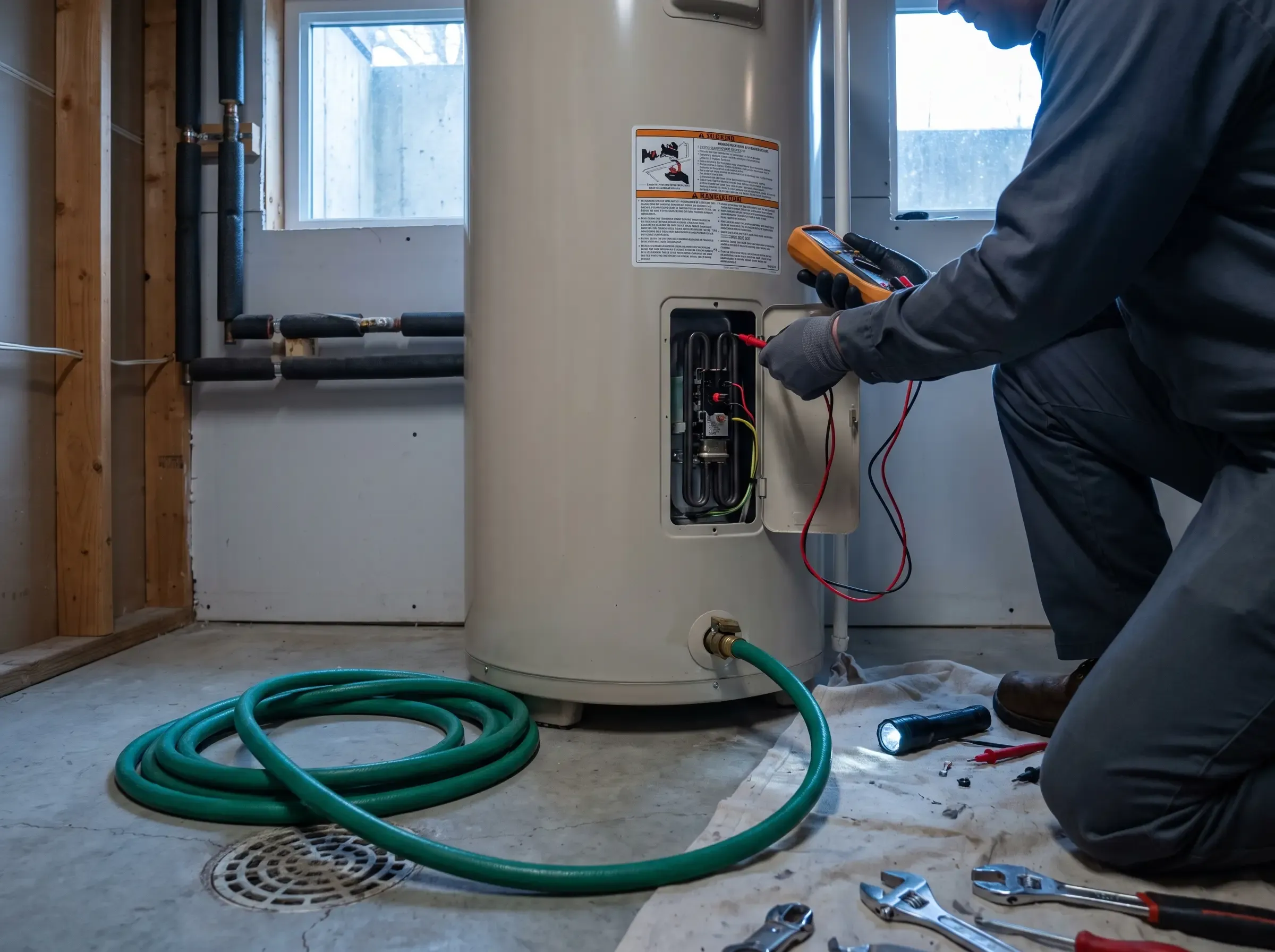
On an electric tank: incoming voltage, both thermostats, both element resistances, and whether the high-limit cut-out has tripped and why. On a gas tank: thermocouple or flame sensor, gas valve, burner condition, draft at the hood and the flue itself. On either: dip tube, anode rod, sediment depth, expansion tank charge, the relief valve, and the mixing valve if there is one. Sediment is a bigger factor here than most people expect, especially on a well.
-
The repair-or-replace call
A leaking tank is not repairable and we will say so in one sentence. A failed element, thermostat, valve or thermocouple on a tank under about ten years old is usually worth fixing. Past twelve years, with the anode gone and sediment on the bottom, a repair is a bet rather than a fix. We show you what replacement costs, including the $1,000 PSE rebate that a heat pump water heater carries and a tank swap does not.
Your part: Decide on the spot or take the written bid away. We would rather you compare it than feel cornered.
-
Repair now, or a scheduled replacement
Common parts get fixed on the visit. If replacement is the answer, we set up the temporary situation you can live with, order the right unit, and file the permit. Whatcom County and the City of Bellingham both treat a water heater replacement as permit work, and the water-side connections are made by a licensed plumbing contractor.
Water Heater Repair questions from Lynden
- I have no hot water at all. What is the most likely cause?
- On an electric tank, a tripped high-limit cut-out or a failed upper element, in that order. On a gas tank, a failed thermocouple or a pilot that will not hold. Check whether the breaker has tripped before you call, and if it trips again straight away leave it off, because a shorted element or a wiring fault is the reason and it needs looking at rather than resetting.
- Should I repair or replace a leaking water heater?
- Replace it. Water coming from the tank body itself means the glass lining has failed and the steel is corroding through, and there is no repair for that. Water at a fitting, the relief valve or the drain valve is a different story and is often a genuine repair. Part of the diagnosis is establishing which one you have.
- How much does a water heater repair cost?
- We quote the repair as a flat rate after diagnosis rather than publishing a figure we cannot stand behind for your specific tank. What we will commit to in writing is the estimate term: an $89.99 trip charge, refunded as company credit if you accept the bid. Parts pricing is on the bid before any work starts.
- Why is my hot water rusty or smelly?
- Usually a spent anode rod, and on well water it can also be sulphur bacteria reacting with the anode. A rotten-egg smell only on the hot side points at the tank rather than the well. Replacing the anode, and sometimes switching to a different anode material, fixes many of these. If the same smell is on the cold side too, the problem is upstream in the well and needs a water test.
- Water is dripping from the pipe on the side of my tank. Is that normal?
- No, and do not cap it. That is the temperature and pressure relief discharge, and it is doing its job because something is wrong: excessive pressure, a failed expansion tank, a thermostat running away, or a tired valve. It is a safety device and the discharge line has to stay open. This one is worth a same-week call.
- How long should a water heater last around here?
- Eight to twelve years is the realistic band for a conventional electric or gas tank, and hard well water shortens it. Draining sediment annually and replacing the anode rod once in that life genuinely extends it. Once you are past twelve years, plan the replacement instead of waiting for the failure.
- Do you work on tankless units too?
- Yes, and the fault list is different: scale in the heat exchanger, a blocked or mis-terminated vent, flow sensor faults, or a gas supply that cannot hold pressure under full fire. Bring us the error code off the display if there is one, because it shortens the diagnosis considerably.
- Can you come out at the weekend?
- Regular hours are Monday through Friday, 8:00 AM to 5:30 PM, and emergency calls are answered 24/7. Call (360) 592-3824, tell whoever answers that you have water on the floor, and we will triage it.
Get a Lynden estimate
Tell us your address or ZIP — 98264 are all in our regular route.
Ready for a straight answer on your house?
Tell us what you have now and what you want it to do. We will tell you what fits, what it costs, and which rebates you actually qualify for — before anyone comes out.
Monday–Friday, 8:00 AM – 5:30 PM · Emergency calls answered 24/7