
Whatcom County, Washington
Heat Pump Repair in Sudden Valley, WA
Find out what is actually wrong, in plain language, with the repair price and the replacement price side by side.
- 19°F heating design temperature (nearest code station: Bellingham 2 N)
- Electricity: Puget Sound Energy
- Gas: None — propane, oil or all-electric
- Permits: Whatcom County Planning & Development Services
- WA L&I #BELLIHC808NM Active registration — verify it with the state
- $30,000 bonded Surety bond on file with L&I
- $1,000,000 insured General liability coverage
- Local since 2020 Owner-operated in Whatcom County
- We pull the permit City of Bellingham or Whatcom County, and we meet the inspector
What heat pump repair means in Sudden Valley
Sudden Valley is largely 1970s A-frames, chalets and split-levels built as recreational cabins, with steady infill and rebuilds since. Almost none of it was ducted: electric baseboard, wall heaters and a wood stove is the classic stack here, sometimes with a propane insert added later. Lots are steep, wooded and narrow, and the garage often sits below the living space, which constrains where an air handler or an outdoor unit can physically go.
The valley lies at the south end of Lake Whatcom, close enough to town that 19°F is the right design temperature, but the lake and the second-growth cedar keep it shadier and damper than Bellingham proper. Mature trees mean needle and leaf litter in the coil every autumn and moss on anything that stays wet, so serviceable clearance around the outdoor unit is not optional. Cold air drains downhill into the lower divisions on clear nights, and those addresses run colder than the ridge.
The install wrinkle here
Two things govern work here. First, Sudden Valley’s HOA operates architectural review, so an outdoor unit’s location, screening and sometimes its colour need approval before installation — building that into the schedule avoids a stop-work conversation with a neighbour. Second, Lake Whatcom is Bellingham’s drinking-water reservoir, so ground disturbance, condensate discharge and any oil-tank decommissioning get scrutinised; the mechanical permit itself comes from Whatcom County, because Sudden Valley is unincorporated.
Your utilities decide your rebates
Sudden Valley takes its electricity from Puget Sound Energy, which is what makes the PSE heat pump rebates reachable at all — PSE serves every address in Whatcom County. There is no natural gas main to most of Sudden Valley, so homes here run on propane, oil, wood, or electric resistance heat. That is actually good news for rebates: PSE's $1,500 conversion rebate pays specifically to replace electric-resistance heat, and it rises to $2,400 for income-qualified households.
Who issues the permit
Mechanical work in Sudden Valley is permitted through Whatcom County Planning & Development Services via its Whatcom County Permit Center application, online or in person. We pull the permit and meet the inspector. Worth knowing: a great many mailing addresses that read "Bellingham" are physically in unincorporated Whatcom County, which changes the permitting authority. We check the parcel before we file.
Getting there
We work out of Larrabee Avenue in south Bellingham, roughly 15 minutes from Sudden Valley — near Sudden Valley Golf Course and the Sudden Valley Barn. We also cover Sudden Valley, Lake Whatcom Boulevard, Cain Lake Road, Agate Bay.
How a Sudden Valley job runs
-
Take the details on the phone
We ask what it is doing, what changed, whether the breaker has tripped, and whether the thermostat is calling for auxiliary heat, before anyone drives anywhere. Some no-heat calls turn out to be a tripped breaker, a thermostat in the wrong mode, or a filter so loaded that the airflow safety cut out, and we would rather tell you that on the phone. Regular hours are Monday to Friday, 8:00 AM to 5:30 PM, and emergency calls are answered 24/7.
Your part: Check the breaker, the thermostat mode, and the filter before we come out, and tell us the model number off the outdoor unit if you can read it.
-
Diagnose on site, with the trip charge disclosed up front
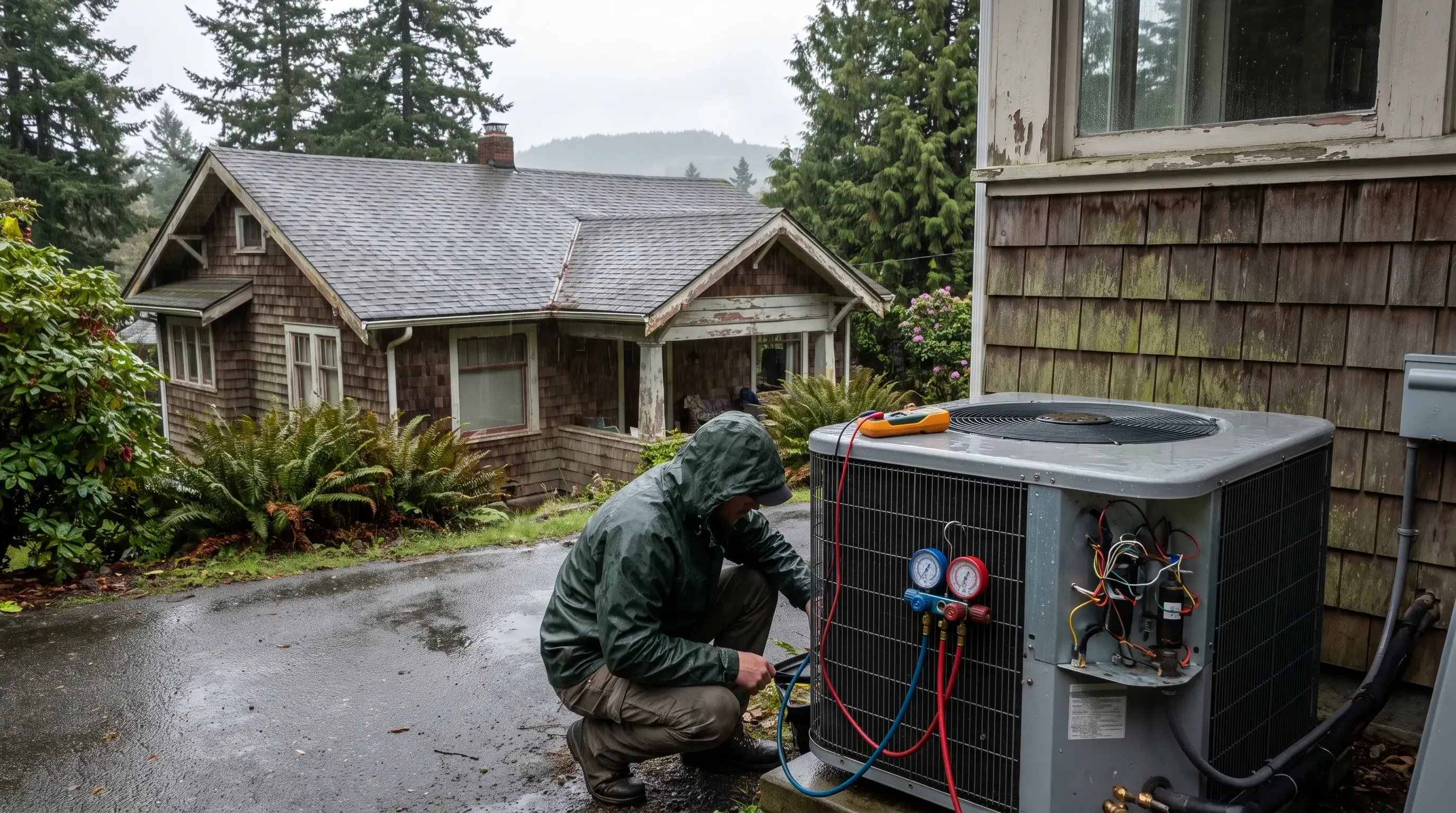
Diagnosis is an $89.99 trip charge, refunded as company credit if you accept the bid, so you know the cost of finding out before we arrive. We check refrigerant pressures and temperatures, the electrical side, defrost operation and controls, and airflow, rather than guessing from symptoms. Refrigeration work is core to this shop’s trade, which matters when the problem is inside the sealed system rather than in the wiring.
Your part: Give us access to the indoor equipment, the outdoor unit, and the electrical panel, and clear anything stacked against the air handler.
-
Name the failed component and price the repair
You get the part, the cause, the cost, and an assessment of what else on that system is close to failing. If the diagnosis is a leak we tell you where it is and whether it is a repairable joint or a coil, because a coil leak on old equipment changes the conversation entirely. Federal rules under 40 CFR Part 82 require Section 608 certification to handle refrigerant, which is why topping off a leaking system indefinitely is not something a shop can responsibly do.
Your part: Ask for the repair number and the replacement number together, then decide with both in front of you.
-
Repair, or say plainly that it is not worth it
Common repairs get done on the visit when the part is on the van: capacitors, contactors, defrost boards, sensors, fan motors and control wiring. Sealed-system work and compressors are ordered, with a date. If the equipment is fifteen years old with a failed compressor and a leaking coil, we will tell you that the repair is a bad use of your money instead of taking it.
-
Verify the fix before leaving
After any repair we run the system in the mode that failed and confirm it with measurements: pressures and superheat or subcool where the sealed system was opened, temperature split across the coil, amp draw, and a forced defrost cycle when defrost was the complaint. Nitrogen pressure testing and evacuation to a micron gauge apply to any repair that opened the refrigerant circuit, exactly as they would on a new install.
Your part: Stay for the last five minutes so you can hear what failed, what we changed, and what to watch for.
-
Tell you what would prevent the next one
Most of what we find is preventable: filters left in for a year, an outdoor coil packed with cottonwood fluff or fir needles, a condensate drain growing algae, or a blower wheel loaded enough to strangle airflow. We say which of those contributed, and whether an annual tune-up would have caught it.
Heat Pump Repair questions from Sudden Valley
- What are the signs my heat pump needs repair?
- The reliable ones are: auxiliary heat running in mild weather, ice on the outdoor unit that never clears, a system that short-cycles, a big jump in the electric bill with no change in the weather, and new noises such as grinding, screeching or a hard clunk on start. A heat pump that runs long cycles in cold weather is normal; one that runs constantly at 45°F is not.
- Do you charge for a diagnostic visit?
- Yes, $89.99 as a trip charge, and it is refunded as company credit if you accept the bid. We would rather quote that number openly than advertise a free visit and recover it in the repair price. If your problem turns out to be something you can fix yourself, such as a tripped breaker or a filter, we will try to get you there on the phone at no charge.
- Do you answer emergency calls?
- Regular hours are Monday to Friday, 8:00 AM to 5:30 PM, and emergency calls are answered 24/7. Someone picks up, and we triage. In a cold snap every shop in the county is booked, so call early in the day and have the model number ready.
- My outdoor unit is covered in ice. Is that normal?
- A light frost that clears during a defrost cycle every hour or so is normal in Bellingham’s damp winter air; a solid block of ice that stays for a day is not. Persistent icing usually means a failed defrost control, sensor or reversing valve, low charge, or a unit sitting where water drains into it rather than away. Do not chip at it with anything metal, since the coil is soft aluminium and the fins puncture easily.
- Why is my heat pump blowing cool air in heating mode?
- A heat pump’s supply air is genuinely cooler than a furnace’s, around 95°F to 105°F rather than 120°F, so it can feel cool against your hand while still heating the house correctly. If the house is actually losing temperature, the likely causes are a stuck reversing valve, low refrigerant charge, or a defrost cycle running longer than it should. The distinction between feels cool and is not heating is the first thing we establish.
- What are the common heat pump problems that need a professional?
- Refrigerant leaks, compressor and reversing valve failures, defrost control faults, blower or outdoor fan motor failures, and electrical faults in contactors and capacitors. The first three all require opening or measuring the sealed refrigerant system, which federal rules under 40 CFR Part 82 restrict to Section 608 certified handling. Filters, clearing debris from around the outdoor unit, and keeping the condensate path clean are the parts genuinely worth doing yourself.
- Will you work on a system another company installed?
- Yes, whatever the badge on it. We service ducted heat pumps and ductless systems from the major manufacturers, including Daikin, Mitsubishi Electric, Fujitsu and Bosch, plus older equipment that is no longer sold here. If the failed part is proprietary and no longer available, we will tell you that early rather than after a week of chasing it.
- Can you just top off the refrigerant?
- Not as a plan, because a sealed system does not consume refrigerant. If it is low, it leaked, and adding more without finding the leak means paying for refrigerant that will end up in the atmosphere and a system that fails again. We locate the leak and price the repair, and if the leak is in an old coil, that is when replacement genuinely deserves consideration.
- At what point should I stop repairing and replace?
- When a major sealed-system component fails on equipment past twelve to fifteen years, when there are multiple leaks, or when the system was the wrong size from the start. We give you the repair cost and a replacement quote at the same visit so you can compare rather than commit under pressure. Homes near saltwater reach that point earlier, since salt air has been reported to shorten equipment life by two to four years without corrosion protection.
- Do I need a permit for a heat pump repair?
- No. Repairing existing equipment in place is not permitted work, unlike installing or replacing a system, which does require a mechanical permit from City of Bellingham Building Services or Whatcom County Planning and Development Services. If a diagnosis turns into a replacement, the permit becomes part of that project and we file it.
- Is there any rebate that covers a repair?
- No. PSE’s heat pump incentives pay for installing qualifying new equipment, not for fixing what you have, and there is no federal credit for either since §25C ended for property placed in service after December 31, 2025. If the repair conversation turns into a replacement, the rebate picture changes completely.
Get a Sudden Valley estimate
Tell us your address or ZIP — 98229 are all in our regular route.
Before you decide
- What it costs Heat Pump Repair Cost — What Whatcom County Repairs Run
- Question What happens to my heat pump in a power outage?
- Question Should I repair or replace my heat pump?
- Compare Repair vs. replace an old heat pump
- Guide Heat pump maintenance schedule for a marine climate
- Troubleshooting Heat pump is blowing cold air
- Troubleshooting Heat pump is not heating at all
- Troubleshooting Heat pump outdoor unit is frozen or iced up
- Troubleshooting Heat pump turns on and off every few minutes
- Troubleshooting Heat pump is making a loud or unusual noise
- Troubleshooting Outdoor unit is not running
- Troubleshooting Mini split is dripping water inside the house
- Troubleshooting Mini split is not responding to the remote
- Troubleshooting Mini split is blinking a light or showing an error code
Ready for a straight answer on your house?
Tell us what you have now and what you want it to do. We will tell you what fits, what it costs, and which rebates you actually qualify for — before anyone comes out.
Monday–Friday, 8:00 AM – 5:30 PM · Emergency calls answered 24/7